

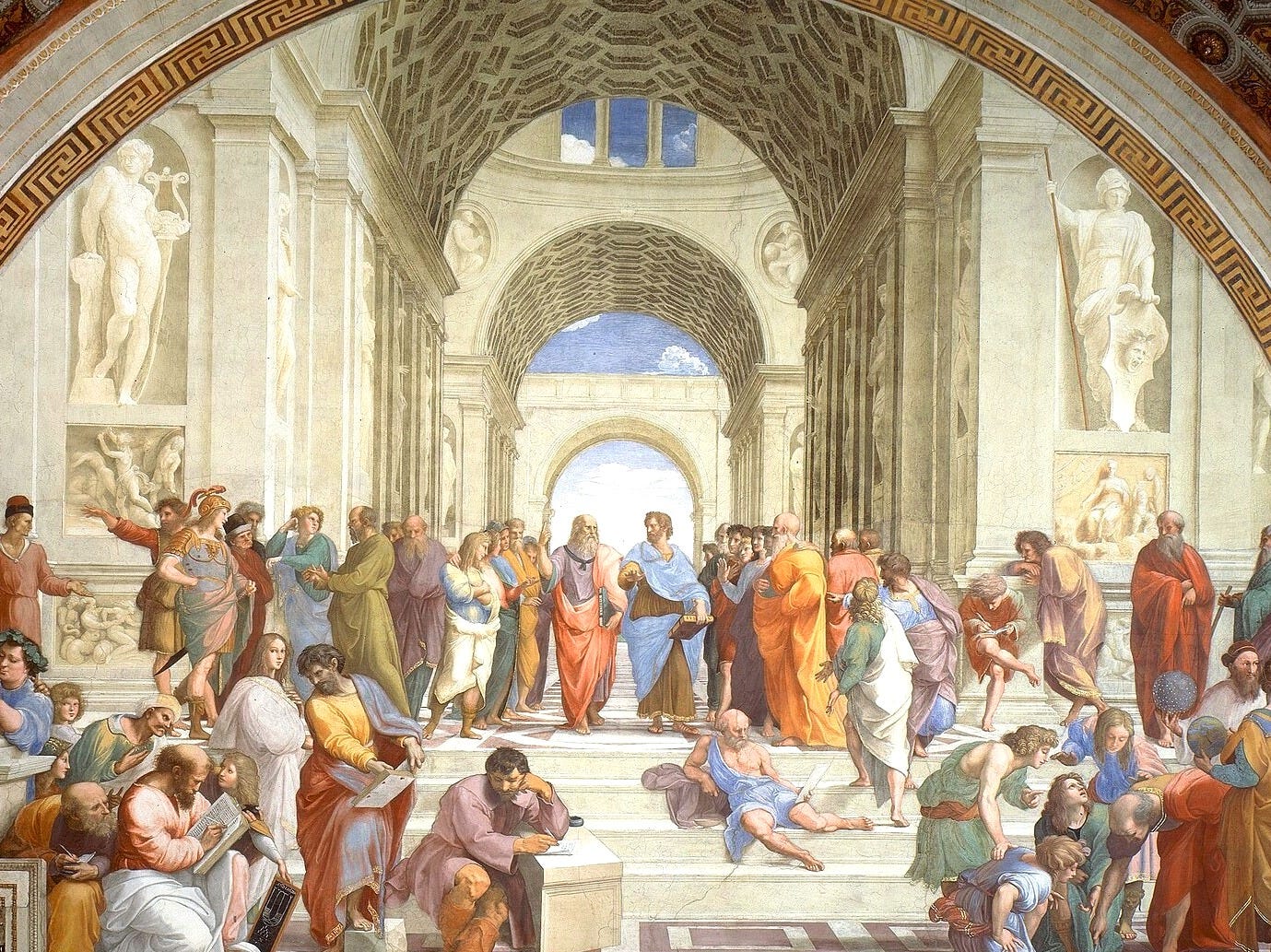
For years, I hated Ancient Greek Literature.
Since elementary school, these archaic Greek myths were shoved down my throat against my will. I was told these stories, thinkers, and playwrights were important, but could not make any sense of them whatsoever.
As far as I was concerned:
The pagan gods aren’t real, so these myths are bunk
Homer Simpson had more to offer me than Homer the poet
Socrates was poor, ugly, and bald — so he had nothing to teach me
You can chalk up this original ignorance to youthful arrogance. If the dictum is true that the most confident scholars are also the most ignorant — then I was the crowned monarch of the proudly ignorant; the blind leader of the blind masses proudly reveling in our blindness.
Thankfully, for all our sakes, I was humbled by father time. In university I discovered my love of literature. This love led me to discover, to my shock, that there are many figures smarter than me, and that perhaps I was not that smart after all. Truly, the greatest lessons are the ones you least want to learn.
Yet even as I persevered into a newfound love of classical literature, I remained baffled by the Greeks. I could not understand why all the greatest writers — from Virgil, to Dante, and even Lewis and Tolkien — were severely indebted to Ancient Greek myths, tragedians, and philosophers.
Yet I persevered in my inquiries of these obscure Grecian folks — for I was too stubborn to stay satisfied with my ignorance. Today, after years of inquiry, I could not be any more grateful for my perseverance.
Truly, with the exception of Sacred Scripture herself, there are no greater boons left behind for mankind’s flourishing than the corpus of Ancient Greek literature.
To ingratiate your imagination with the narratives and ideas from Homer to Aristotle is to witness the birth, maturation, and apotheosis of the intellectual pre-Christian western mind — which is ultimately your mind as a Westerner today.
To see, know, and love the Greeks then, is to see, know, and love yourself. Better than that, it’s to understand your human nature, your telos, and what contributes to the common good for your fellow man.
And believe it or not — according to the Early Church fathers — to pay close attention to the Ancient Greek development of thought is to see the workings of Providence playing out over centuries. To put it bluntly, if Christ became Incarnate in the fullness of time, then God used the Greeks as a crucial people to prepare mankind for that very revelation.
With all this said… it would be a shame to live a full lifetime, and die, without having read the Greeks.
Today then, I’m going to give a recommendation of 10 must-reads from the Ancient Greeks, to help you appreciate their true identity as a cornerstone of Western Civilization. May you find a similar joy in these texts as I have.
I offer private mentorship in the Great Books for those seeking clarity of vision and depth of soul. Inquire here.
If you’d like to support this work and receive future writings, you can subscribe below.
1. The Iliad — Homer
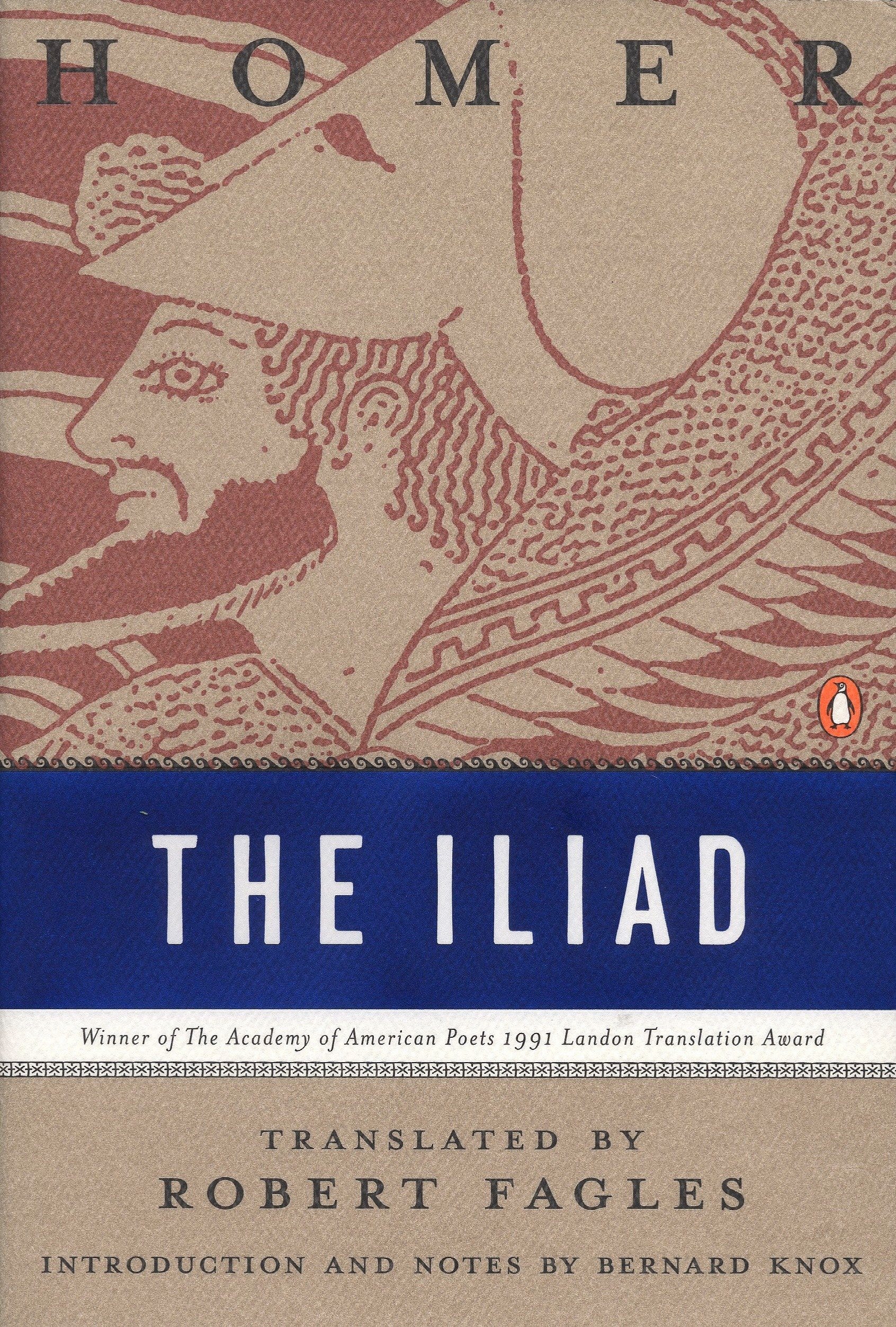
Of course Homer starts this list. If Athens and Jerusalem are the cornerstones of the West, then Homer is to Athens what the Bible is to Jerusalem. Homer wasn’t just one poet among many, rather his Iliad and Odyssey were the literal education of Ancient Greece itself, lasting for roughly 400 years until Plato.
Yet the Iliad is often overlooked today. The modern outsider sees only carnage, destruction, and massive human egos in collision. But properly understood, The Iliad is one of the most enduring works in human literature — precisely because it’s the most relentless depiction of violence ever written.
In other words, this is not story of a mythic war from long ago, rather it portrays the ever-present hell-on-Earth that awaits when civilization collapses:
Indeed, civilization is a fragile thing, and very much worth preserving. No book ingrains that idea more than Homer.
2. The Odyssey — Homer
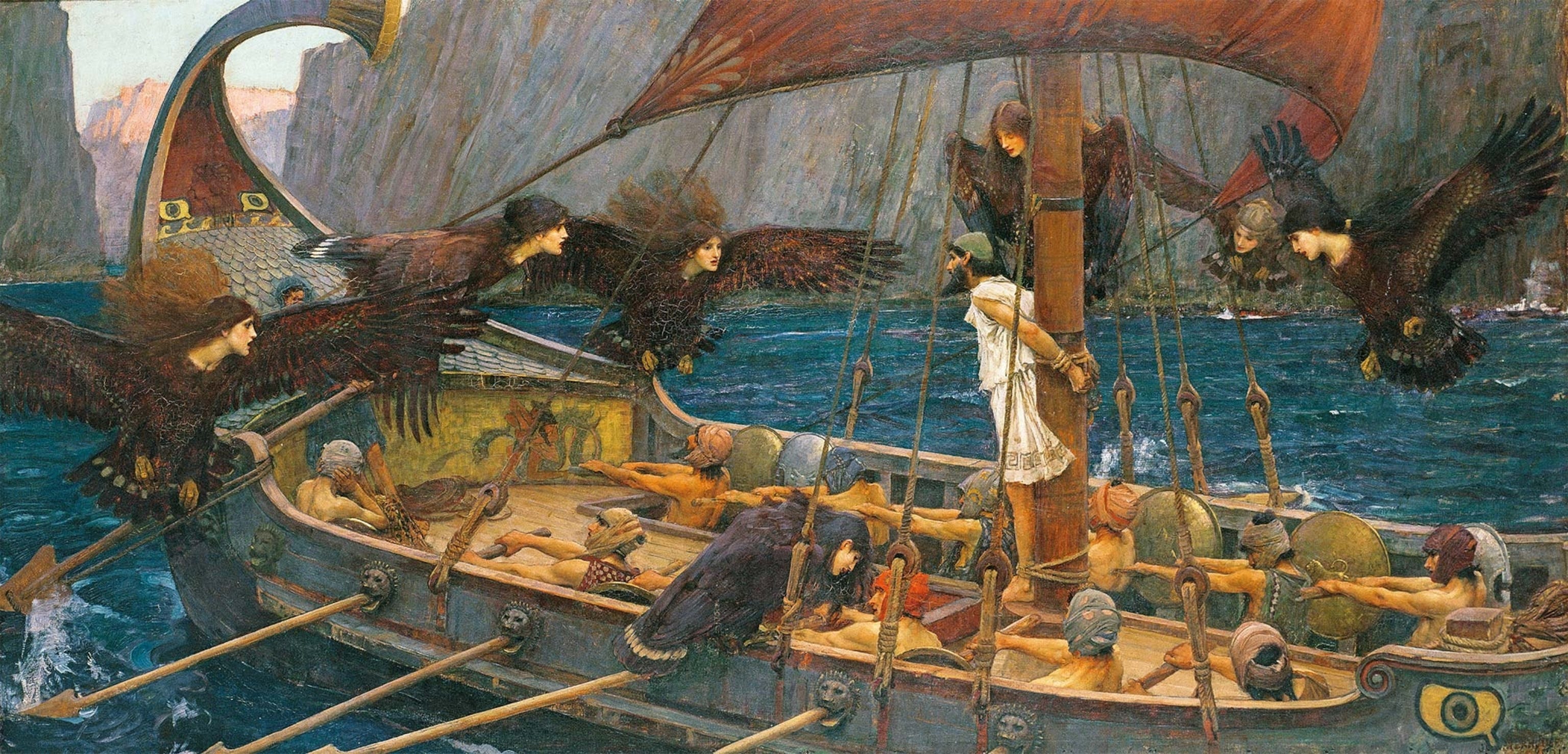
If the Iliad is “man at war,” then the Odyssey is “man at peace.” Odysseus endures every trial, tribulation, and temptation under the sun — from offers to immortality, to man-eating Cyclopeses, and facing the wrath of Poseidon himself.
But Odysseus is, in short, a man who wants to come home to his family. And this journey home is a universal longing — for all mankind finds themselves lost in a figurative wilderness — searching for a communion of friends and family, and a place of rest to ease our ever present sorrows and aching heart. Odysseus’ journey home then, is your journey home. Read this story carefully. Read it many times. Keep it close to your heart.
3. Theogony — Hesiod
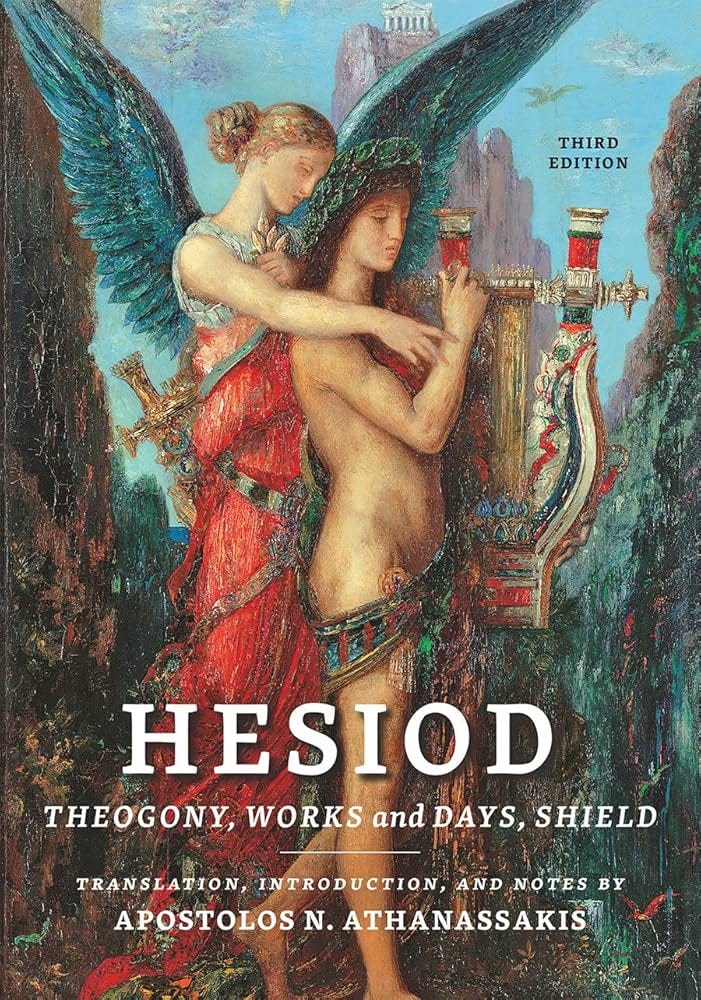
Hesiod was a contemporary of Homer. Though far less famous today, he was once considered his equal.
The Theogony is a Greek creation account explaining the primordial structure of reality — how the cosmos emerged from Chaos, and how the gods themselves were born into a world of conflict, succession, and eventual order. What makes it philosophically remarkable is that Hesiod is asking a genuinely serious question:
What is the nature of things at the most fundamental level?
Notably, eros — love — plays a central role in that order. Both Plato and later Christian thinkers would take note of Hesiod’s claim that love is woven into the fabric of being itself. The Theogony is a primitive cosmology, yes — but it’s also the first sustained attempt in the Western tradition to answer the question every philosopher after him would inherit:
Why is there something rather than nothing?
(Honorable mention: Mythology — Edith Hamilton, a classic compendium of Greek myth.)
4. Oresteia — Aeschylus
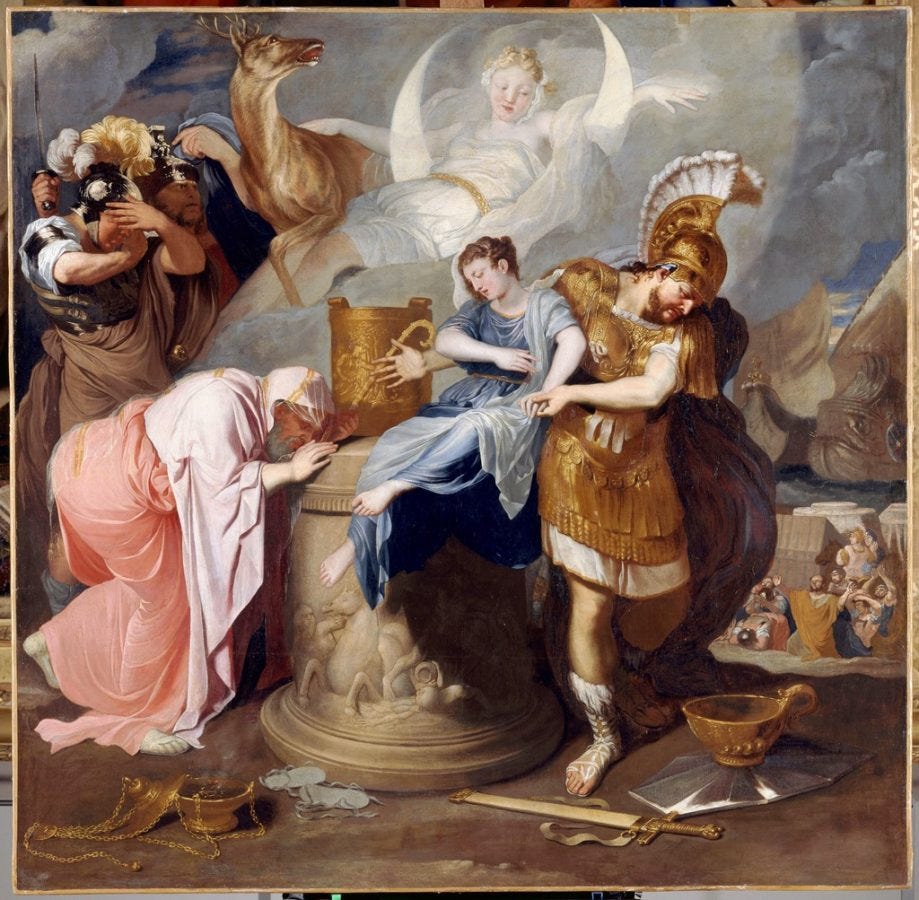
Aeschylus is considered the “Father of Tragedy.” He, Sophocles, and Euripides are the 3 great Greek Tragedians whose plays are a bridge from Homer to Plato. In other words, these plays are the bridge from the mythological centric mind of Homer to the philosophic and intellectual mind of post Socratic Greece.
Reading these playwrights is like witnessing man begin to “wake up,” and rationally comprehend the cosmos in real time.
The Oresteia is the crown jewel of Aeschylus. It follows Orestes, who is commanded to avenge his father by killing his mother. But this act awakens the wrath of the Furies — primordial forces bound to blood guilt and family crime. The trilogy is one of the earliest sustained attempts to ask, in a serious way: what is justice?
(Honorable mention: Sophocles — Antigone)
5. Alcibiades I — Plato
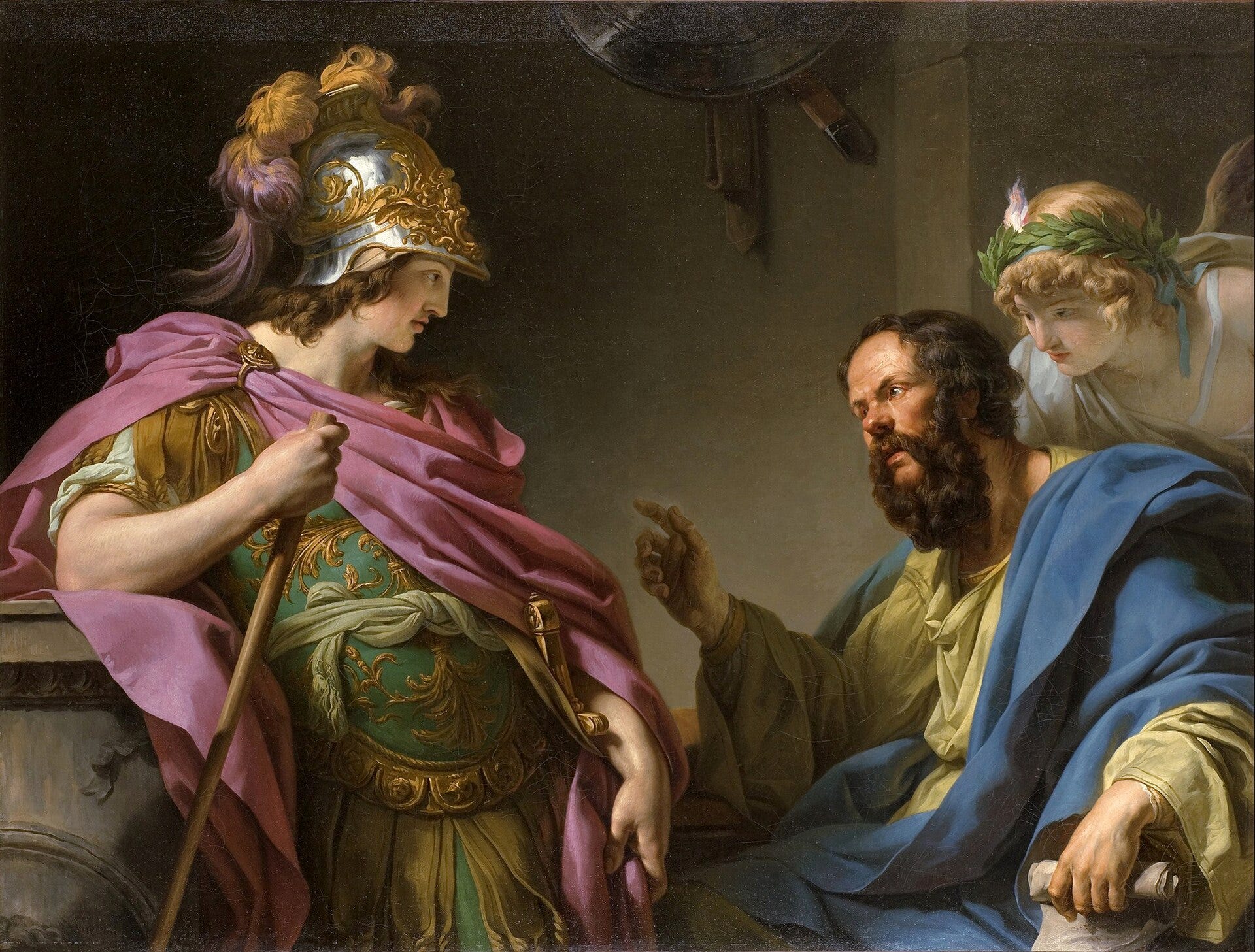
Alfred North Whitehead famously said that all philosophy is “footnotes to Plato,” and there is truth in that.
Plato single-handedly reshaped Greek intellectual life. Before him, education was largely shaped by Homeric ideals of glory and honor. Plato turns that world inward: life is not about glory, but virtue, knowledge, and truth. He reframes human fulfillment around self-knowledge and moral order.
Alcibiades I is a perfect entry point. It was traditionally the first dialogue studied in Plato’s academy. Socrates attempts to redirect a politically ambitious young man toward self-knowledge:
If you would rule others, you must first rule yourself.
6. Apology — Plato
This is Plato’s most famous work, recounting Socrates’ trial for allegedly corrupting the youth and introducing impious ideas.
Socrates is condemned to death, yet remains remarkably untroubled. He would rather die than abandon philosophy. Even more striking is his defense: he is less concerned with self-preservation than with urging others toward truth and philosophical life.
He embodies the dictum that to philosophize is to learn how to die.
7. Phaedo — Plato
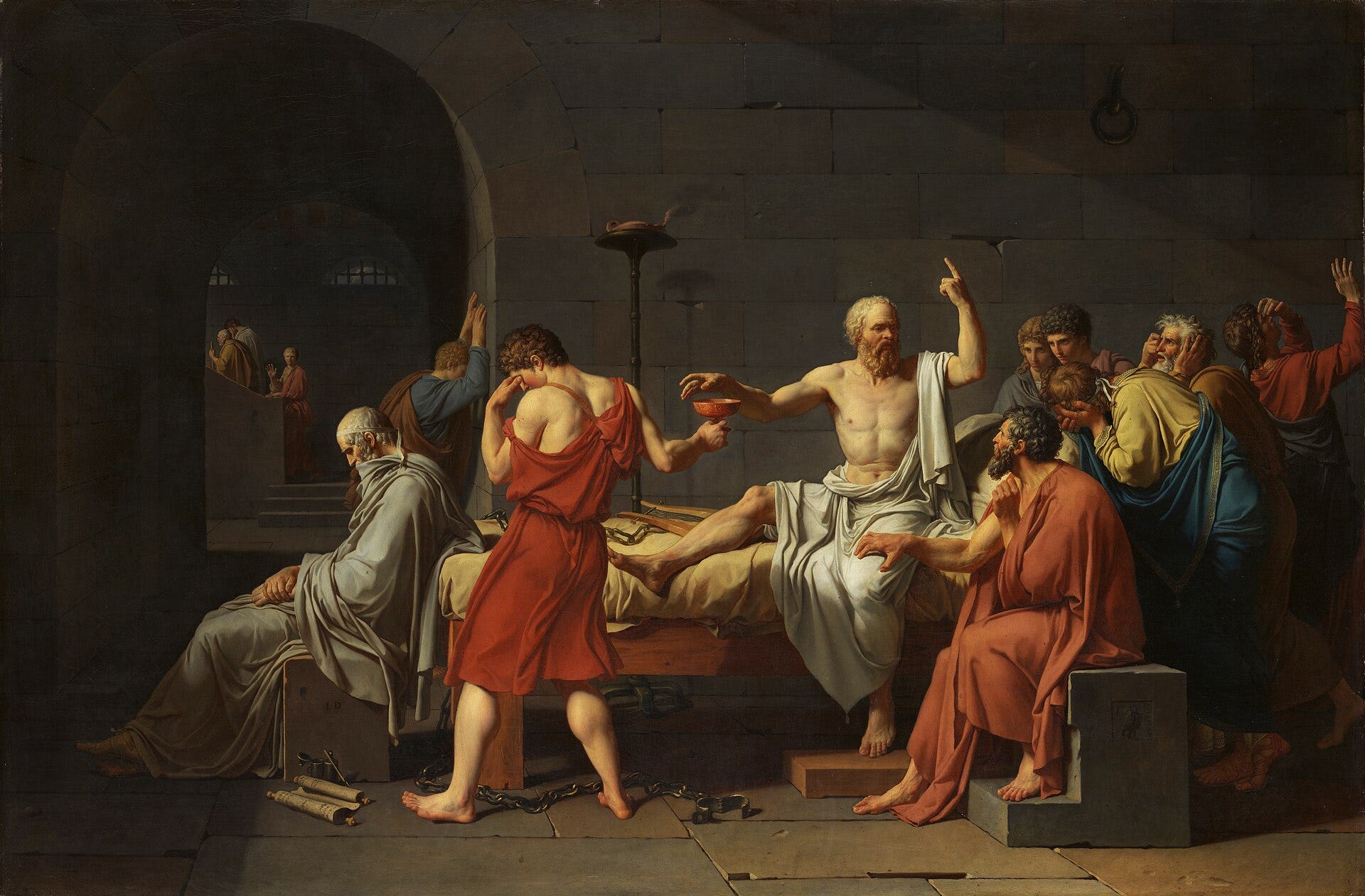
The Phaedo recounts Socrates’ final hours before his death. He suggests his trial in The Apology, was a “scam trial,” for he was condemned by inferiors who could not understand philosophy.
Instead, this final discussion in Phaedo is his real trial.
Why?
Because he is asked to defend the ultimate claim in all of philosophy:
That the philosopher should not fear death, but welcome it with peace. This is not because death is desired in itself, but because a life ordered toward truth, virtue, justice, and piety is already oriented beyond it.
If this argument holds, his death becomes the culmination of his life, and the ultimate triumph of philosophy over death. If it fails, then philosophy itself is placed in doubt.
8. Republic — Plato
This is Plato’s magnum opus. It attempts to answer the question “what is justice?”
Arguably no other work of Plato’s has drawn so much attention, curiosity, ire, and praise than this work. Idealists love it, Nietzsche hated it, Christianity embraced it — every great thinker/tradition has something to say about it.
To my estimation, the Allegory of the Cave is the greatest piece of philosophy ever written by a human being. It would be a shame to have lived a full life without encountering Plato’s Republic.
9. Nicomachean Ethics — Aristotle
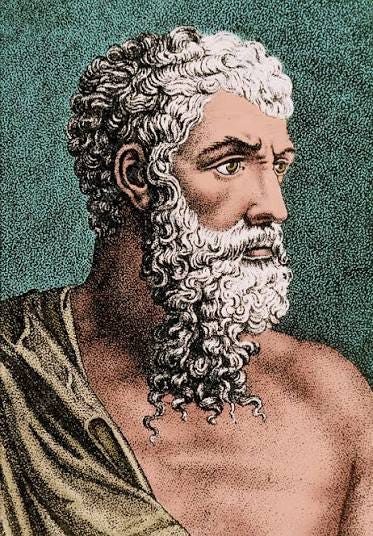
Aristotle, Plato’s student, was so revered in the pre-modern world that he was simply called “The Philosopher.”
He was philosophy’s first systematic thinker, who pioneered countless disciplines (science, logic, zoology, etc.), and created a framework to understand everything in reality.
His Ethics asks a basic question: what is the meaning of life?
His answer is eudaimonia — human flourishing or happiness — which is achieved through “activity of the soul in accordance with virtue.”
It is one of the most precise accounts of human fulfillment ever written: rigorous, structured, and deeply practical. Few works better explain what it means to live well.
10. Politics — Aristotle
Aristotle explicitly recommends reading the Politics after the Ethics. If ethics is about human happiness, politics is ethics at scale.
Man is, by nature, a political animal. We realize our flourishing not in isolation, but within a community ordered toward the good.
To live ethically is therefore to live politically — and to live politically is to participate in a shared pursuit of human flourishing with others.
I offer private mentorship in the Great Books for those seeking clarity of vision and depth of soul. Inquire here.
If you’d like to support this work and receive future writings, you can subscribe below.
No love for Epictetus?
(He wouldn’t be upset for being left off the list)
I can’t wait to read these in our book club!