

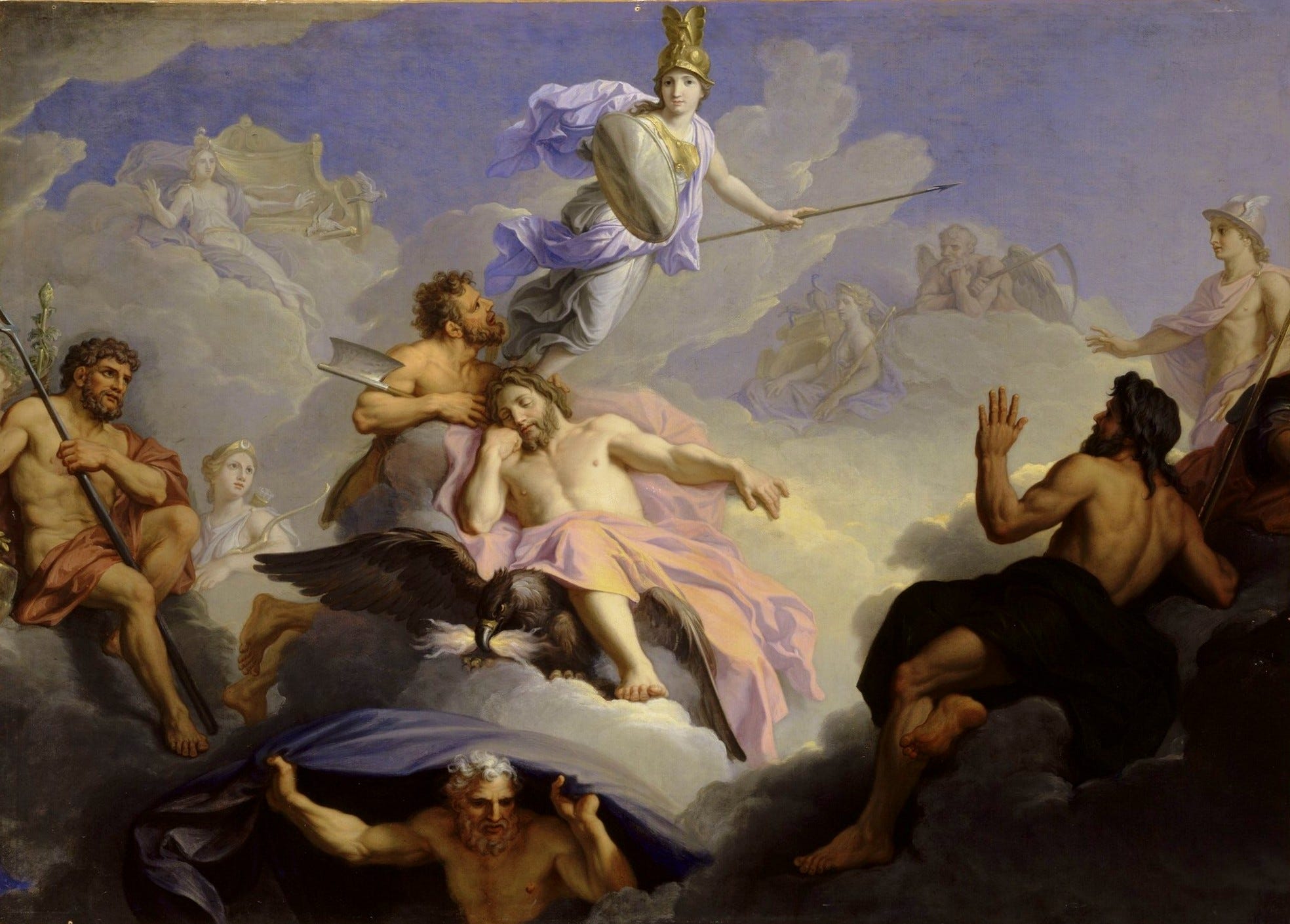
Greek mythology is essential reading because it provides us the bare fodder and soil of our intellectual tradition.
The rich beginning of Western philosophic discourse on rational thought began with primitive stories that were archetypal of the human condition. To be familiar with these narratives is to grasp at the patterns that help explain to us the fullness of our nature.
And throughout the entire canon of Greek mythology, there is arguably no character more important than Athena, and the story of her birth.
She’s celebrated as both the goddess of heroes — who champions the greatest warriors of Greek mythology — and is the goddess of wisdom, which suggests her character is the marriage of martial prowess and intellectual prestige that makes man truly glorious.
Even more important, the story of her birth reveals a deep pattern that would inspire one of the greatest Christian poets of all time — who provided a warning of what happens when wisdom is twisted to make an evil so wrong it can only be called Luciferian.
Here then, is the story of Athena’s birth, and why it still matters today…
I am 100% reader-supported. This newsletter is free, but if you’re able to support, please consider a paid membership — it helps my mission of sharing Truth, Beauty and Goodness with maximal reach
As a paid member, you’ll get:
Two full essays a week
Access to all recordings (past & future) of my Great Books lectures on this publication
Eternal gratitude from me
Chaos, Consumption, and Primordial History
For our purposes today, it’s helpful to remember that Greek myth can function as primordial history, not too dissimilar to how Genesis 1-11 functions as “history before history.”
Greek myth then, can be read as the genre of how human civilization emerged from the chaos of pre-historic times, and this is precisely why Athena’s birth is important.
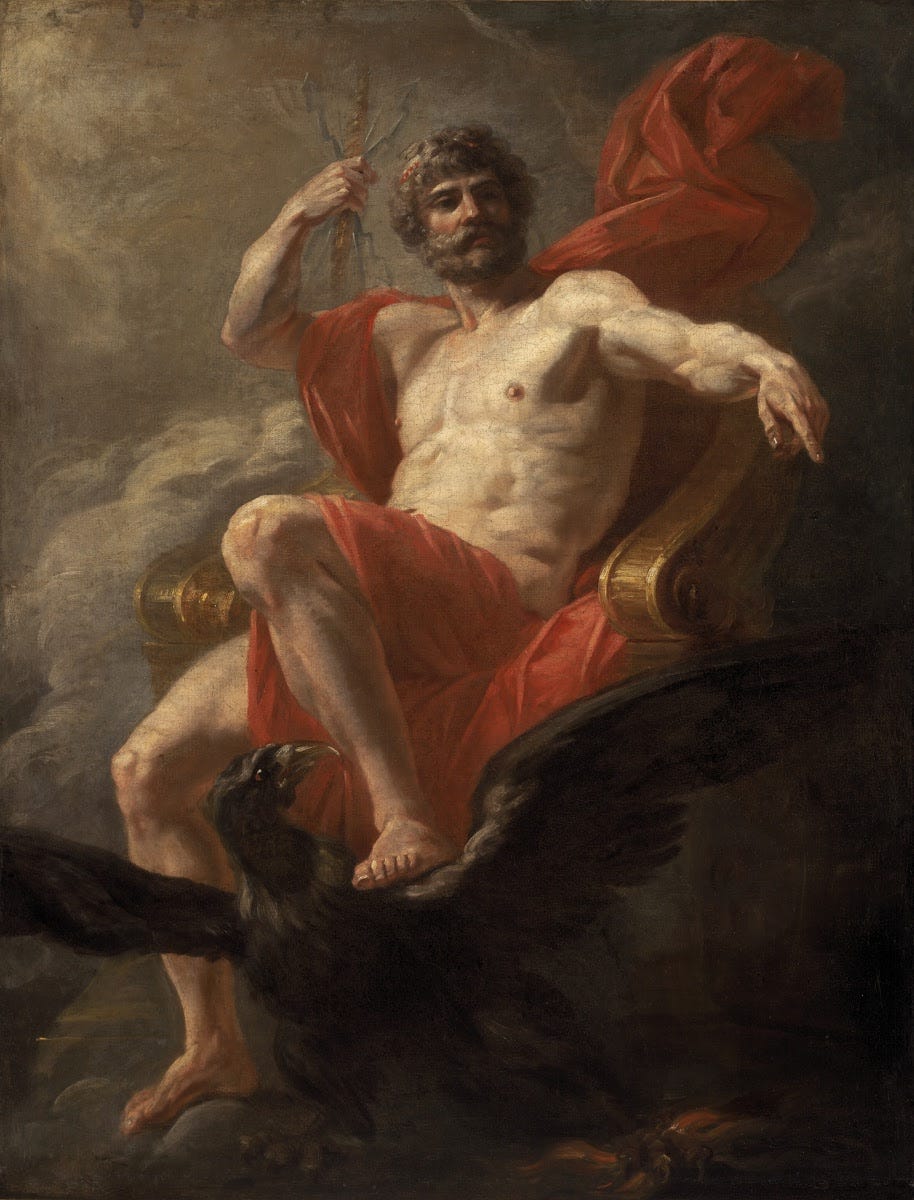
This story begins, as is often the case in Greek myth, with the lustful passions of Zeus. As the newly enthroned ruler of Olympus, he grew enamored of Metis, the original goddess of wisdom. However, Metis was an older, abstracted deity, who represents something of an impersonal, nascent wisdom that is de-personified.
Nonetheless, after Zeus impregnates her, he learns of an alarming prophecy:
Metis shall birth a daughter and son, the latter of whom will overthrow Zeus to rule Olympus.
This prophecy actually represents a generational curse in Greek Mythology, of the son overthrowing the Father in endless wars of secession (Cronus overthrew Uranus, and Zeus overthrew Cronus). This familial strife then, appears to emphasize the bloody realities of pre-civilizational man marked by infighting and tribal warfare, even amongst one’s own kin.
Zeus, however, is desperate to avoid the same fate as his fathers. He swallows Metis whole, and in doing so, absorbs her essence into him, so that she permanently becomes a part of his mind.
Against all odds, this plan works:
Zeus’ absorption of Metis prevents the birth of a son, which ends the generational curse of offspring killing the father. It’s this act that allows him to rule Olympus, and bring stability to the heavens and earth. Hence Zeus is seen as the archetype of order upon chaos — the slayer of titans, monsters, and beasts that marked the primordial world before the rise of man.
But the story doesn’t end here. We’ll soon see that civilization itself will quite literally bleed out of him…
Wisdom Birthed from the Divine
Soon after consuming Metis, Zeus is plagued by unbearable headaches. He finds no cure and enlists Hephaestus to perform brain surgery on him.
Hephaestus helps split open Zeus’ head, and out emerges a dazzling, fully grown goddess — Athena herself. Strikingly, she emerges armed with armor and a spear.
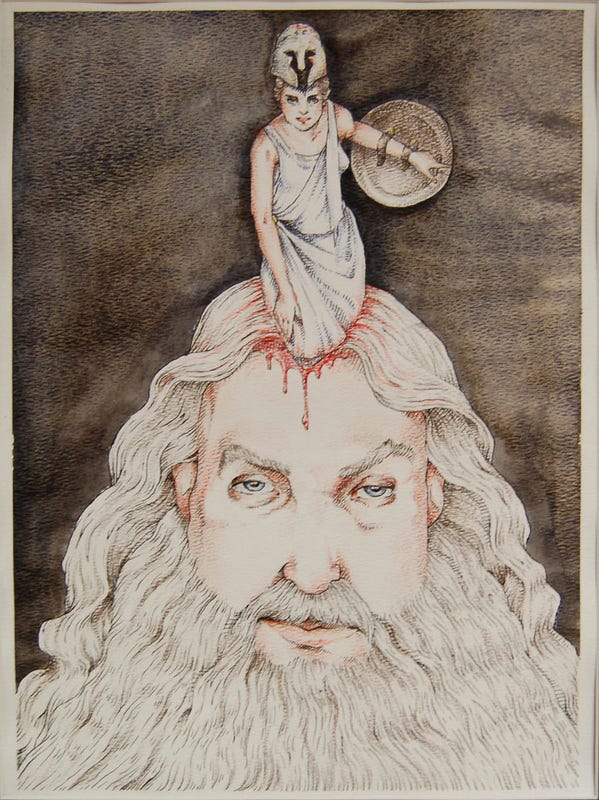
Athena is immediately praised as the new goddess of wisdom, but she isn’t just “Metis 2.0.” First, one notes that she arises fully armed for war, and is a far more personalized goddes than the abstract Metis. It’s suggested then, that Athena is the consummation of Metis’ primordial intelligence absorbed into Zeus’ divine sovereignty, and its this specific union that allows Athena to emerge as wisdom made incarnate, armed, and capable of acting upon the world.
This insight leads to the most important aspect of Athena’s character — she’s the champion of heroes, including Odysseus, Perseus, Heracles, Diomedes, and many more.
But what is the significance of Athena as champions of heroes?
Well, Greek heroes represent the ordering principle of Zeus in human form. Just as Zeus brought order to the chaos of the cosmos, so too is man called to bring order to the chaos of the natural world. This is most notably seen in Heracles — whose 12 labors not only destroy monsters, but allow civilization, trade, and commerce to arise out of this destruction.
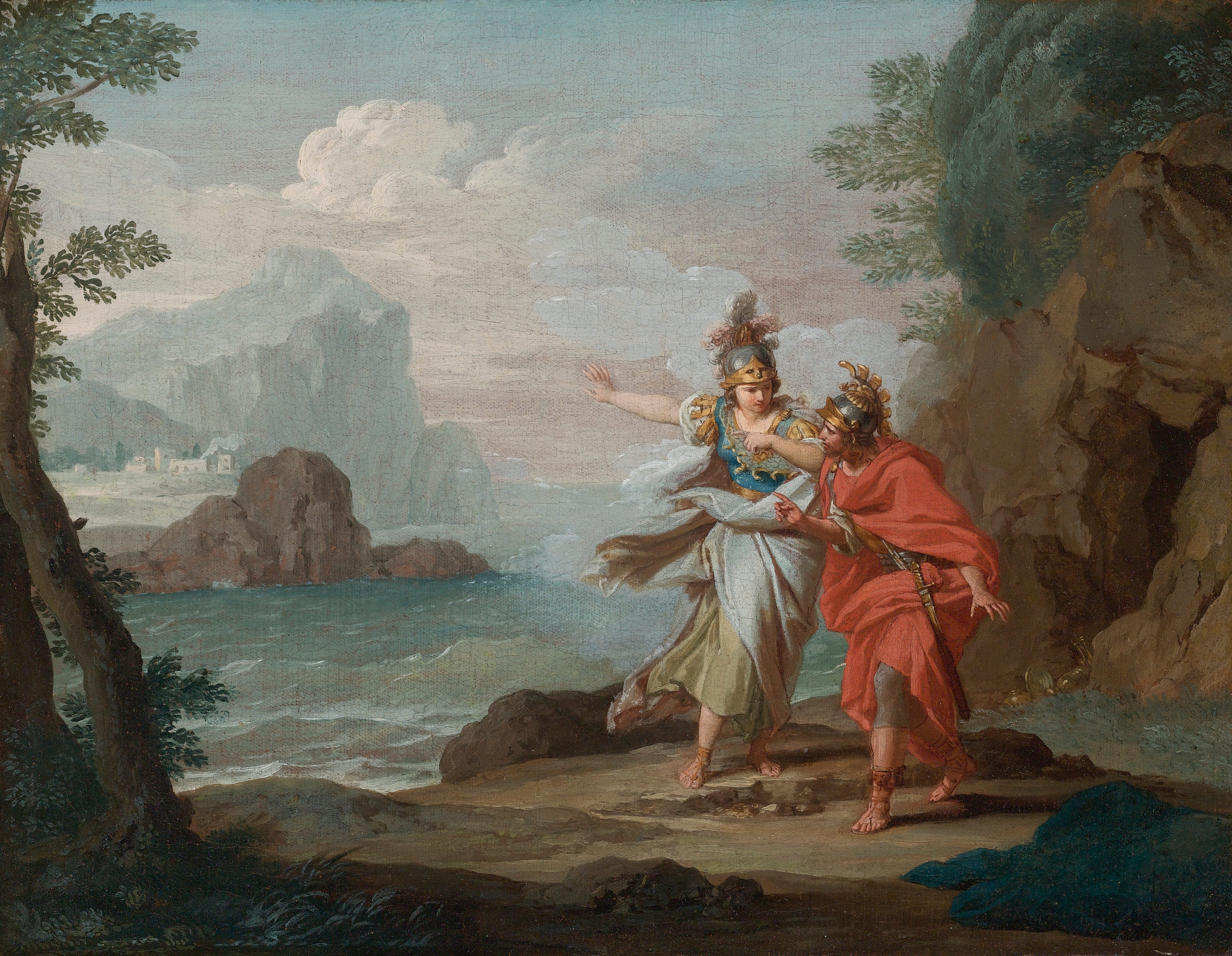
And yet Odysseus is arguably the greatest of Greek Heroes, and he most literally reflects Athena herself. He’s a formidable warlord, but ultimately revered as the clever and cunning “man of twists and turns.” His entire story of the Odyssey can be seen as the archetype of man bringing order to human civilization.
So Athena as the armed goddess of wisdom, birthed from divine sovereignty, suggests that men of the ancient world were called to strive as figures of both martial prowess and wisdom. This is how man reaches the fullness of his nature, and builds a civilization worth living.
I’d also argue Plato himself picks up on this suggestion implicitly. His magnum opus, The Republic, spends half of its entire argument imploring men and women to become formidably strong and educated in proper wisdom to learn a love of the good.
This will be the prevailing wisdom of Athena for 2,000 years, until the 17th century, when poet John Milton re-imagines this myth with a twist. Yes, he maintains his reverence for Greek mythology, but he asks whether Athena is truly the goddess of wisdom.
Through the theological lens of Christianity, Milton suggests a great warning: the birth of human wisdom may have carried within it the seeds of all human evil.
Here’s why…
