

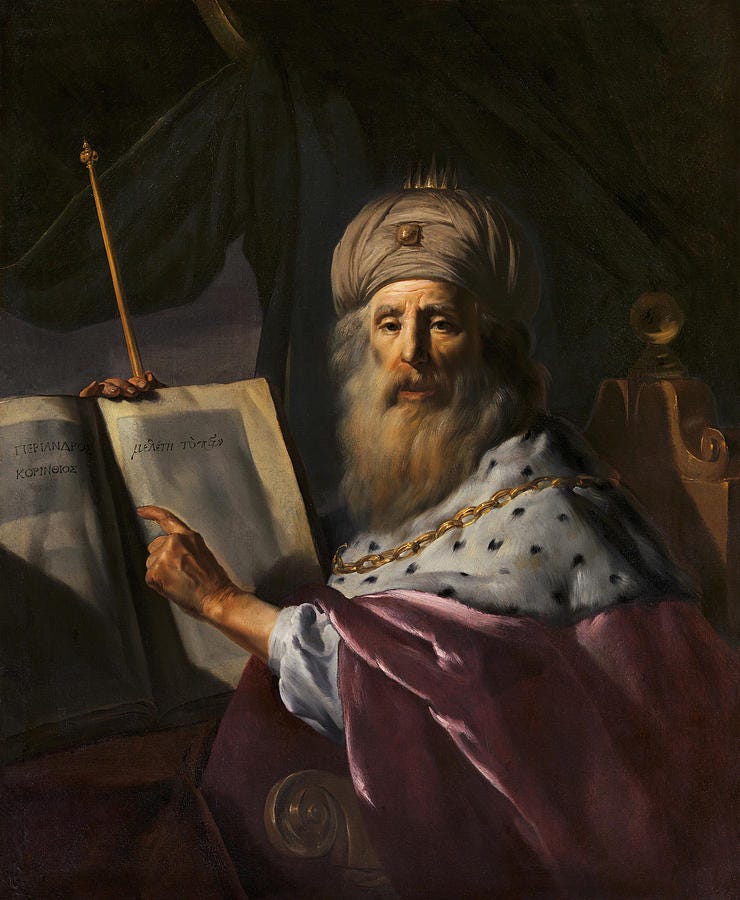
The Ring of Gyges is one of the most influential myths ever written.
It’s a short excerpt found in Plato’s magnum opus The Republic. It’s a story about a man who finds a ring that turns him invisible, and permits him to commit any crime without consequence.
The context of this story is even more disturbing:
Socrates is tasked with using it to defend justice. The story suggests that men are only just because they fear punishment, but if they knew they could get away with injustice, then it would be superior to do so.
In other words, the story asks:
“Does justice exist, or is it a human construct masking the chaos of a nihilistic universe?”
It goes as no surprise that this story — and Socrates’ genius answer — has continued to inspire the greatest minds of civilization some 2,500 years later (perhaps influencing Tolkien’s Lord of the Rings itself).
Here then, is Socrates’ answer to the Ring of Gyges, his defense of justice, and why the human soul cannot survive without it.
I am 100% reader-supported. This newsletter is free, but if you’re able to support, please consider a paid membership — it helps my mission of sharing Truth, Beauty and Goodness with maximal reach
As a paid member, you’ll get:
Two full essays a week
Access to all recordings (past & future) of my Great Books lectures on this publication
Eternal gratitude from me
The Ring of Power
The Ring of Gyges is a “story in a story,” or an interlude told in Plato’s Republic.
The ultimate question of The Republic is “what is justice?” Socrates gives an initial defense of justice, claiming that it’s intrinsically good and necessary to live a happy life.
Glaucon, however, is not convinced. He attempts to steel-man the opposite position:
Justice is just a convention, and not a virtue.
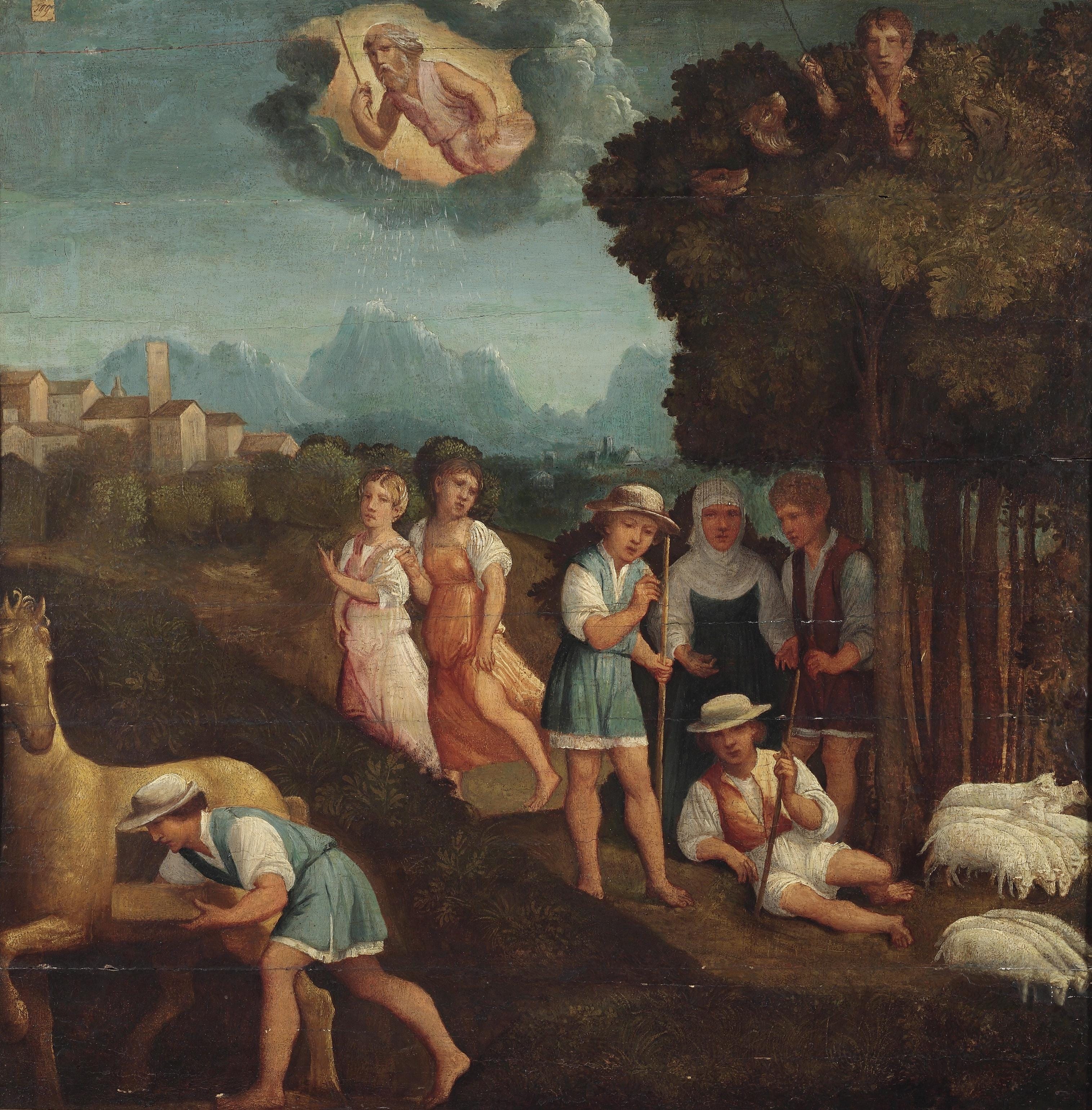
To do so, he tells the Ring of Gyges like this (paraphrased):
“One day a shepherd named Gyges was in the field, when lightning struck, opening a crater.
Gyges descended, and found a hollow bronze horse. Inside the horse was a ring that gave him the power to be invisible whenever he wore it.
Gyges used the ring to murder the king of Lydia, seize his wife, and take the throne.
He lived as a king who pretended to be virtuous in public, but was secretly vicious. Thus, he was beloved by all, and had every desire satisfied, all accomplished through his injustice.”
Glaucon then contrasts this with a just man who is impoverished and wrongfully hated, falsely believed to be unjust:
“He’ll be whipped, stretched on a rack, chained, blinded with fire… and impaled”
The argument then, can be summarized as such (paraphrased):
“Imagine an unjust man who has all his desires satisfied, and is beloved by all. Now imagine a just man who is wrongfully hated, tortured, and murdered. Prove that it’s still superior to be just than unjust”
Socrates is uncertain whether or not he can answer the challenge, but attempts to do his best.
Building the Perfect City
Socrates says to explain what justice is, they should build an imaginary city.
Why?
Because a city is a collection of many souls. Therefore, the justice found in the human soul will be far easier understood by studying a city at scale.
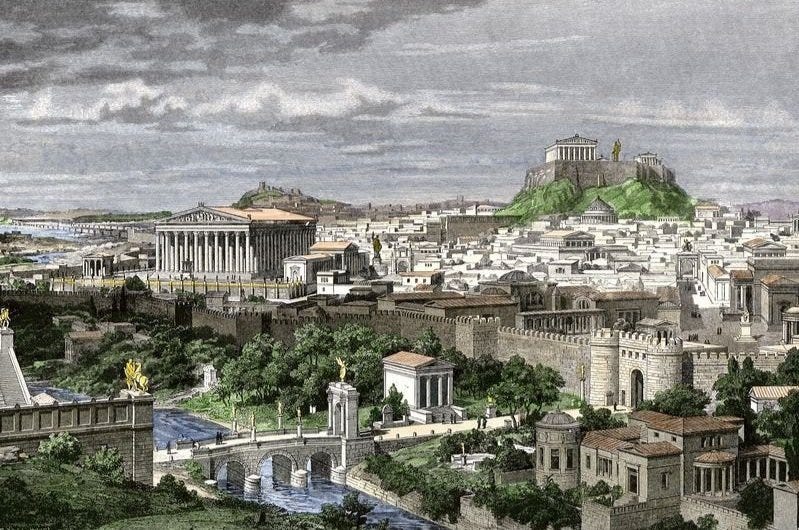
This is a classically Greek idea: your city is an extension, or map, of your soul.
Starting from scratch, Socrates muses that humans living in a state of nature form tribes for personal advantage; 10 souls working together is superior to individual labor.
Eventually they’ll grow and become wealthy. The growing demand breeds war. Necessity requires them to attack other cities, while other cities will want to attack them.
Therefore, the city of merchants now needs a second class, namely auxiliaries (warriors).
But this introduces a problem, namely, “who’s going to police the police?”
This simple question is the implicit beginning of all political discourse, whether you know it or not. Force is the most fundamental law of nature, and justice cannot prevail if force is dominated by tyrannical men.
But how can we ensure the auxiliaries of the imagined city don’t become tyrants?
The answer is through education. Socrates says poetry and gymnastics will do the trick:
They are to hear (censored) poems that celebrate glory, virtue, and moral excellence. This will make them morally virtuous. Additionally, they are to undergo rigorous physical training.
The result is auxiliaries will be like loyal dogs: gentle to their fellow citizens, but vicious to strangers.
This solves the problem of force, but the picture is not yet complete. The city still needs rulers and statesmen. These will be selected by the noblest of the auxiliaries.
They’ll have unprecedented rule over the masses, but will not be allowed to accumulate wealth, property, nor have a wife. Socrates says they’ll be happy, however, for their salaries prevent any fear of material privation, and they’ll have endless leisure to contemplate, share, and proclaim Truth and Goodness to their fellow man.
This is the creation of the city, and a fairly sound one if taken hypothetically. But there’s a problem:
Justice has still not been defined.
We have discovered how a city can become virtuous, but we have not yet answered the deeper question: what makes a human soul just?
Until this question is answered, the Ring of Gyges argument still stands. Perhaps justice is merely a human invention — a mask we wear to hide the brutal realities of an uncaring universe.
Yet this is precisely where Socrates reveals the final and most important leg of his argument. He will not only explain what justice is, but why the unjust life is ultimately a form of self-destruction...
