

Of all the great thinkers in the Western Canon, the ancient historian Thucydides is perhaps the most wrongfully overlooked.
It’s understandable why. He’s considered a founder of political realism — the “Machiavelli” of Ancient Greece — with a relentlessly pessimistic account of human nature. For Thucydides, war is the great revealer of mankind, stripping away the comforts of peace and exposing what men become when fear, honor, and self-interest rule.
And nowhere is this assertion made more clear than in the infamous Melian Dialogue.
It’s one of the most brutal episodes in all of ancient history, in which a small Greek colony begs for its life against a colonizing empire. Yet this dialogue’s value lies precisely in its darkness. To understand the Melian Dialogue is to confront the greatest tragedies of a fallen world, and to ask whether your own beliefs about justice, morality, and God can withstand them.
For that reason, Thucydides’s value transcends that of an ordinary historian. He’s the ultimate moral testing ground. Any philosophy or religion that claims to explain the human condition must first survive contact with him.
Here, then, is the dark account of the Melian Dialogue, and the timeless truths it reveals about the human condition.
I offer private mentorship in the Great Books for those seeking clarity of vision and depth of soul. Inquire here.
If you’d like to support this work and receive future writings, you can subscribe below.
A Possession for All Time
The Melian dialogue is recorded in Thucydides’ Histories (Inquiries) into the Peloponnesian War.
Before we get to the dialogue itself, let’s recap some of the key arguments Thucydides asserts in his work.
First off, he has a concise account of human nature, positing that mankind is motivated by three forces:
Fear
Honor
Self-interest
He says the most honest account of human nature is to analyze what scares him, what feeds his ability to be honored and celebrated, and what practically motivates him for gain. When compared to the tradition of natural law, this is arguably a reductive account of human nature — but its simplicity is crucial to understanding Thucydides’ genius.
That’s because his next claim is easily as powerful as it is controversial:
“War is a rough teacher that brings most men’s characters down to the level of their fortunes.”
He claims this is a universal truth of the human condition. Namely, wartime reveals the human condition most clearly, because it strips away the excesses and decadence of civilized man in times of peace, and shows you what remains in life or death situations.
And the grim reality of what remains is made most clear in the Melian dialogue itself.
A Dark Debate
The Melian dialogue takes place between Melos and Athens. The former is a small civilization — allied with Sparta, but who wants to remain neutral in the war.
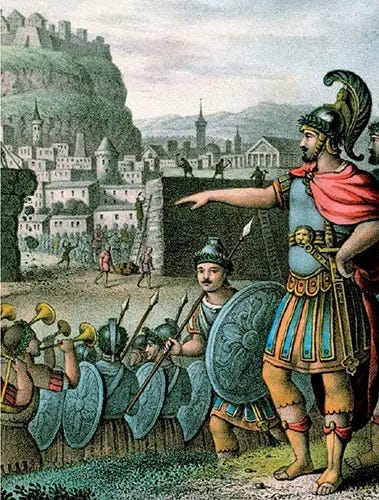
Athens is a superpower who demands Melian loyalty. They approach the small colony with a simple ultimatum:
“Ally with us, or die.”
Athens asserts neutrality is not an option, for they cannot risk appearing weak to their allies whose loyalty they rely on. They reason that peace is mutually beneficial:
Athens gets a tax-paying ally
Melos maintains its livelihood
Nonetheless, the Melians sue for peace. They refuse to ally, but appeal to argument and reason to avoid war. Their arguments can be summed up in four points:
You can’t sack us, for that would be unjust in the eyes of man
You can’t sack us, for that would be unjust in the eyes of the gods
Imagine what the world would think of your atrocities?
Sparta is our ally, they’ll save us
Athens’ rebuttals to these points are simple. They infamously assert:
“The strong do what they can, while the weak suffer what they must.”
In other words, Athens is free to sack Melos on the account of their strength, because this is how the world works. The human sense of justice is meaningless in the face of force. The opinions of the world don’t matter either — for they are powerless to stop Athens. Sparta won’t come to save Melos either, for it’s not in their self-interest to do so.
And to give the Athenians credit, they were proven correct on all accounts above. Yet their most chilling rebuttal is their account of divine justice:
“Neither our pretensions nor our conduct are in any way contrary to what men believe of the gods, or practise among themselves. Of the gods we believe, and of men we know, that by a necessary law of their nature they rule wherever they can.
And it is not as if we were the first to make this law, or to act upon it when made: we found it existing before us, and shall leave it to exist for ever after us; all we do is to make use of it, knowing that you and everybody else, having the same power as we have, would do the same as we do.”
The Athenians assert it’s moral to sack Melos if they choose to, for they’re merely following the behavior of the gods, who rule as the strong do. In other words, the Athenians state that war reveals what justice truly is — not a virtue ensuring equality and protection to humans, but the normative right of all beings to assert dominance and take what they wish by force.
It’s not too dissimilar to the account of nature as that espoused by Hobbes — that the natural world is ultimately a war of “all against all.”
This final assertion effectively ends the debate of the Melian dialogue.
Melos chooses to fight rather than surrender, and Athens obliges.
What follows is the darkest episode in Thucydides’ writings — but also the reason the Melian Dialogue has endured for over two thousand years. To confront its conclusion is to learn how to stare into the abyss of human evil without surrendering your own humanity…
