

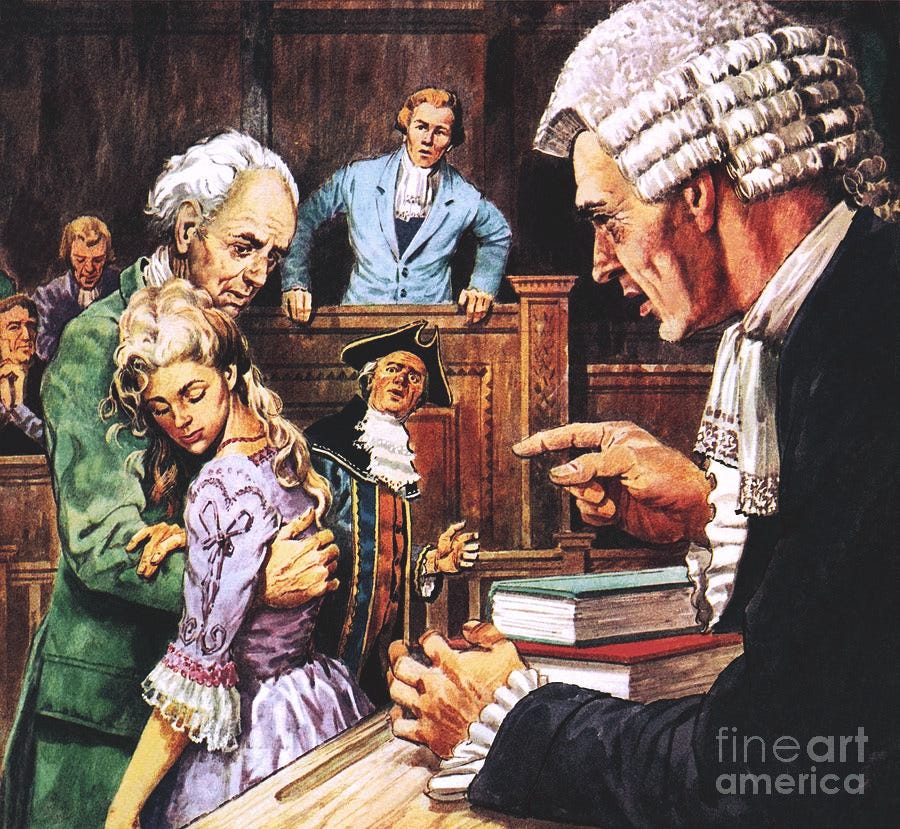
Can man be “recalled to life” from the dead?
This is perhaps one of the central questions of Charles Dickens’ A Tale of Two Cities. The novel is ambitious in scope — set between England and France during the tumultuous rise of the French Revolution — and consequently carries a litany of themes.
And yet, perhaps its chief concern is the possibility of human redemption after a lifetime of suffering, transgressions, and human folly.
Indeed, the heroes of this novel are not Achillean archetypes of strength, virtue, and glory. Rather, they are those who are “recalled to life” after having seemingly wasted it.
And perhaps most surprisingly, the redemption of these characters comes from the least likely of places: the loving gaze of a beloved woman.
Today, then, we’ll explore not just Dickens, but the Western tradition’s understanding of human redemption as mediated through the love of another, to understand why it truly is the case that love can redeem a life, no matter how late one begins.
I am 100% reader-supported. This newsletter is free, but if you’re able to support, please consider a paid membership — it helps my mission of sharing Truth, Beauty and Goodness with maximal reach
As a paid member, you’ll get:
Two full essays a week
Access to all recordings (past & future) of my Great Books lectures on this publication
Eternal gratitude from me
Recalled to Life
There’s many redemption arcs you can focus on in A Tale of 2 Cities, but for our case, we’re going to focus on Dr. Manette. And fear not, my good reader, for this article will be spoiler free.
Manette is a secondary character, yet his arc is perhaps the most theologically substantive in the story. The Frenchman is presumed dead, only for the main characters to discover he had spent 18 years in solitude in the French Bastille prison.
Yet changing political winds led to Manette’s release.
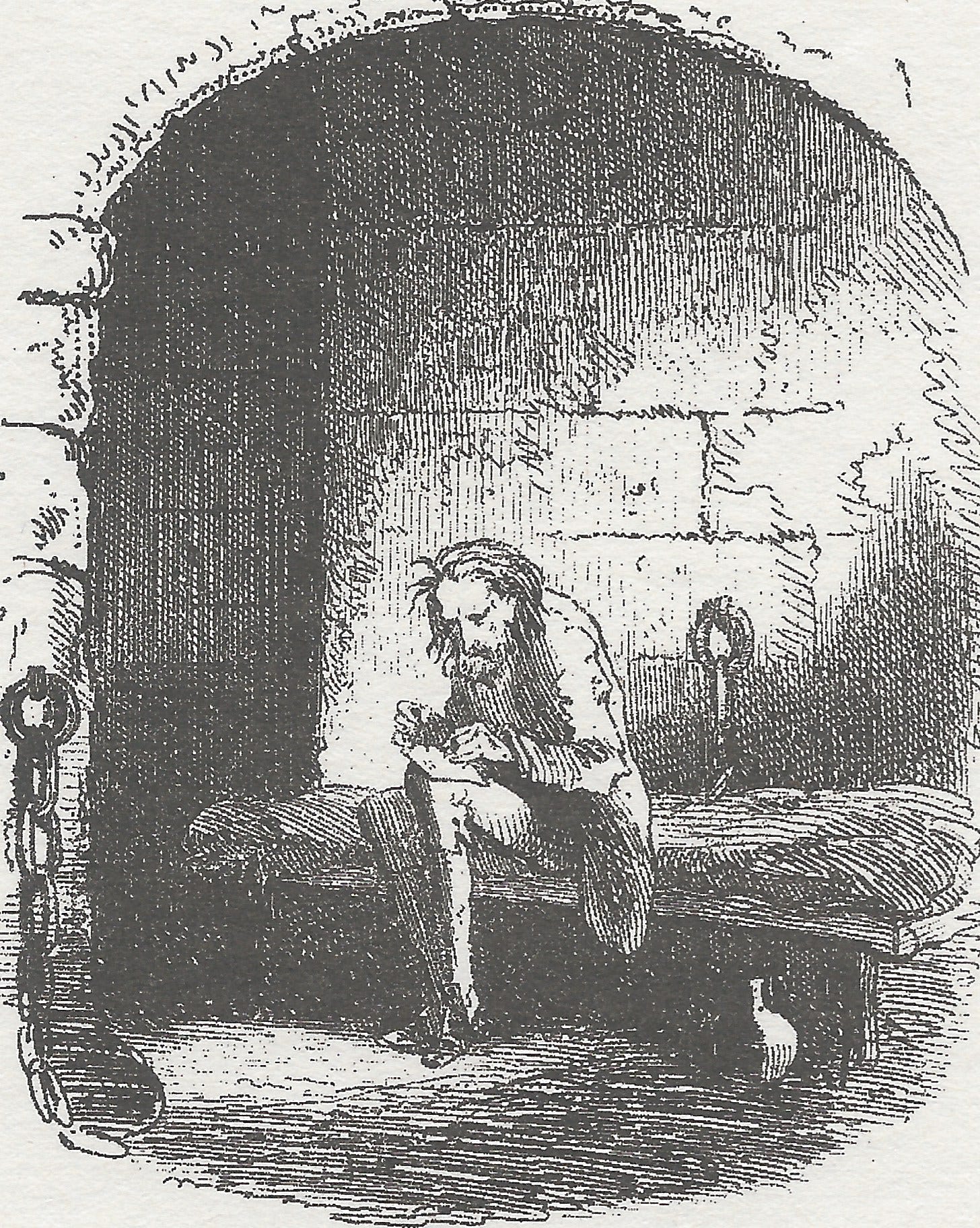
Manette’s daughter, Lucie, later discovers this news via a note delivered to her and an acquaintance named Lorry. It’s but a three word message:
“Recalled to life.”
This simple note has a dual meaning. On the surface, it’s a poetic way of saying Manette is given a new shot at life, but there’s a deeper meaning too.
Remember, Lucie believed her father to be dead, and for all intents and purposes, we might say he was. The man’s mind, body, and spirit are shattered, and he has no memories of his past or identity. He goes by the name “cell 105, North Tower” emphasizing that prison has consumed his identity.
Thus Lucie is given a great commission by Mr. Lorry, who delivered her the news of her father’s release from prison:
“Your father has been taken to the house of an old servant in Paris, and we are going there: I, to identify him, if I can: you to restore him to life, love, duty, rest, and comfort.”
Consider the details Dickens is hinting here. Manette has not just been released from prison, but “recalled to life,” and it is the duty of his beloved daughter Lucie to be the one to restore him to life.
In short, if Manette is to find redemption, it will be expressed through the obedient and dutiful eyes of his beloved daughter…
The Strains of Memory
So how successful does Lucie’s commission go?
Well indeed, Lucie finds her father in bad shape. He’s stowed away in the attic of a former servant, working as a shoemaker, but out of his senses.
Of Manette, Dickens writes:
“The faintness of [his] voice was pitiable and dreadful… it was the faintness of solitude and disuse. It was like the last feeble echo of a sound made long and long ago. So entirely had it lost the life and resonance of a human voice, that it affected the senses like a once beautiful color, faded away into a poor, weak stain.”
Ponder this image for a minute. Manette has been freed from prison, and even found a trade to work, and yet spiritually he fares no better than when he labored at the Bastille.
Human freedom then, is far more than freedom from external restraint (like prison), nor does it arrive from the peace of noble civic labor and toil. Manette still lives in a dark attic, figuratively and literally… until the reunion with his daughter.
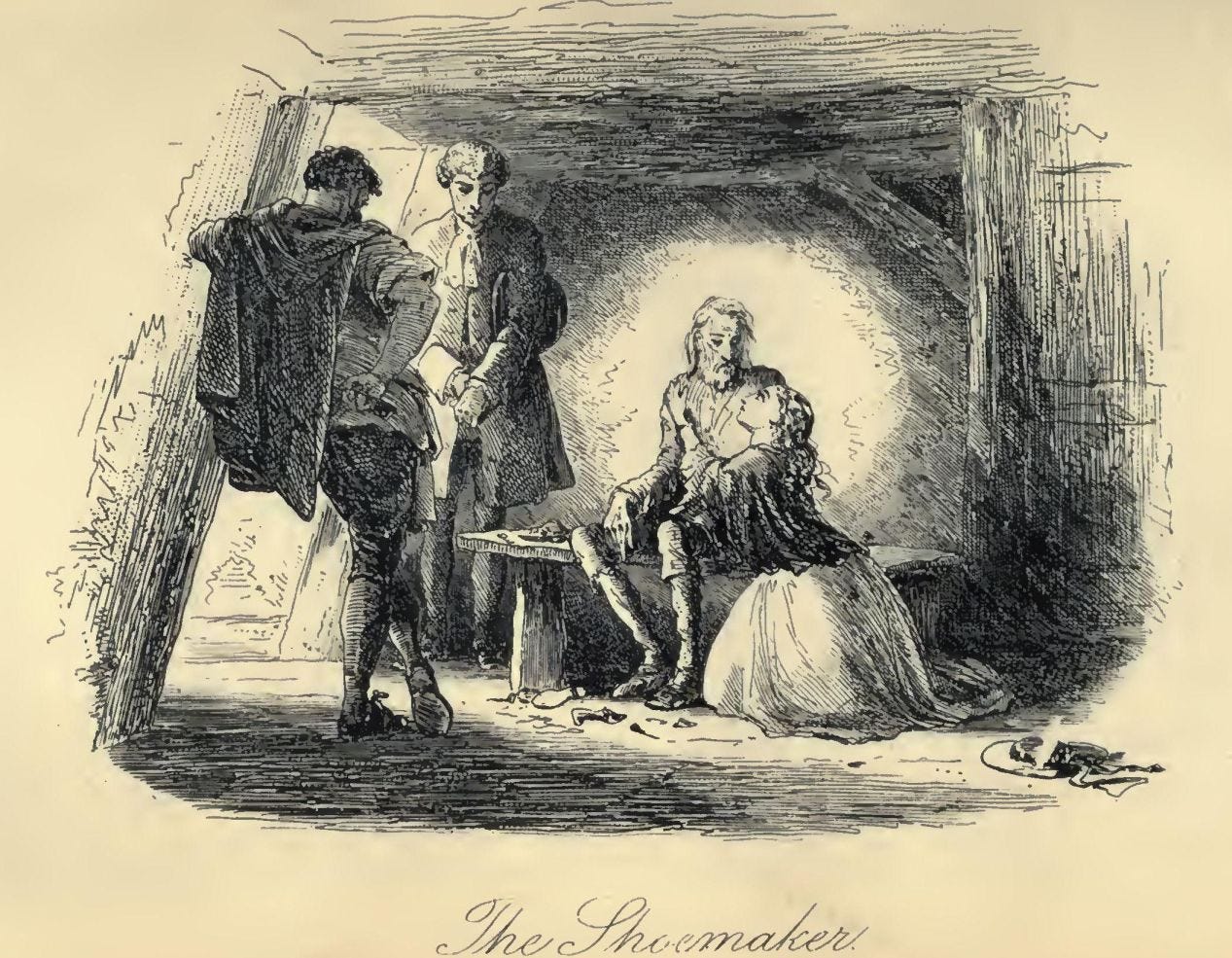
Indeed, his new life begins the moment Lucie reunites with him:
“[Lucie] sat down on the bench beside him. He recoiled, but she laid her hand upon his arm. A strange thrill struck him when she did so, and visibly passed over his frame; he laid the cobbler’s knife down softly, as he sat staring at her”
Lucie’s touch, and the love of her gaze, shed light upon the darkness of Manette’s soul. Though it torments him initially, it begins a long process of recollection.
Soon after, the novel begins a timeskip 5 years into the future — revealing that Manette had returned to England with Lucie, was nursed under her care, and eventually restored to his senses.
But a closer look shows that this redemption of Manette’s was far more than the product of nursing, fresh air, and mere companionship.
It’s in the slight details left unsaid that Dickens gestures towards what constitutes true human redemption.
Lucie, the Living Beloved
To understand the fullness of Manette’s 5 year redemption, we must return to Lucie’s initial reunion with him — for this is the most concrete evidence of how Lucie “recalls him to life.”
We’ve already seen that her mere presence and touch removed him from his stupor.
Here, a critic might point out that Manette was simply moved by the presence of a beautiful woman (he had only seen his daughter in infancy), or that Lucie happened to be the first person to show him kindness.
Yet Manette’s words suggest perhaps no human being in the world but Lucie may have restored him to life. Specifically, Manette was fixated on his daughter’s hair. He then withdrew a small bag with a long strand of golden hair and placed it alongside Lucie’s, shocked to find it the same color — the same color of his long lost, and now deceased, wife’s.
He exclaims:
“[My wife] had laid her head upon my shoulder, that night I was summoned out…
But you are too young, too blooming. It can’t be. These are not the hands she knew, this is not the face she knew, this is not a voice she ever heard…
What is your name, my gentle angel?”
It is precisely here that Manette returns to his senses, and the reason is two-fold:
First, Lucie calls to Manette’s mind the living memory of his deceased beloved, but note that this memory isn’t merely nostalgia.
Lucie is not merely a reminder of Manette’s wife, but the living fruit of their marriage. She is the living bearer of the very love that, though seemingly lost to death, has now endured in Manette’s daughter.
Notice, then, that while years of freedom and physical nurture proved insufficient to restore Dr. Manette, the memory of his beloved, awakened through the presence of their daughter, begins to breathe life back into his shattered soul.
Indeed, he was recalled to life by love, though not an abstract nor sentimental conception of it. His restoration emerged through a deeply personal love, rooted in marriage and sustained through memory, and now made manifest in the living person of his daughter.
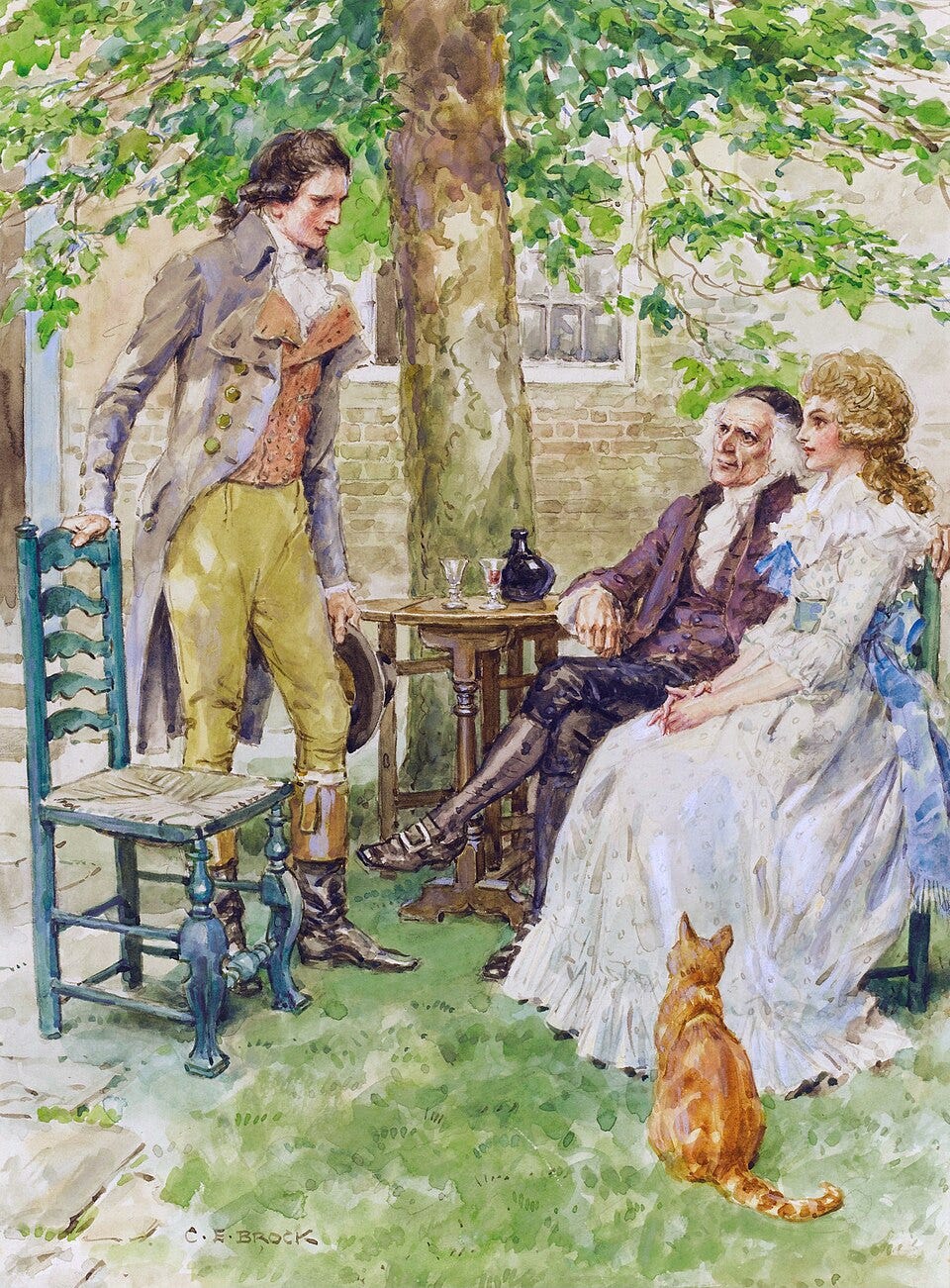
So how exactly does this love fuel redemption?
It echoes back to the traditional wisdom that man is fundamentally a social creature, or a “political animal,” as Aristotle deemed it.
This means that the full maturation of one’s nature is realized through relationships — particularly loving relationships predicated upon mutual self-sacrifice. And among the richest expressions of this sort of relationship is marriage, which begets new life.
In other words, Manette’s resurrection is not just a satisfying narrative arc constructed by Dickens, but a demonstration of the deepest wisdom known to man:
Life is most fully realized through virtuous relationships of self-sacrificial love, reaching their apotheosis in marriage.
It’s only fitting, then, that Lucie — the bearer of Manette’s deepest love — becomes the one soul capable of recalling him to life. And Manette will not be the only soul Lucie helps recall to life in the course of this novel. But the point stands:
Man’s nature is most fully realized in love. Not merely a love reduced to cheap emotional happiness, nor even the erotic rush of new romance, but the love sustained over years through mutual self-sacrifice between friends and spouses. For it is not good for man to be alone. And it is precisely when two become one that new life is begotten, and man remembers that life is good — no matter how many years of darkness may have strained his senses.
I am 100% reader-supported. This newsletter is free, but if you’re able to support, please consider a paid membership — it helps my mission of sharing Truth, Beauty and Goodness with maximal reach
As a paid member, you’ll get:
Two full essays a week
Access to all recordings (past & future) of my Great Books lectures on this publication
Eternal gratitude from me