

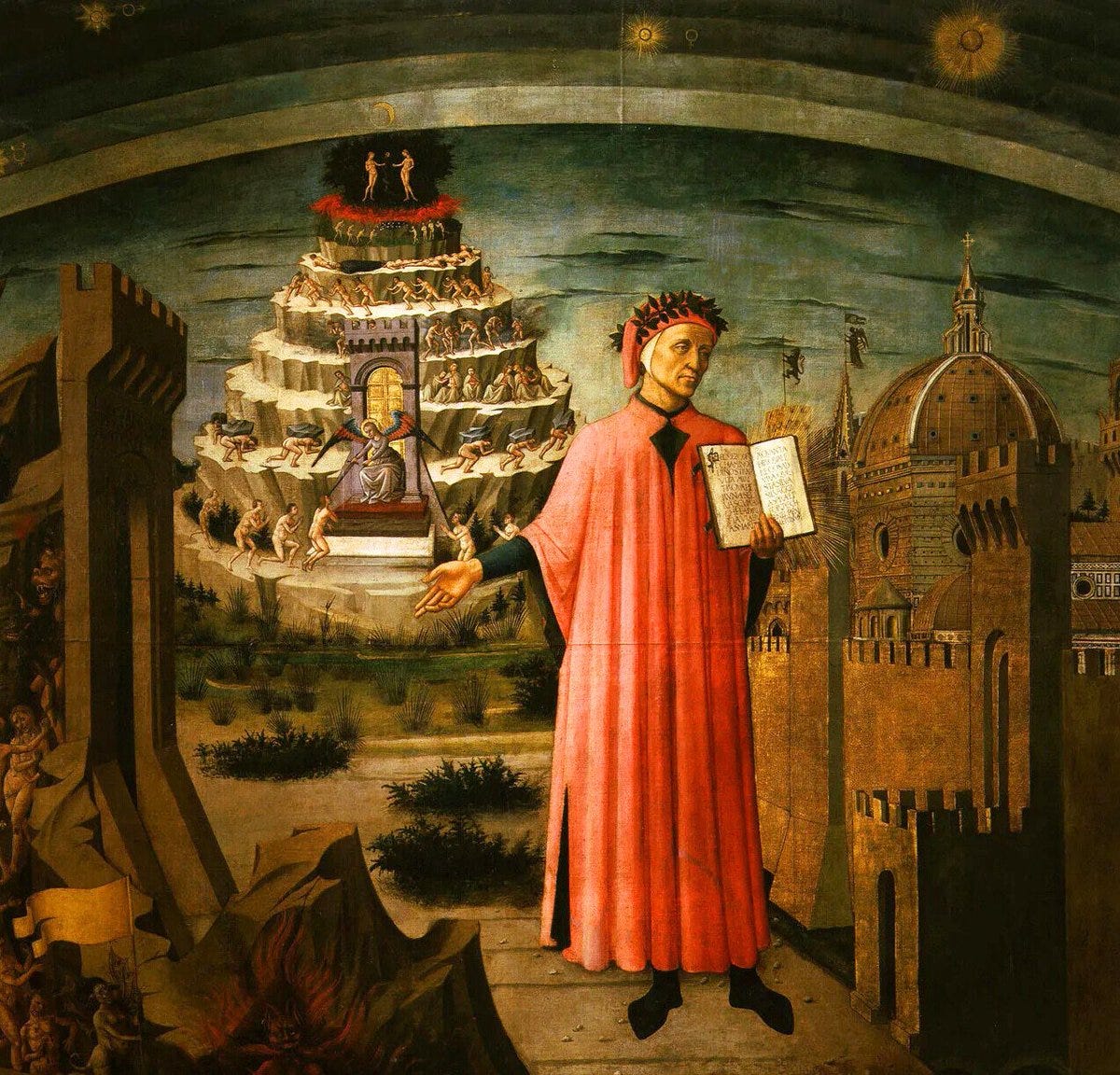
The Divine Comedy has a wild origin story. Dante’s legendary epic poem of an otherworldly descent through Heaven, Hell and Purgatory — often lauded as the greatest work of artistic genius ever penned — was conceived of in the least likely of places. Indeed, Dante’s genius wasn’t born in the ivory tower of the lecture hall or local church seminary, rather it takes root in adolescent love and despair. Dante was a man of strong passions, deep loves, and deep griefs.
His full story is one of heartbreak, grief, exile, homelessness, and despair. He lived in the darkest of days in Italian history, in which the wartorn in-fighting deprived him of everything and cast him off into 20 years of wandering in the wilderness. And even worse, he would live to see his beloved die when he barely entered adulthood.
And it was precisely here, as a homeless exile of heartbroken grief, that Dante penned down The Divine Comedy.
Today we’ll explore the background of Dante’s life, the misery that birthed his magnum opus, and what Dante’s story teaches us about human genius.
I am 100% reader-supported. This newsletter is free, but if you’re able to support, please consider a paid membership — it helps my mission of sharing Truth, Beauty and Goodness with maximal reach
As a paid member, you’ll get:
Two full essays a week
Access to all recordings (past & future) of my Great Books lectures on this publication
Eternal gratitude from me
The Flames of Eros
Little is known of Dante’s personal life. It’s believed he was given an aristocratic upbringing and education, although his family was not wealthy. The most important element of Dante’s early life, and its relation to the Divine Comedy, is teenage romance… of all things.
Dante fell in love at nine years old when he met his first beloved — Beatrice Portinari — the same woman who would later be immortalized in the Commedia.
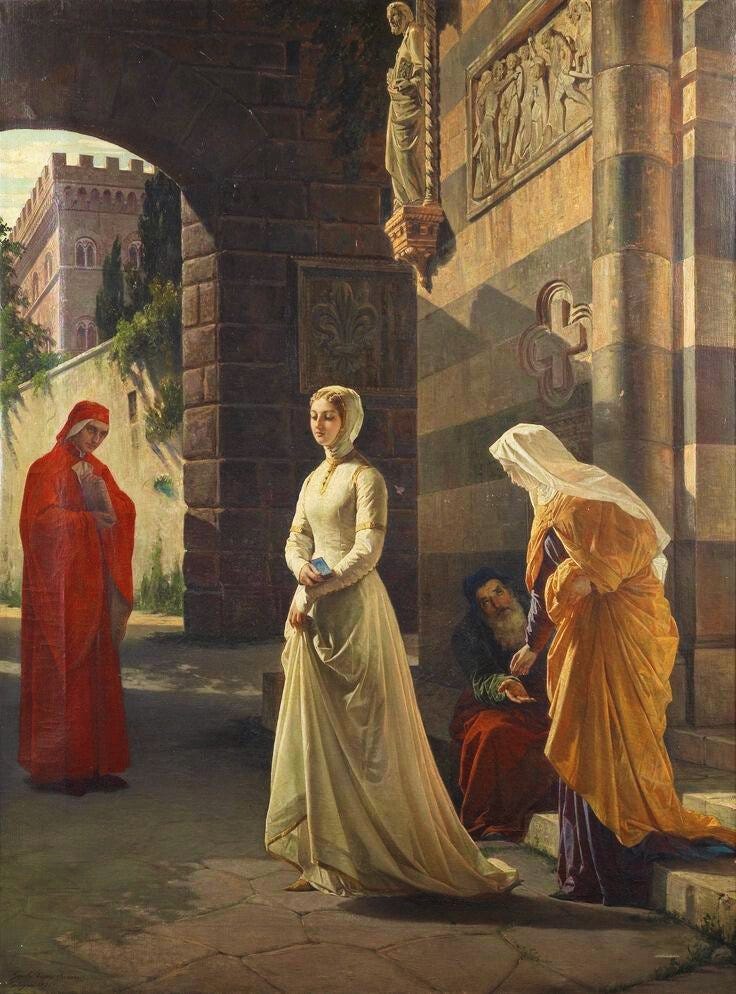
Yet the nature of Dante’s love is a mystery. He met her only in passing, though she left a strong impression on his 9-year-old mind. Surprisingly, this would be their only meeting for 9 years. Their second meeting was just as brief — an 18 year old Dante passed by Beatrice in the streets, and the two gave a brief greeting to each other. This would be the second, and last, known occurrence of their meeting, and yet this chance encounter smited Dante’s heart. On the spot Dante espoused a lifelong vow of love and fidelity to his beloved Beatrice. And he would make due on this promise too:
Though both went on to have arranged marriages to different partners, Dante spent the next 5 years writing love poems to her.
Yet it was at this time that Dante would meet the first of many life-changing heartbreaks.
A Grief that Seeks the Stars
Beatrice died when Dante was 25, and it plummeted him into a black grief. Dante first took to writing love poems mourning Beatrice, but was frustrated that they failed to capture her glories. He renounced the project, making a new, lifelong vow:
“I decided to write nothing more of Beatrice until such time as I could treat of her more worthily...”
This vow would follow him all his life, as it would take roughly 30 years to produce the Divine Comedy.
In the meantime, Dante was not just artistically frustrated but wallowing in a deep-rooted grief and despair. Nothing of the world could bring solace to his grieving heart… so he looked beyond the world.
Dante turned to higher studies, and encountered Boethius’ Consolation of Philosophy — a book detailing the innocent Boethius on death row, turning to philosophy to console him in light of his doom. Dante describes this book as the turning point in his intellectual life. He discovered philosophy and theology, which introduced in him a love of wisdom that provided escape and solace from his worldly woes.

The next two years of his life were followed by rigorous study of philosophy and theology that soothed his heartbreak and birthed in him a newfound love for virtue, truth, and God. All the while, the memory of Beatrice burned in his heart, exhorting him to ever greater labors in honor of her memory and glory.
And though Dante was placed on a newfound path of virtue, the twists of fortune would once again lead him to ruin.
A Poet in Exile
It’s worth remembering that 13th century Italy was a brutal period in history. The nation was composed of countless factional city-states at war with one another.
Dante himself was immersed in the hot-bed of this conflict. He was a diplomat for the White Guelph political party in Florence. After years of infighting, his faction was defeated by the Black Guelphs, and Dante was stripped of his possessions and cast into exile, promising death if he returned… For the rest of his life, Dante would be a homeless wanderer in the wilderness.
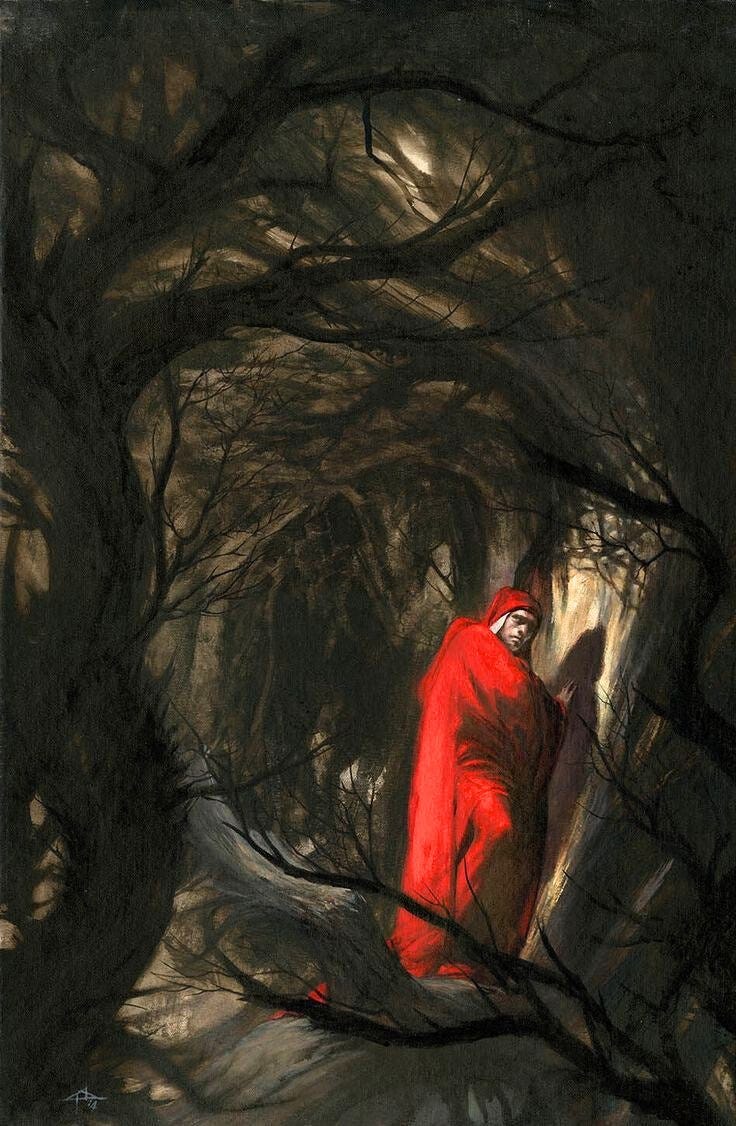
Little is known of Dante’s biography during this period of exile, which would be a grueling twenty years. This silence, however, doesn’t bear well, as it implies Dante likely lived in an arduous state of survival without any certainties that come from owning property, steady income, or a community of family/friends to rely upon.
What we do know, however, is that it was precisely this twenty year period that Dante composed, drafted, revised, and finished the Divine Comedy. We also know that Beatrice remained burning in his heart. His vow was to immortalize her memory in poetry, and in totality he succeeded. Beatrice would become a primary protagonist of the Commedia, who saves Dante from certain death and guides him to Heaven. All the while, it’s believed Dante continued immersing himself in his studies of philosophy, theology, politics, mythology, history, and poetry as such. The man nurtured an indefatigable work ethic and heavenly genius for the simple love of a woman’s memory… whom he only met twice.
And despite the toil, and ever present fear of death, Dante’s labors would pay off — he finished the Commedia in 1321, just a few months before his death.
And with his story finished, one question remains:
What exactly about Beatrice birthed both his love, and the true nature of his human genius?
Eros, Agape, and Human Genius
It is mandatory to know Dante’s story to understand his genius. With this context in mind, it’s clear that what inspired Dante was far more than God-given talent or high IQ. In fact, by Dante’s own measures, his poetry was wanting and insufficient well into his adulthood — his poetic genius was nurtured rather than freely granted at birth.
And Dante’s intellectual magnitude is indeed amongst the greatest of any artists who have ever lived, and yet it seems far more understandable how he envisioned such a poem when he spent 30 years of intensive labor and study.
So the greater question then is, how exactly did Dante find the inspiration to joyfully labor for 30 years, while living through a sort of Hell on Earth?
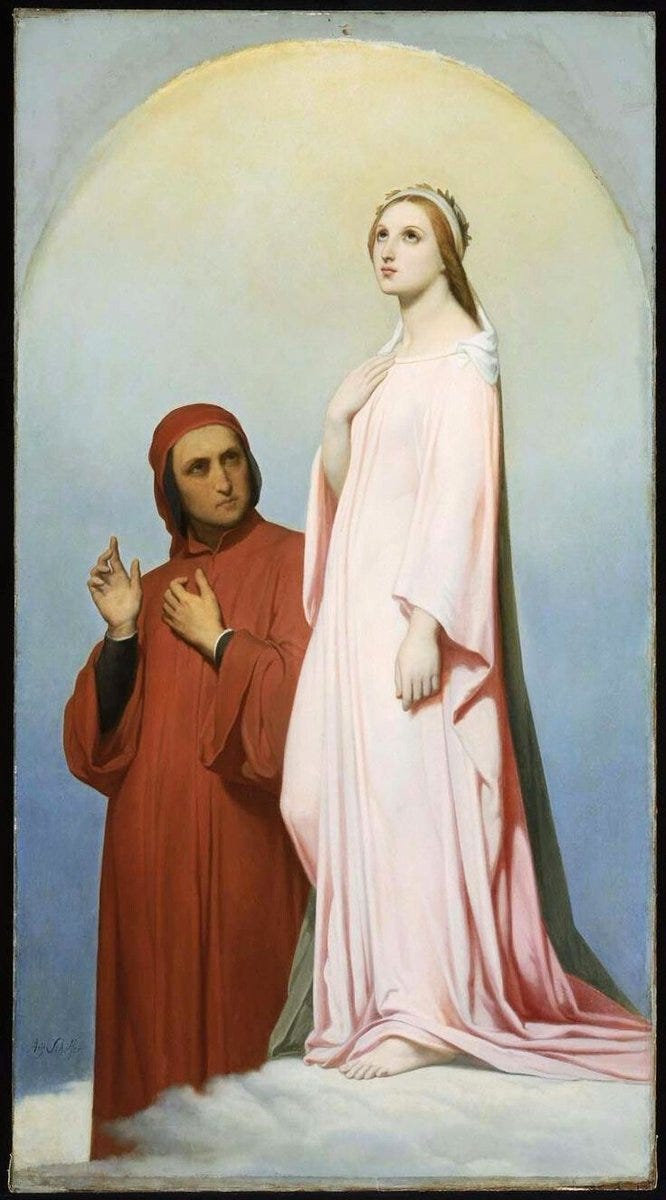
The blunt answer is that his genius was a love borne out of suffering. Dante’s story is a masterclass in the Christian teaching of “eros aimed at agape,” that makes for human genius. It states the human eros supplies the fuel of Dante’s inspiration, and agape gave him the form and substance that created his poem.
Recall that eros is desiring love: the powerful attraction toward some perceived good that captures the heart and draws the lover toward its possession. In its most obvious form, this is romantic or sexual love. But we also speak naturally of being ‘in love’ with music, philosophy, history, art, or a particular craft.
Agape meanwhile, is a divine form of love. It’s said to be the love that is the essence of God, and is fulfilled by the golden rule of selflessly willing goodness to God or neighbor.
So Dante’s many studies were rooted under agape, to seek a unified understanding of God, the cosmos, human nature, and how all of these things are contingently grounded in and moved by love.
Dante’s genius then, is fundamentally a case in how he channeled his loves. No one can deny that Dante was impassioned for Beatrice — and passionate erotic feelings are certainly not unique to Dante — but consider how he fueled them. Rather than merely “releasing his passions,” through carnal acts that dull the mind and senses, Dante channeled them upwards. He labored selflessly for her honor. Recall that Dante made this vow after Beatrice died, meaning he had nothing to gain or no hopes of winning her heart. So it was agape, a selfless love in her honor, that gave form and substance to Dante’s writing.
Indeed, it was simply this combination of eros given form by agape that sustained Dante’s will to live for those thirty years.
So Dante’s genius then, which I reckon is a universal paradigm, was not to be primarily understood as intellectual magnitude, but a spiritual journey of self-sacrificial love. His eros for Beatrice exhorted him to sacrifice his life in pursuit of “the love that moves the sun and the stars,” and seek the face of God himself.
And though there can only ever be one Dante, every human being shares in his nature. Genius in man appears to be, in totality, a cultivation of love. In matters of the artistic, the intellectual, or even the romantic, one need not be given innate heavenly talents. The full scope of human genius is he who dares to love greatly — an erotic desire for his craft or beloved — and surrendering to agape, willing the good of thy neighbor. This is precisely the path thea leads one to the same love that Dante gazed upon at the culmination of the commedia — the love that moves not just the human soul, but the entire cosmos.
I am 100% reader-supported. This newsletter is free, but if you’re able to support, please consider a paid membership — it helps my mission of sharing Truth, Beauty and Goodness with maximal reach
As a paid member, you’ll get:
Two full essays a week
Access to all recordings (past & future) of my Great Books lectures on this publication
Eternal gratitude from me
. . . and they called it puppy love, at nine that 30 years later, became agape love.
What a wise man he was to channel his passion into a great piece of literature.
Like at the beginning of Inferno you see how people who drifted through life wake up or suddenly realize they’re lost in the proverbial wilderness. Often consumed by the animals/vices following them through life or preventing them from finding their way back.
Just finishing up Purgatorio and about to start Paradisio.