

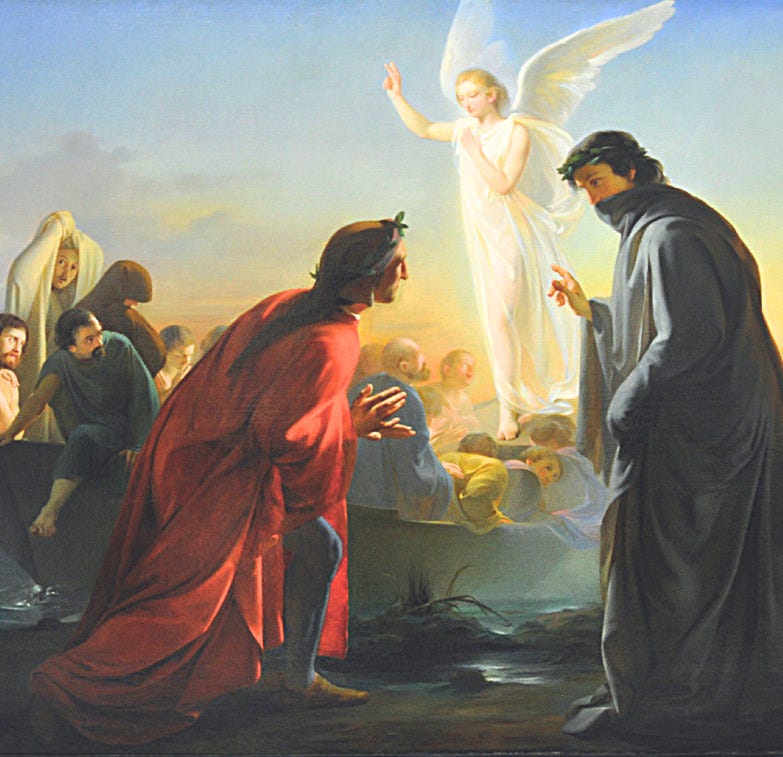
Dante’s Inferno is the most famous poem of the Divine Comedy, but Purgatorio shines if you want to transform your life.
The sequel follows Dante’s escape from Hell as he climbs Mt. Purgatory in pursuit of Paradise. To do so, he must confront and conquer the seven deadly sins of his soul, scattered across seven terraces on the mountain.
The story is entertaining, but it’s also deeply pedagogical:
Dante is giving you a personal map to conquer evil, embrace virtue, and live a life so ordered that you may be deemed worthy of Paradise. Christians and classicists alike have called this book the “greatest self-help manual of all time” for its timeless wisdom.
Today, we’ll take a deep dive into the core message of Dante’s Purgatorio—to learn what it reveals about the human condition, and how to live so that your soul may ascend to Paradise.
I offer private mentorship in the Great Books for those seeking clarity of vision and depth of soul. Inquire here.
If you’d like to support this work and receive future writings, you can subscribe below.
The 7 Deadly Sins
First, let’s recap the structure of Mount Purgatory.
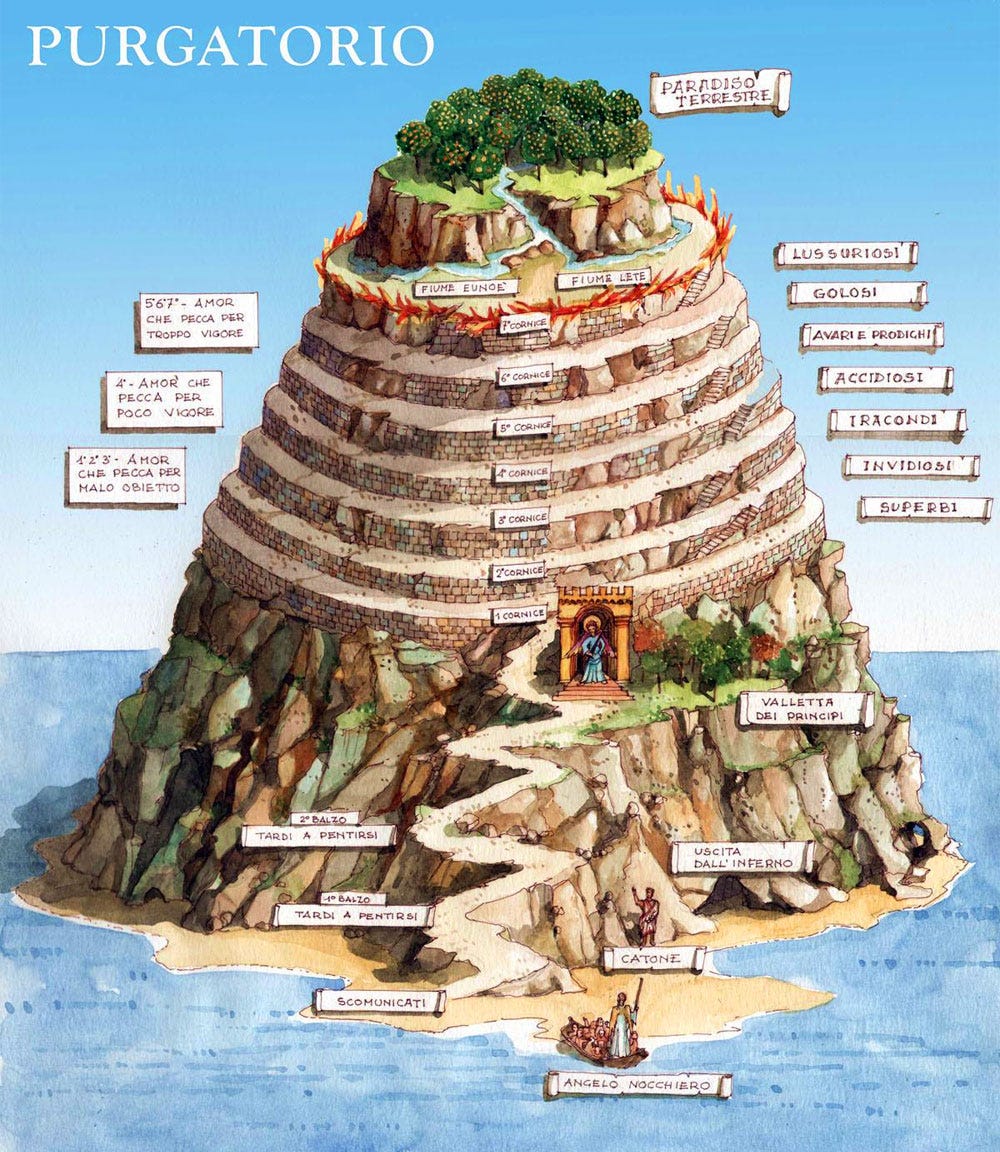
The 7 terraces of the mountain actually divide onto 3 main sub-sections of Purgatory.
Here’s their order, from bottom to top:
Lower Purgatory, consisting of Pride, Envy, and Wrath. These are sins of perverted love.
Middle Purgatory, consisting of Sloth. This is the sin of deficient love.
Upper Purgatory, consisting of Avarice, Gluttony, and Lust. These are sins of excessive love.
In each terrace, repentant sinners undergo “contrapassos,” or punishments that fit their unique crimes on Earth. These punishments are efficacious — they purge the soul of evil and teach a corresponding virtue.
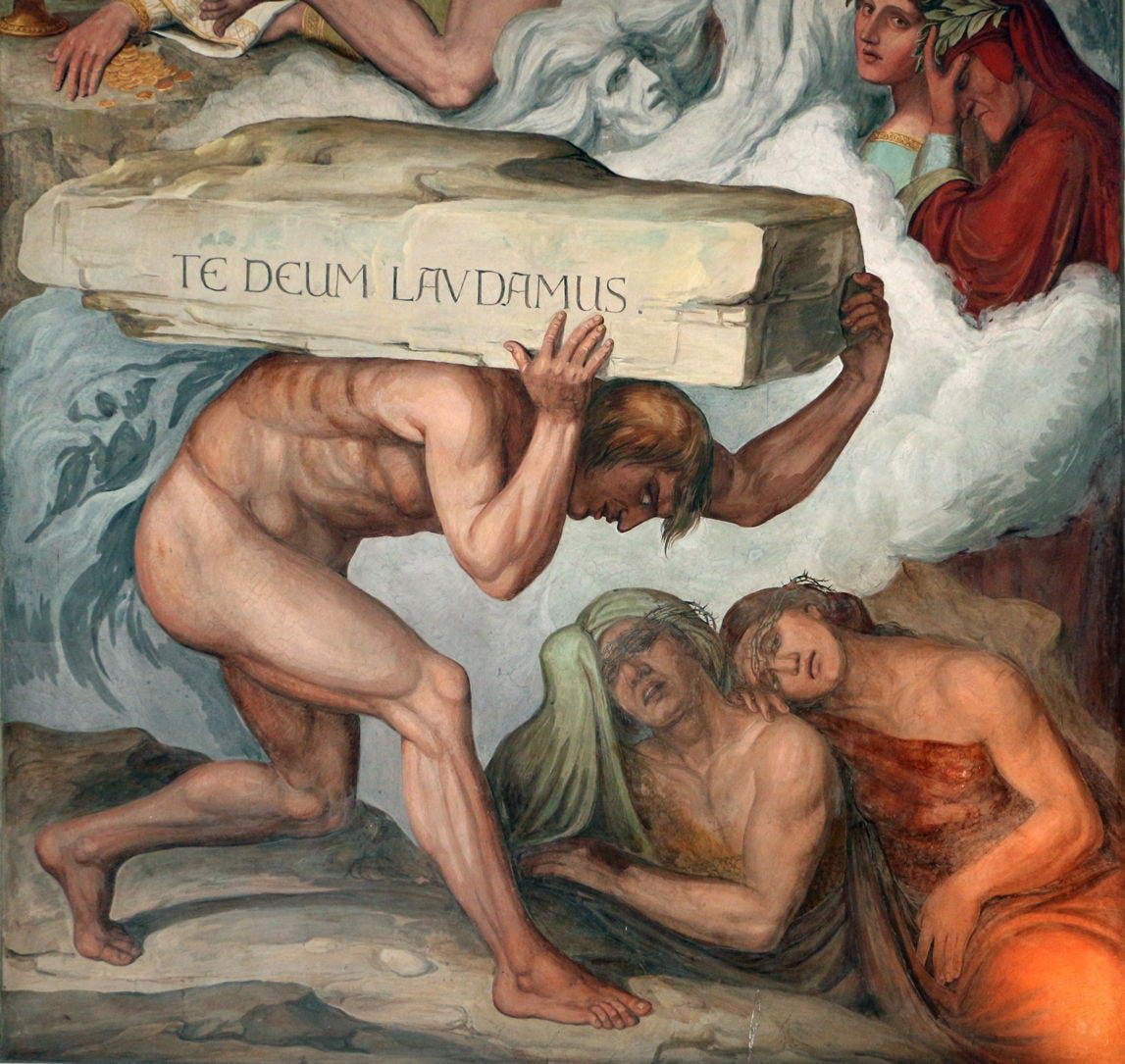
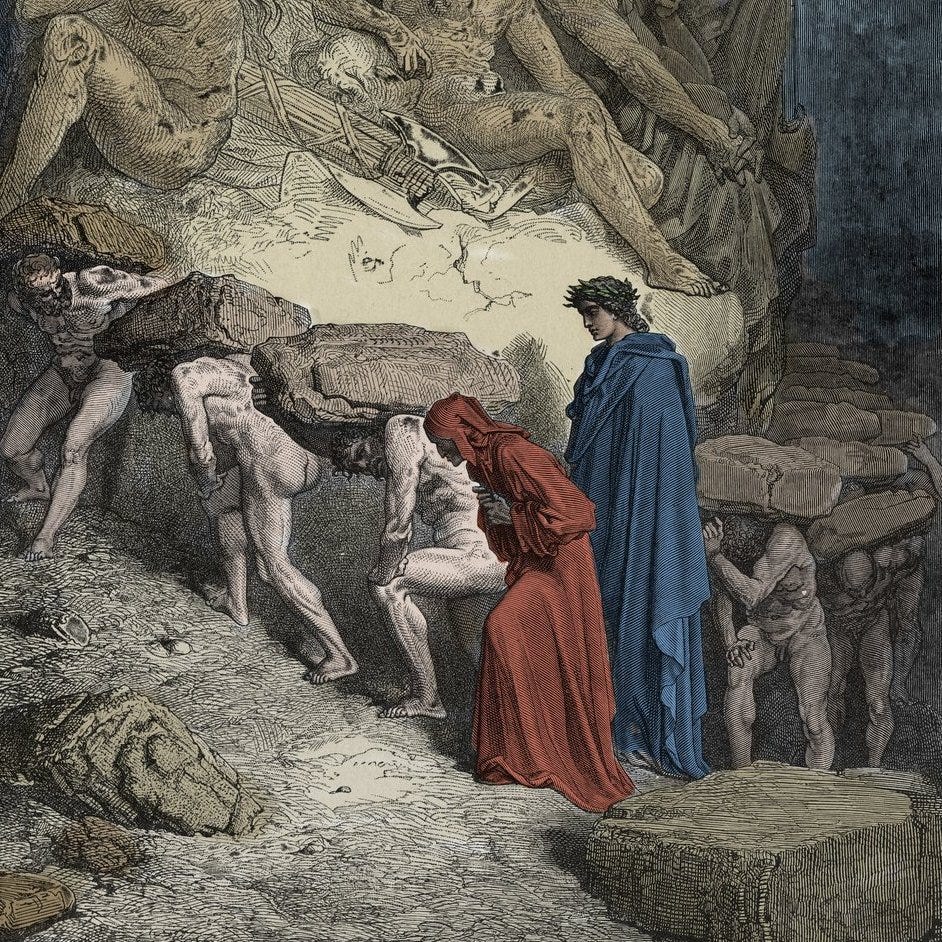
For instance, in the terrace of Pride, sinners must carry heavy boulders while hunched over, which teaches them humility.
This also leads us to an important question:
Why does Mt. Purgatory begin with pride?
This is considered the deadliest sin, and the hardest one to tackle… shouldn’t it come last?
Here is where we see Dante’s genius shine.
The Burden is Light
Dante himself converses with sinners in this circle, and by the time he exists this terrace, he notices that he too is transformed:
“Teacher, as I climb I feel almost no strain!
Tell me what heavy thing I’ve been relieved of now.”
Dante’s guide, Virgil, replies:
“Your feet will be so conquered by good will,
Not only will they feel no strain—they’ll take
Delight in being urged up on the hill”
Pride is the most fundamental evil in the soul — and the hardest to conquer — but this is precisely why it must come first. If you want to live well, find redemption, and reach Paradise, it is the first battle you must fight.
In other words, it is impossible to live the good life without humility.
But it gets better. When you learn humility as Dante does, the climb gets easier. Virgil himself says you’ll find “delight,” in being urged up the hill.
In other words, a humble heart with a proper aim at The Good, or God, draws from a grace that conquers transforms suffering. Just as Purgatory’s punishments become a kind of delight to the humble, so too earthly suffering can become a source of joy as you persevere along the path of virtue and human flourishing.
What’s remarkable is, after all this wisdom, we’re still only at the first terrace!
There’s far more wisdom, and far deeper transformation, to come.
In fact, the real turning point doesn’t begin until Dante conquers the third terrace, which is wrath.
Blinded by Rage
The punishment for wrath is its inhabitants must walk in a blinding smoke. It mirrors the experience of blind rage — which can be an intoxicating pleasure (perverted love) — and forces the inhabitants to learn meekness, restraint, and desire for God.
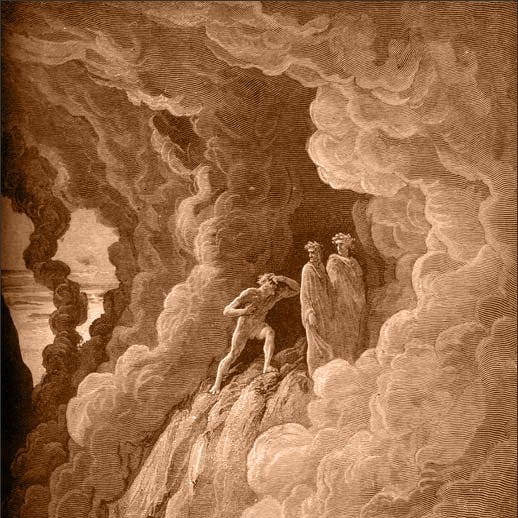
Dante himself is blinded in this smoke. He’s just as lost as the repentant sinners ascending here.
In this blindness, he meets a fellow sinner named Mark the Lombard. They enter into a philosophical conversation where Dante asks Mark to explain the origins of evil in the universe. Mark will give a surprising answer, which will perhaps be Dante’s biggest breakthrough in the entire Divine Comedy:
“Living men attribute to the sky
The causes of all things, as if they moved
Ever and only by necessity.
That would destroy the freedom of your will,
Nor would it then be just to deal out joy
For doing well, or woe for doing ill…
You men lie subject to God who made
You free, a greater force, a better nature,
Who formed your minds without the planets’ aid.
Thus if this present world has gone askew,
Look to yourselves, in yourselves lies the cause”
Mark tells him that evil is to be blamed on man’s free will. This references the Fall, but more importantly, it references every individual too. If Dante is to recognize the cause of evil, he must recognize that “in yourselves lies the cause.”
Ironically, the same free will that led to the Fall is also the path to redemption and the good life.
Dante’s revelation is that the proper use of free will is the path to ascent — that the way “upward” is, in fact, a turn “inward.”
But this raises a deeper question:
How do you actually use your freedom to ascend?
The next terrace gives Dante the answer — and shows exactly how a soul begins to rise toward Paradise.
