

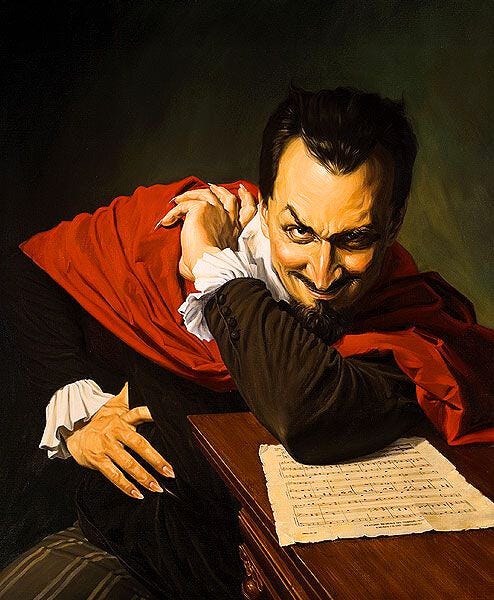
Goethe’s Faust is a masterpiece — a classic “deal with the Devil” tale about a man who sells his soul for worldly gain… but this play comes with a twist.
This isn’t your typical Christian story about resisting temptation, rather it’s best understood as an allegory of the spiritual crisis of modern man. Goethe saw a modern world skeptical of religion yet carrying a “God-shaped hole” in its heart.
His life’s mission was to show how man could live a meaningful life without traditional religion, and Faust was his grand attempt at a solution. This work is brilliant, ambitious, and intellectually rich — but ironically, it falls short.
Yet it’s the very shortcomings of Faust that make the play brilliant — it exposes the hidden temptation that has ruined the heart and soul of modern man, teaching us that it’s far easier to “sell your soul,” than you’d think.
Here’s the story, and what it reveals about the modern day devil — and the true answer to living with meaning today.
I am 100% reader-supported. This newsletter is free, but if you’re able to support, please consider a paid membership — it helps my mission of sharing Truth, Beauty and Goodness with maximal reach
As a paid member, you’ll get:
Two full essays a week
Access to all recordings (past & future) of my Great Books lectures on this publication
Eternal gratitude from me
The Futility of Knowledge
The play follows Dr. Faust. He’s an educated scholar who’s grown dissatisfied with the world. He laments that though he’s studied “everything,” he remains unhappy. No amount of book learning, he concludes, can bring him peace.
In this disillusionment, he gets a visit by a devil from hell:
Mephistopheles
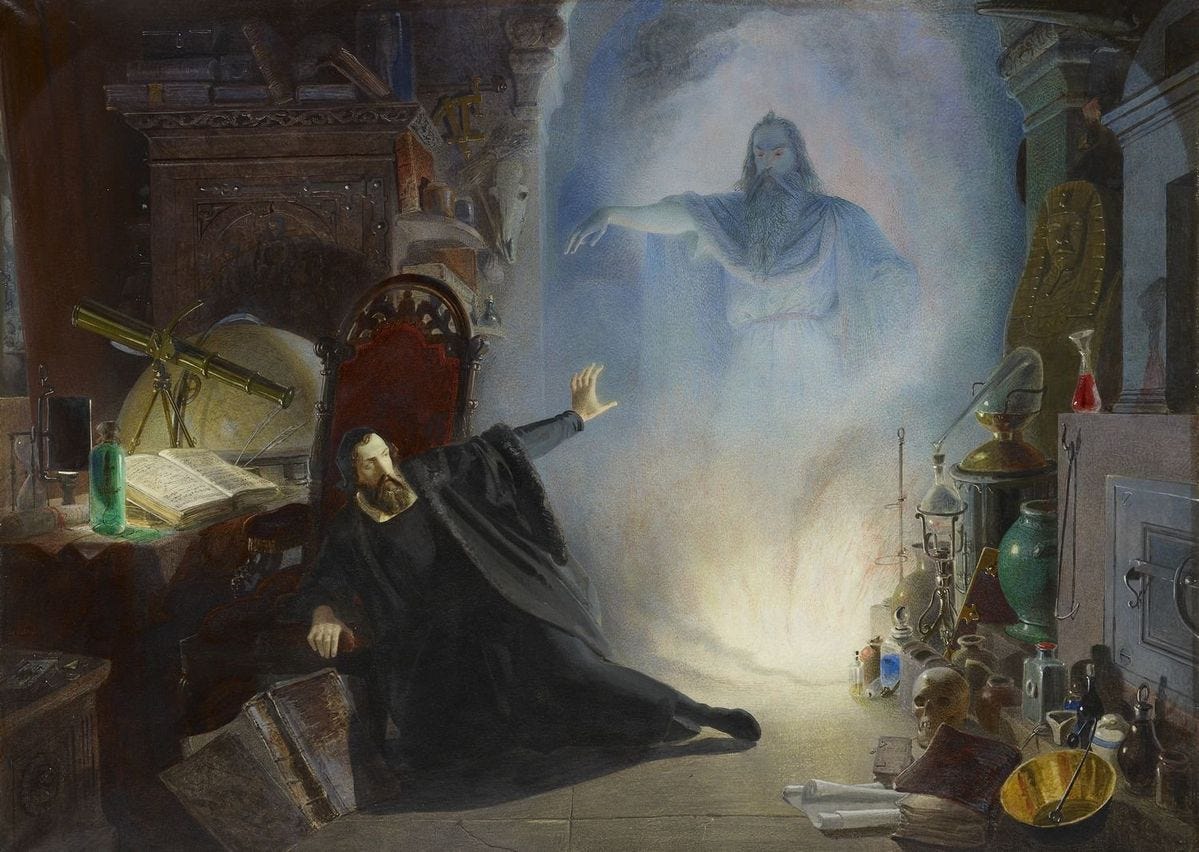
The Demon comes with a simple but familiar promise — sign this contract, and I’ll give you all the powers of hell to do your bidding.
But of course, there’s a catch:
If Faust ever finds true happiness, Mephistopheles will snatch his soul for eternity.
Faust, the over-ambitious, dissatisfied, and skeptical scholar, signs on the dotted line.
But why would he do this?
Faust is not as simple as he looks. He actually wants the devil to snatch his soul — for that would mean he finally found a lasting satisfaction to end human desire. Ironically then, Faust’s yearning for a lasting happiness expressly sets him on a pathway to Hell, from his own choosing!
And yet the story has just gotten started. So let’s see what awaits Faust on this proverbial “highway to Hell…”
Pleasure, Pleasure, Pleasure
With all the powers of Hell at his disposal, Faust’s first schemes are, surprisingly, pathetic.
He doesn’t inquire with Mephistopheles about divine knowledge, nor dare to see the heavenly realms of the cosmos. Instead, he rejects knowledge altogether, and instead seeks happiness in… worldly pleasure, of all things.
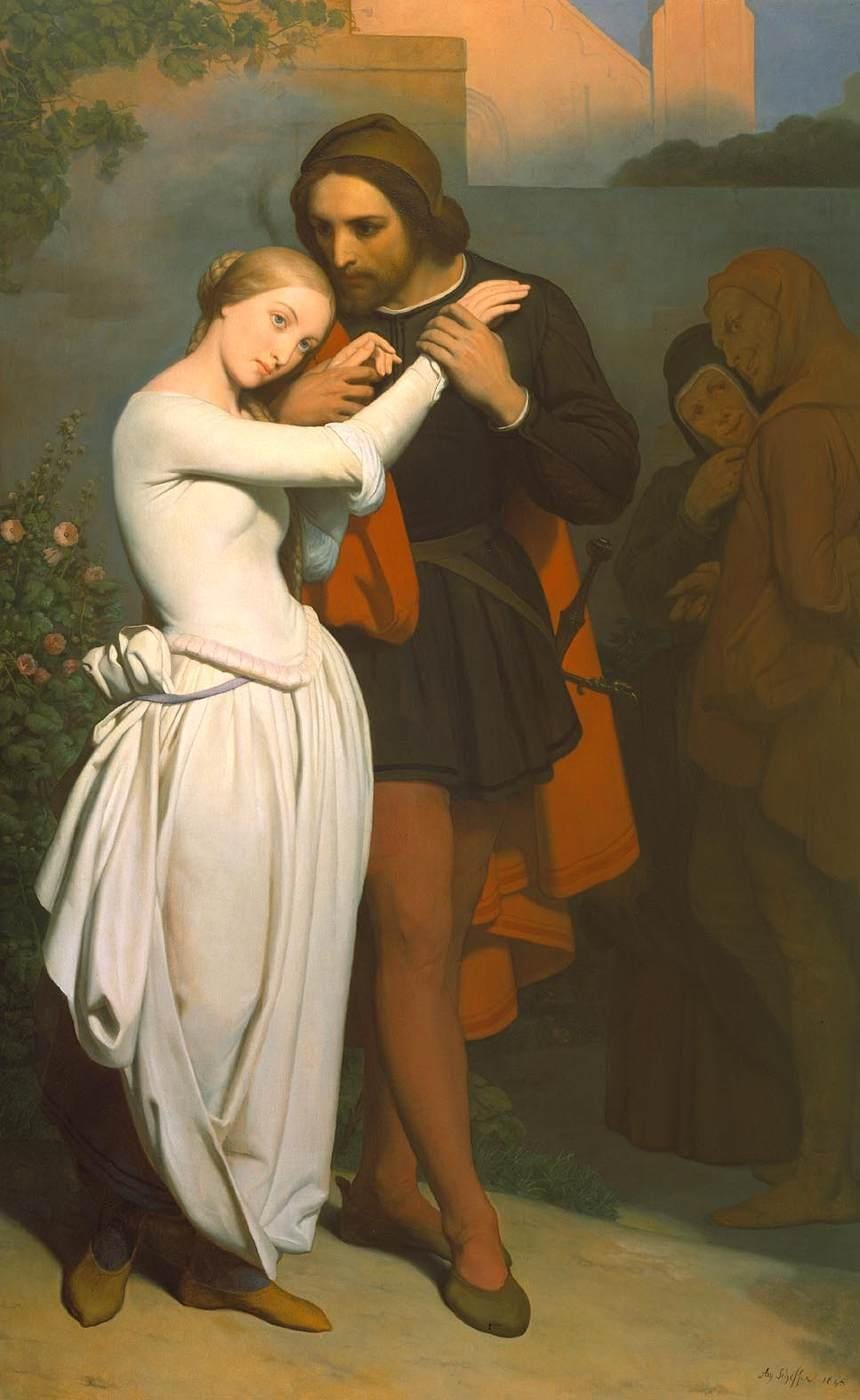
With Mephistopheles’ power, he enjoys riches, food, drink, and all the delights that sensual pleasure can grant him. He even begins a tragic affair with a woman named Gretchen — but impregnates and abandons her, to her shame.
The affair ends in tragedy, with Faust lamenting that neither book-knowledge, nor worldly pleasure can save him.
From here, he turns to greater ambitions, in which he’ll unlock the full potential of the demonic…
Mysticism, Power, and Beauty
Rejecting the modern world, Faust turns to mysticism.
He visits the ancient Greek mythological world and marries Helen of Troy — the embodiment of classical beauty. This marriage is not just romantic, but philosophic in nature:
Faust hopes that by marrying the woman who is “beauty incarnate,” such beauty can bring lasting satisfaction to his aching soul. In other words, his marriage asks “is beauty enough to bring eternal happiness to humanity?”
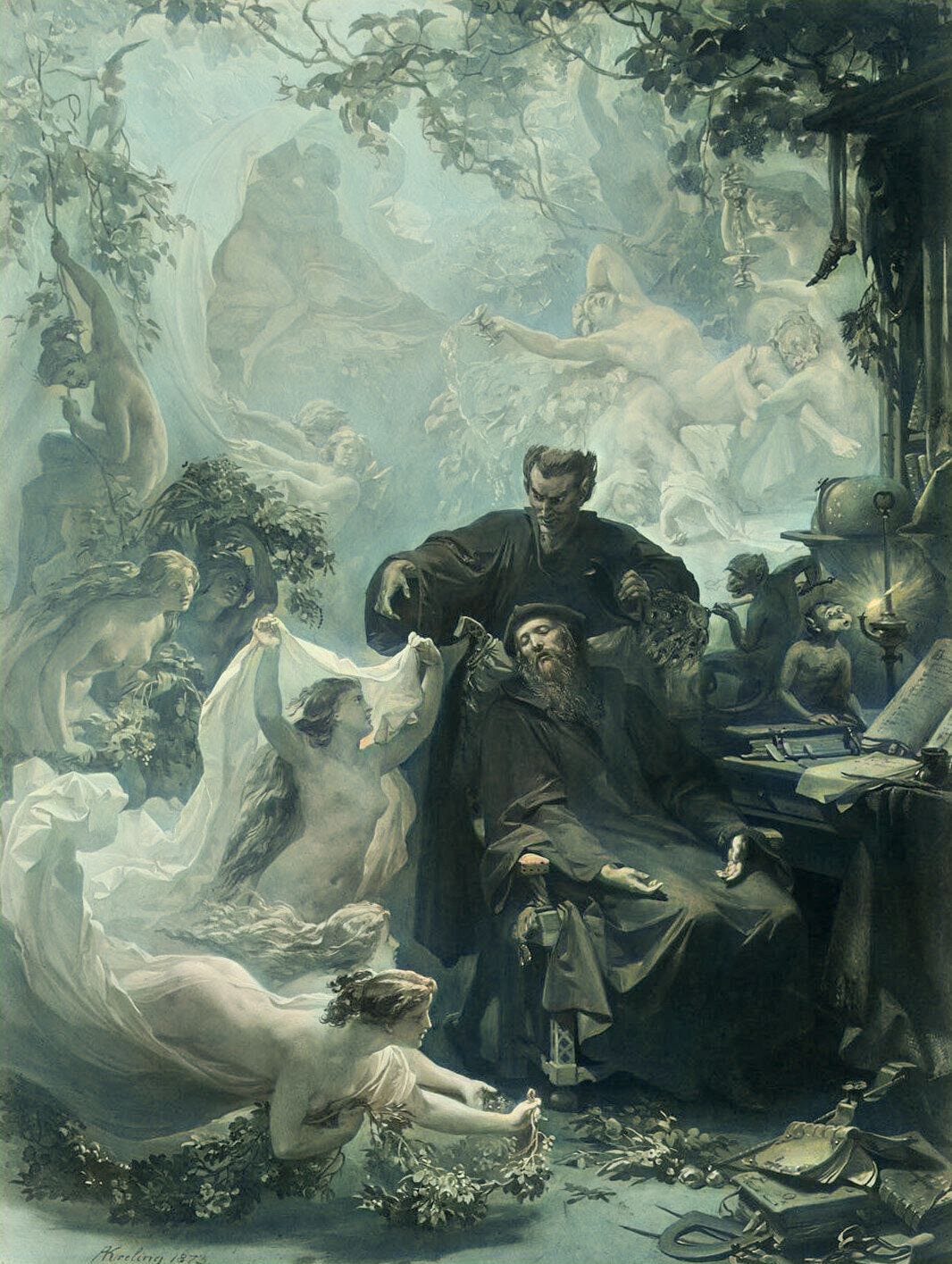
Predictably, this plot too, ends in failure. The problem is that Helen’s beauty is finite, but human desires are infinite, and no finite object can satiate infinity. As such, Faust discovers that neither philosophy, sublime beauty, nor even the grandeur of the ancient mythological world can satiate his soul.
Finally, Faust turns to his last bastion of hope — which is the embrace of power itself. Specifically, Faust takes to political life, and attempts to impose his will on reality via political and material achievement. It’s an attempt at becoming a “great man,” of history, but this too fails to bring him his long sought happiness:
Throughout his life, Faust remained unhappy and miserable…
The play’s ending has a divinely foreshadowed means of salvation — God saves Faust through an act of mercy — but the play’s genius lies not in the happy ending… this play is so masterful precisely because Faust lived, and essentially died, in despair.
Despite the Christian imagery that Goethe uses, this is not a Christian play. In fact, Goethe himself rejected orthodox Christianity and all organized religion.
And it is precisely this rejection that explains Faust’s despair. To see why, we must return to the beginning, where one crucial mistake set the course of his misery.
A Fatal Mistranslation
We first met Faust in his study, lamenting that book knowledge could not make him happy. But there’s an easy-to-miss detail.
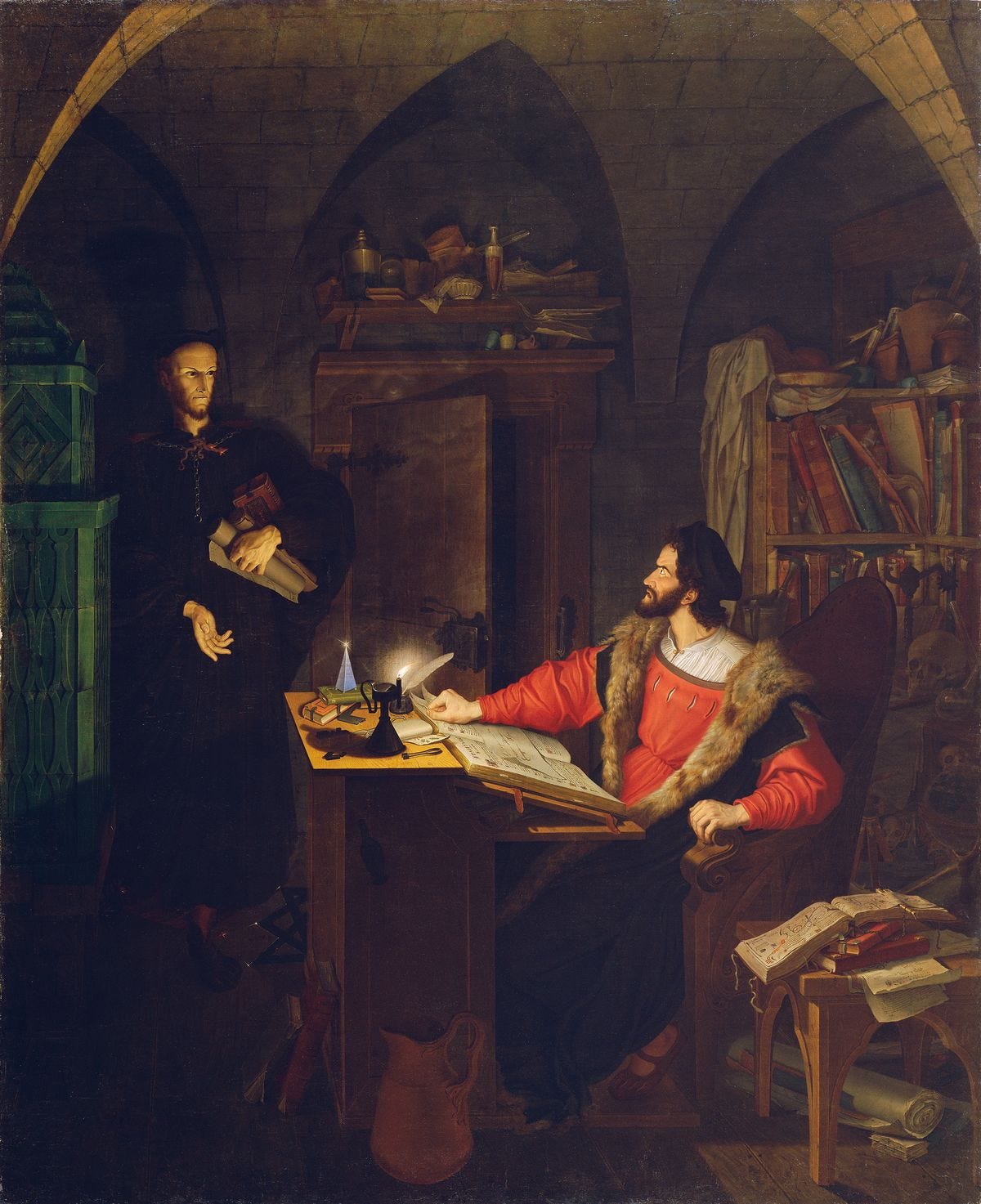
He was translating the Bible — and mistranslated a key passage, John 1:1, which traditionally reads:
“In the beginning was the Word.”
In the original Greek, “Word” is translated as Logos — divine order, the intelligence of reality, natural law, and the guide to living a good life. Traditionally, this meant true life is found by knowing and loving the Logos.
Faust, however, renders it differently:
“In the beginning was the deed.”
That single line explains the entirety of his misery.
Faust is unhappy because he lives in a world without Logos — a world with no truth, good, nor evil — and therefore no ultimate meaning.
Instead of Logos, life becomes mere action. For Goethe, meaning is not discovered, but created through striving.
Thus Goethe suggests Faust’s life is “meaningful” only because he strove, even in unhappiness. In this view, a world without religion is a world without truth, good, or evil. There is no “good” life, only a life to be lived — filled as fully as possible through creative action.
This is the heart of Faust’s despair, and of modern man’s spiritual crisis: life reduced to meaningless action, an endless striving meant only to distract from the misery of being.
Such a worldview has dire consequences, but also hints at the true solution.
Rediscovering Logos
The dire consequences of Faust’s philosophy are clear. His life is morally gray, even condemnable, yet it cannot be called “evil,” for Goethe’s rejection of logos means that he denies evil exists.
Though he may speak of “evil,” or depict guilt in Faust, the reality is that a world without logos is a world without morality.
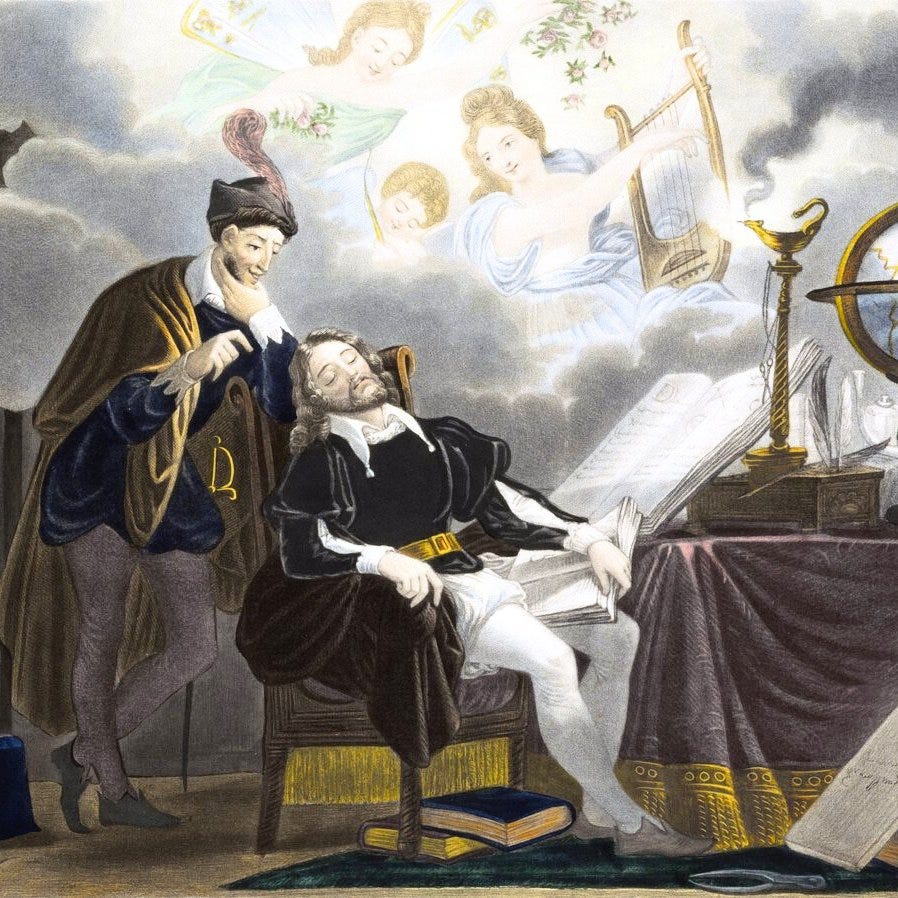
Thus Faust’s atrocities like ruining Gretchen, or causing the death of innocent bystanders are dismissed as “errors in judgment,” rather than acts of evil. In such a world, “anything is permitted,” and yet this unlimited freedom leaves Faust miserable.
The solution, though not offered by the play, lies in correcting Faust’s mistranslation:
“In the beginning was the deed.”
Faust must rediscover that the Word — the Logos — exists. Goethe shows that life without good, evil, and Truth collapses into despair. Like Faust, modern man may chase wealth, sex, power, or pleasure, but all roads end the same: an unsatisfied life and dread of death.
To rediscover the Logos is to embrace humility — to admit that life is not about personal happiness but about loving Truth. It means acknowledging that Truth exists, is greater than us, and demands our submission.
The paradox is that only in such submission — the forgetfulness of one’s happiness — can true happiness be found. For modern man to find himself, he must lose himself. His motto is not to embrace “the deed,” nor to “live his truth,” but to love the Truth.
This love is stubbornly ancient, yet it alone promises not just happiness, but a hopeful, meaningful future.
I am 100% reader-supported. This newsletter is free, but if you’re able to support, please consider a paid membership — it helps my mission of sharing Truth, Beauty and Goodness with maximal reach
As a paid member, you’ll get:
Two full essays a week
Access to all recordings (past & future) of my Great Books lectures on this publication
Eternal gratitude from me
Awesome!