

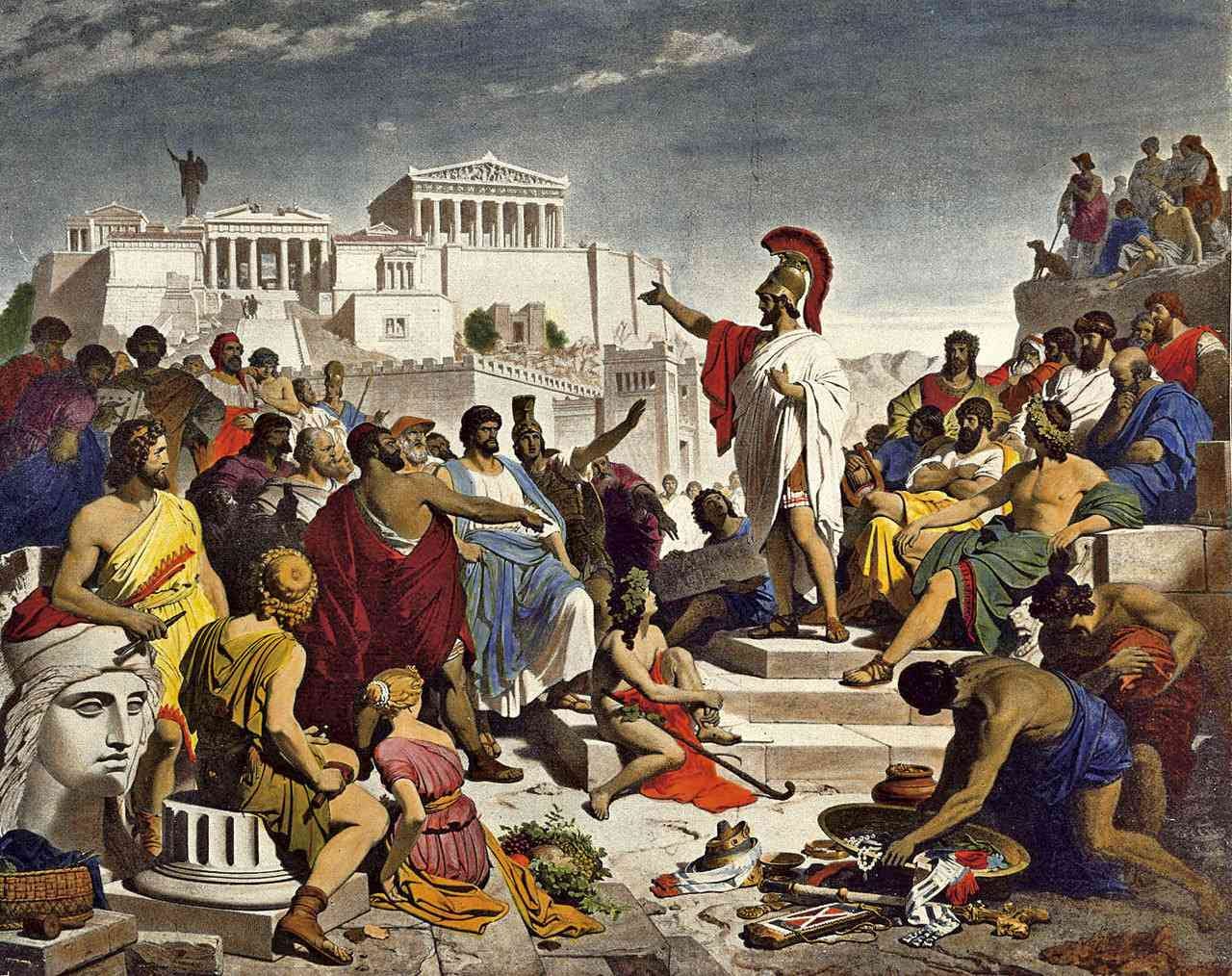
Pericles’ Funeral Oration is amongst the greatest, and perhaps most overlooked, speeches in human history.
It was delivered on the eve of the Peloppensian War — right before Athens and Sparta would engage in a grueling, bloody, decades long conflict for dominance over the Mediterranean.
But this speech’s relevance amounts to much more than a mere motivating war cry. In totality, it’s a revolutionary dialogue that reveals an important truth about human nature, and what happens when mankind tries to deify politics in place of the divine.
In short, what happens to mankind when politics becomes the new religion?
What follows, then, is a timeless warning: that the worship of the state leads ultimately to the destruction of the polis, and that Pericles’ speech even gestures toward an ancient warning first found in Scripture itself.
I offer private mentorship in the Great Books for those seeking clarity of vision and depth of soul. Inquire here.
If you’d like to support this work and receive future writings, you can subscribe below.
In Praise of Greatness
Pericles’ Funeral Oration is distinct in that he gives an emphatic praise of the city of Athens itself.
Recall first, that the Athenian culture is in stark contrast to Sparta. The Spartans were a militant, pious, traditional people who celebrated action, warfare, and courage above all. The Athenians, by contrast, were democratic, cultured, and philosophic.
In a sense, this war was a conflict of word (logos) vs deed (ergon). The mindful Athenians vs the muscular Spartans.
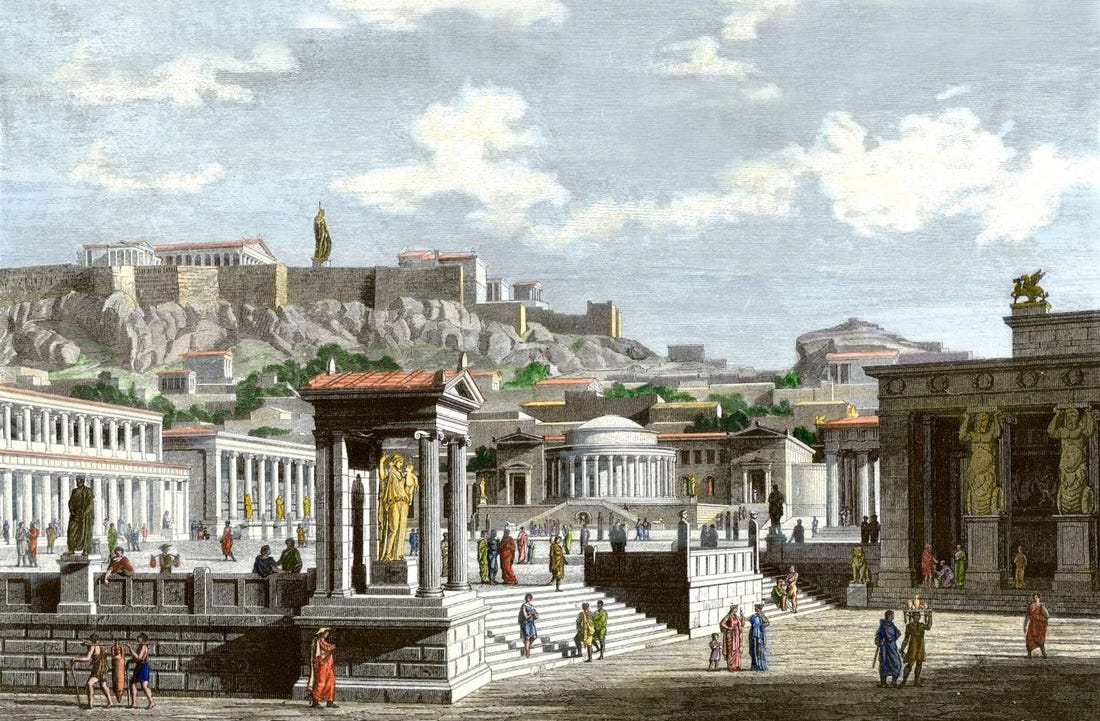
Pericles then, praises Athens’ brilliance in mind:
“Our strength lies… in that knowledge which is gained by discussion preparatory to action. For we have a peculiar power of thinking before we act, and of acting, too, whereas other men are courageous from ignorance but hesitate upon reflection.”
This “mind,” is not just a reference to philosophy, education, and culture — but technology too. Athens had a dominant navy and scientific culture. Their technical mastery is what enabled them to have a strong navy, become a maritime powerhouse, and expand their empire throughout the Mediterranean.
In fact, Pericles even goes on to call Athens the “school of Hellas,” or the cultural, intellectual hub of all Greece. And if you think that sounds prideful, it’s just the beginning.
Pericles’ most jarring claim is what follows:
“We shall not need the praises of Homer or of any other panegyrist whose poetry may please for the moment, although his representation of the facts will not bear the light of day. For we have compelled every land and every sea to open a path for our valor, and have everywhere planted eternal memorials of our friendship and of our enmity.”
This rejection of Homer could not be more radical. Recall that in Athens, for centuries, Homer was the poet who grounded all education. The meaning of life in Ancient Greece was about seeking immortal glory (kleos) through honorable deeds in which poets could deify your name.
Now Pericles says, “we don’t need Homer anymore, Athens shall be our immortal glory.”
In other words, he has deified the polis. Politics is the new religion, for Athenians can be assured of immortality by expansion, servitude, and exaltation of their empire.
And believe it or not, Pericles was proven correct.
The Athenian Golden Age
This might sound strange at first — the oldest warning in literature is do not worship earthly things. Piety is giving due reverence to the gods, and the worship of worldly things is idolatry.
Yet, one has to give Pericles his due:
Athens was amongst the highest, greatest, and most cultivated civilizations in human history at the time, and it came precisely due to civic pride in their own polis.
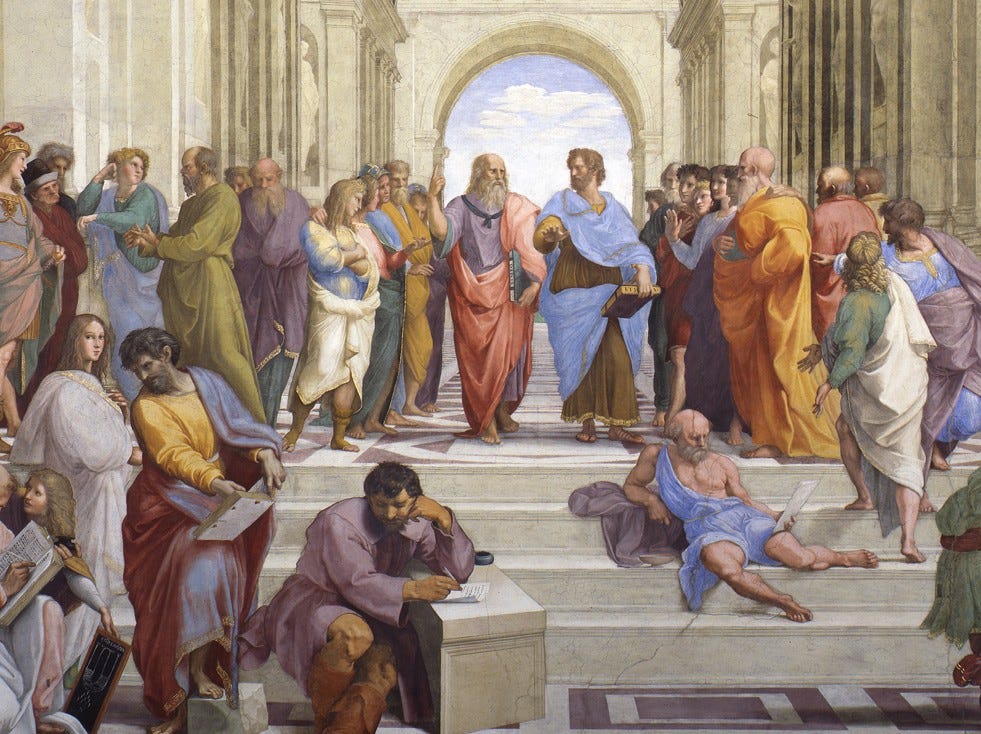
Recall Pericles’ days were the historic golden age of Athens. It was this precise era of polis worship that birthed the likes of Socrates, Plato, and Aristotle, along with the legendary tragedians of Aeschylus, Sophocles, and Euripides, and the comic playwright Aristophanes.
Beyond the arts — science and mathematics saw expansion through the likes of the Pythagoreans and later Aristotle — and Athens was made incredibly wealthy through its navy and expansion.
In other words, one of the greatest, most beautiful, and intellectually sophisticated civilizations to have ever existed in history, was a civilization birthed out of a civic pride that deified its own political and empire-centric ambitions.
And yet, Athens’ history is more than a two-dimensional celebration of glory.
Its greatness carried within it the principle of its own undoing. The city did not fall by chance, but according to a pattern older than history itself — a pattern first articulated in the opening pages of Scripture.
What follows is that pattern, and how it came to be fulfilled in the fall of the greatest civilization of early antiquity.
