

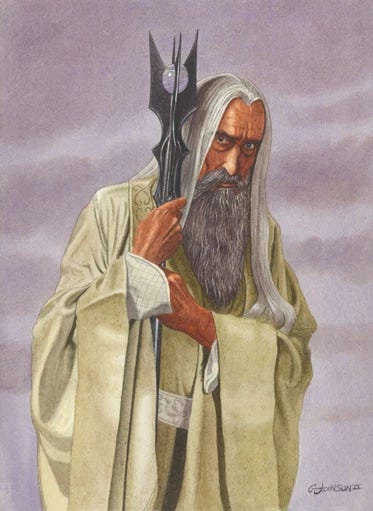
As we discussed last week, the Scouring of the Shire is the most important but overlooked chapter of Lord of the Rings.
Tolkien called it essential to understanding the full story, but few fans fully appreciate it because the chapter was omitted from the movies.
The Scouring of the Shire is famous for its political prophecies that are coming true in real time in England — but the deepest message of this chapter actually transcends politics itself.
To fully appreciate Tolkien’s genius, we have to understand Frodo’s crucial faceoff with the last standing villain of Middle Earth — the evil wizard Saruman.
Saruman’s last stand offers us a masterclass in Tolkien’s pedagogical vision of grace and mercy as the only true solutions to tyranny and human depravity. When you understand this vision, you understand the fullness of the LOTR trilogy — why Frodo was chosen, why the fellowship failed, why Boromir and Denethor died, and why the ring had to be destroyed instead of weaponized.
Today then, we’ll revisit the Scouring of the Shire to analyze Frodo’s final faceoff with Saruman, and Tolkien’s ultimate doctrine of mercy.
I offer private mentorship in the Great Books for those seeking clarity of vision and depth of soul. Inquire here.
If you’d like to support this work and receive future writings, you can subscribe below.
An Unhappy Homecoming
As a reminder, the Scouring of the Shire takes place after Sauron has already been defeated.
Frodo and his friends return home victorious, but find their homeland in shambles. The Shire has been ravaged with industrialization, and ruffians have overrun the country. They’re led by Saruman who rules with an iron fist.
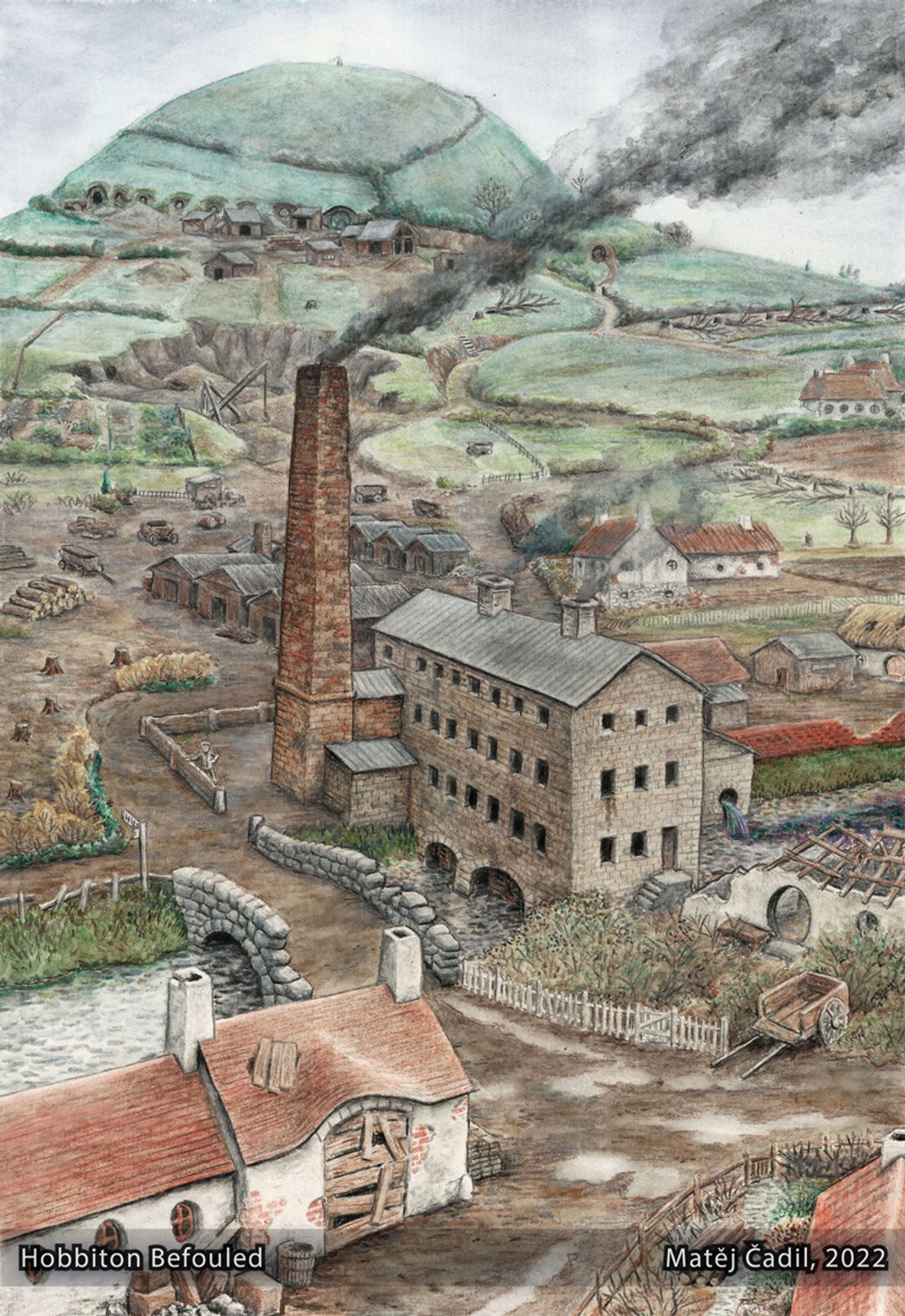
Though the situation appears dire, this scene is ultimately an anticlimax:
Frodo and his friends rally the masses, and defeat Saruman’s forces with ease at the Battle of Bywater.
But, it’s not the battle that matters, rather it’s the final conversation Frodo has with a newly defeated Saruman.
It’s this simple exchange that is perhaps the final and fullest triumph of Tolkien’s grace triumphing over evil.
The Tyrant’s Last Battle
This exchange takes place in the Shire, as a defeated Saruman is surrounded by Frodo and his army.
Though he’s defeated, he is not without his wits, deceit, and treachery, which can prove fatal if the hobbits are not careful.
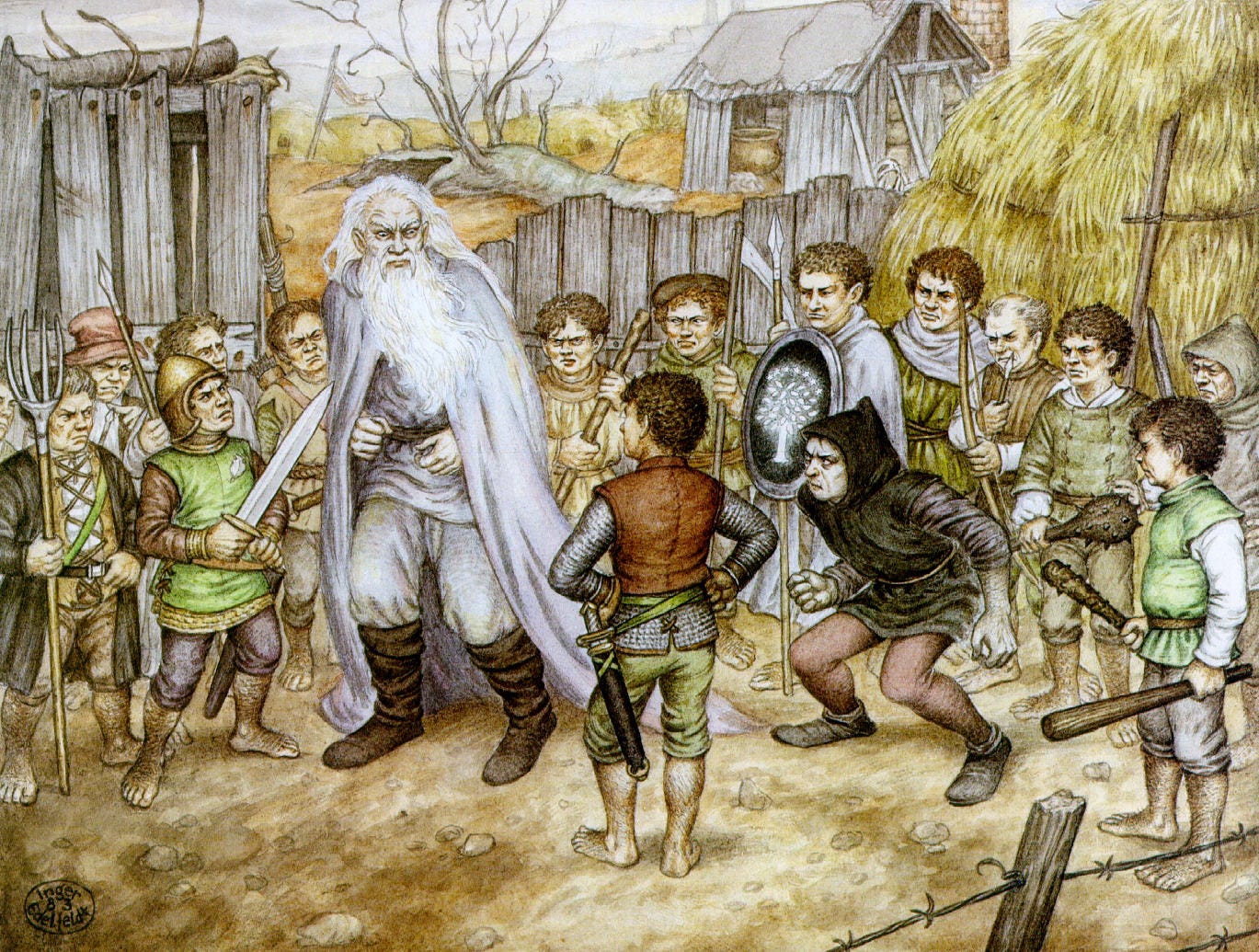
Before we get to the exchange, let’s analyze Saruman’s motive for sacking the Shire.
It may come as a surprise at first, for his plot to rule the Shire appears desperate compared to the Saruman of old. Recall that one book ago, he was a powerful wizard vying to usurp the throne of dark Lord Sauron himself. By comparison, Scouring the Shire appears like a pitiful power grab… except Saruman wasn’t pursuing power at all.
His true motive for tyranny is, frankly, embarrassing:
“I have already done much [damage] that you will find it hard to mend or undo in your lives, and it will be pleasant to think of that and set it against my injuries”
It’s truly a pitiful utterance. Recall Saruman’s true form was a maia (angel), sent by God himself to help bring grace to Middle Earth. Not only did he betray his divinely ordained mission, but he fundamentally destroyed his soul. In addition to losing his powers, his life has resorted to a petty mission of revenge against Hobbits.
Frodo himself acknowledge’s Saruman’s humiliation:
“Well if that is what you find pleasure in, I pity you… go at once and never return!”
These words are surprising. Frodo and the Hobbits have every right to administer capital punishment, and yet Frodo lets him walk free. The hobbits, however, disagree. They shout Frodo down and begin chanting “kill him!”
Saruman mocks them in turn:
“Kill him! Kill him! If you think there are enough of you, my brave hobbits…
Whoever strikes me shall be accursed. And if my blood stains the Shire, it shall wither, and never again be healed!”
Notice how Saruman mimics Biblical Cain — the exiled murderer, forced to wander Middle Earth aimlessly, vows divine punishment to any who strikes him down. The connection exemplifies that Saruman’s soul — if not irredeemable — is about as close to purely corrupt as possible.
Yet still, Frodo calls for mercy:
“Do not believe him, he has lost all power, save his voice which can still daunt you, and deceive you, if you let it. But I will not have him slain. It is useless to meet revenge with revenge. It will heal nothing. Go Saruman, by the speediest way”
This might sound jarring at first. Saruman has attempted to enslave an entire people out of malice. He’s done nothing to warrant mercy nor repentance. Politically speaking, Frodo’s mercy is perhaps the most foolish and naive decision that a statesman can make.
The catch, however, is that Tolkien is not writing this passage as a political exhortation. He’s not saying that all statesmen should radically forgive crime. The message of this passage is actually a teaching on the doctrines of justice and mercy, namely:
True mercy is a grace that even presupposes the nature of justice itself.
Mercy can only be offered to one who commits an injustice, and therefore deserves punishment. Frodo and company were in the right to hang Saruman if they desired, but Frodo withholds the very justice that Saruman deserves — as an act of genuine pity for one who wishes goodness to an enemy that does not deserve it.
This might sound soft, or sentimental — and it would be if the story ended here — but it doesn’t…
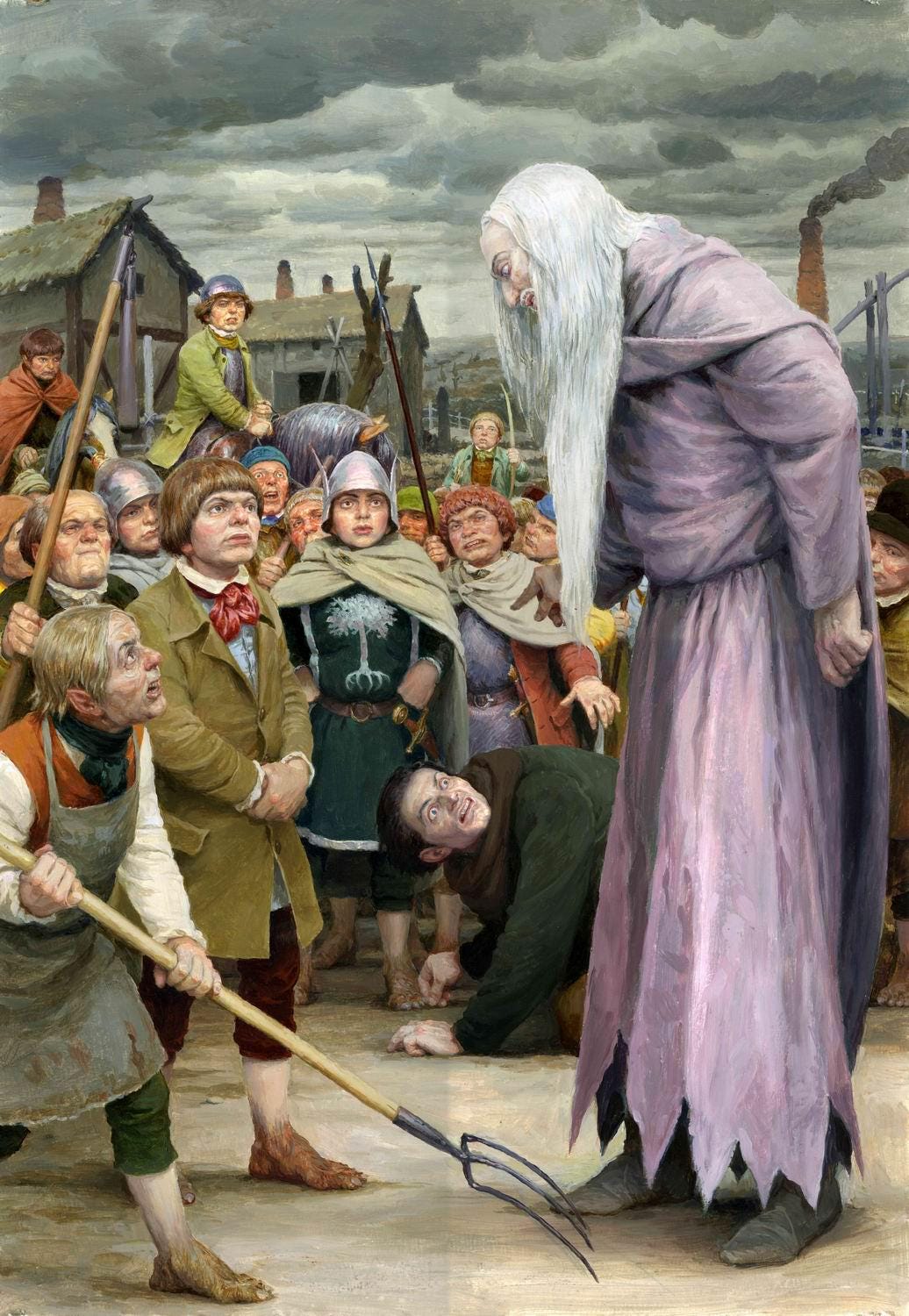
Saruman is given a free escape, and you would rationally think he would take it — to run with his life in joy, live to fight another day, and perhaps commit more grave evils.
Yet Saruman’s reaction to Frodo’s mercy is anything but rational.
Instead, he glares with rage and a heart of wrath, clutching at a sword beneath his cloak.
What follows is not only the unexpected demise of Saruman, but a jarring glimpse into the true nature of evil — and Tolkien’s only solution to defeating such depravity without getting corrupted yourself…
