

You can’t fully appreciate the genius of The Lord of the Rings without a proper understanding of The Silmarillion — Tolkien’s prequel that includes the thousands of years of history, cosmology, and theology preceding the events of Frodo and the Ring.
And though such a read sounds daunting, given the thoroughness of Tolkien’s writing, there is one story that speaks to the heart and soul of Middle-earth’s beauty and Tolkien’s underlying genius.
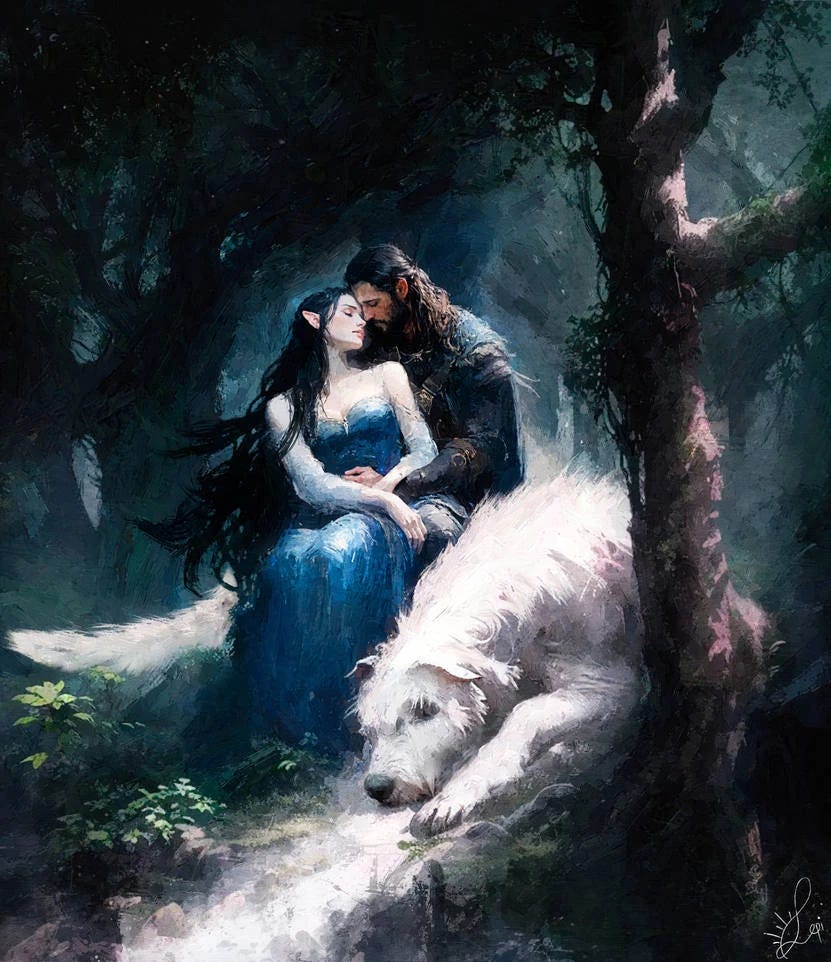
That story is the tale of Beren and Lúthien. On the surface, this is a love story between Beren, a mortal man, and Lúthien, an immortal Elf — though its ultimate meaning transcends romantic love.
In Tolkien’s own words:
“The chief of the stories of the Silmarillion, and the one most fully treated, is the story of Beren and Lúthien the Elfmaiden.”
In fact, this story was so central that Tolkien inscribed the name Lúthien on his wife’s tombstone after she passed, for she was his muse and lifelong inspiration. He would later have Beren inscribed on his own.
But why exactly is this obscure love story the central story of Middle-earth?
This is precisely what we’ll uncover today, to understand the core roots of Tolkien’s inspiration, genius, and message of love’s triumph over the demonic forces of his cosmos…
I am 100% reader-supported. This newsletter is free, but if you’re able to support, please consider a paid membership — it helps my mission of sharing Truth, Beauty and Goodness with maximal reach
As a paid member, you’ll get:
Two full essays a week
Access to all recordings (past & future) of my Great Books lectures on this publication
Eternal gratitude from me
The Mortal Outlaw
We of course don’t have time to cover the entire mythology of Middle-earth here, but we can begin with some high-level narrative context:
The tale of Beren and Lúthien is set a few thousand years before the plot of The Lord of the Rings.
At this point, the Dark Lord Morgoth (the Satanic figure of Tolkien’s world) has continued his long rebellion against Eru Ilúvatar (the God of this universe), seeking to dominate and corrupt His creation.
We first meet Beren, a mortal man and son of a royal lineage, although his life is marked by tragedy — Morgoth has murdered his father and many of his dear friends. As such, Beren is forced into a painful exile as he wanders Middle-earth.
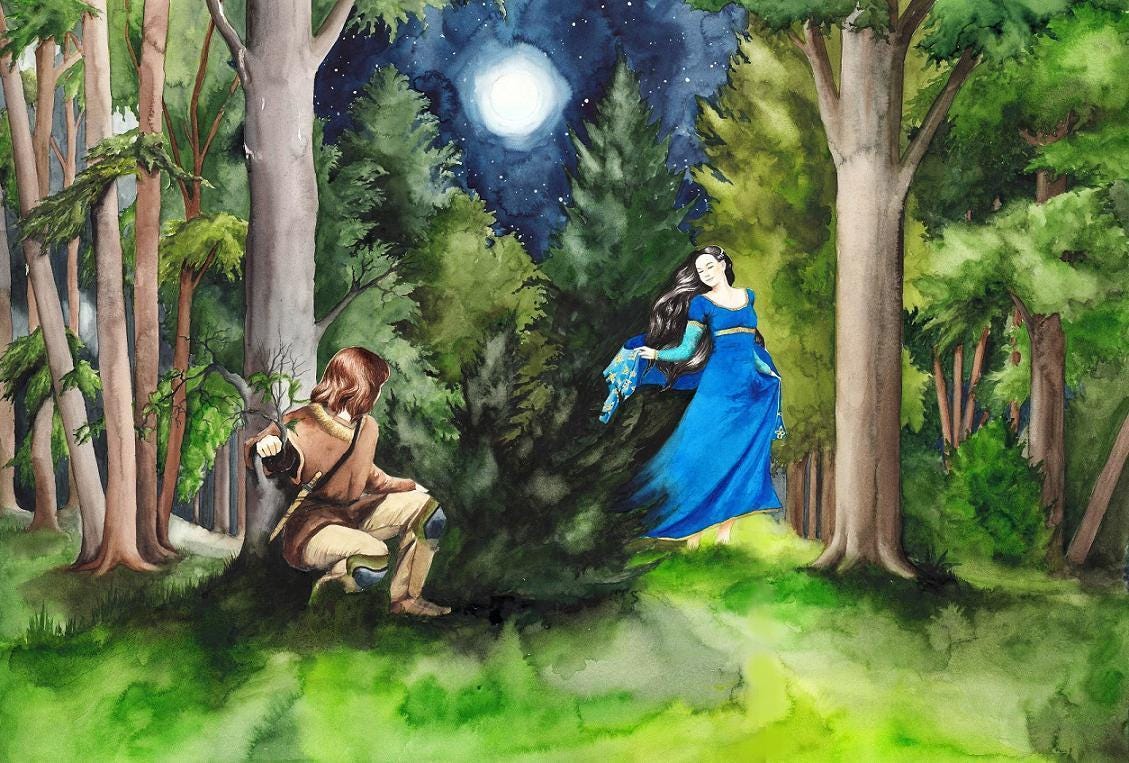
Yet one day, his travels take him to the forest of Neldoreth, where his eyes fall upon a beautiful Elvish maiden named Lúthien:
“Then all memory of his pain departed from him, and he fell into an enchantment; for Lúthien was the most beautiful of all the Children of Ilúvatar. Blue was her raiment as the unclouded heaven, but her eyes were grey as the starlit evening; her mantle was sewn with golden flowers, but her hair was dark as the shadows of twilight…
Suddenly she began to sing. Keen, heart-piercing was her song as the song of the lark that rises from the gates of night and pours its voice among the dying stars, seeing the sun behind the walls of the world; and the song of Lúthien released the bonds of winter, and the frozen waters spoke, and flowers sprang from the cold earth where her feet had passed.”
Notice the nature of Lúthien’s beauty. Indeed, her appearance is aesthetically pleasing, but her allure is not merely physical or erotic. Notice that her countenance draws comparison to nature and its beautification, and that her voice has an enchanting quality, as if “releasing the bonds of winter” in favor of a life-affirming spring.
Her grace makes the “memory of [Beren’s] pain” depart from him — her beauty is intertwined with a grace affirming the benevolence of life itself. Indeed, her beauty is not merely something that pleases the observer, but something that reveals the goodness and vitality of creation.
And this is the precise beauty which Beren falls in love with.
In fact, he accounts it so dear that he’d be willing to sacrifice anything in devotion to her…
Thingol’s Death Sentence
Thankfully, Lúthien reciprocates Beren’s love for her, and the two begin meeting in secret. Soon, however, they are spotted and delivered to Thingol — Lúthien’s father and king of the Elves.
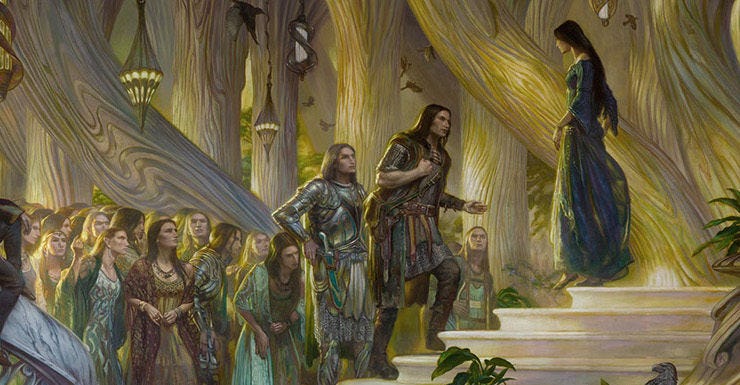
The king is enraged that a mortal man would court his daughter, though Beren stands firm in his love for her. Thus, the king makes a deal with him:
Bring me one of the Silmarils from Morgoth’s crown, and you can marry my daughter.
This is effectively a death sentence — for countless warriors, Dwarves, Elves, and even armies have fallen in pursuit of these Silmarils. The idea of a mortal man attaining one is suicide.
And yet Beren remains unfazed:
“’For little price,’ he said, ‘do Elven-kings sell their daughters: for gems, and things made by craft. But if this be your will, Thingol, I will perform it.’”
His confidence, however, is perhaps little warranted — after recruiting a party of ten Elves for the mission, they’re promptly captured by Sauron (who, for now, is merely Morgoth’s lieutenant, rather than the Dark Lord).
None of the party betray their mission, despite interrogation, although Sauron begins feeding them to his werewolves one by one.
And it’s here, from afar, where the love of Lúthien will once again rise up…
Facing Down Sauron
Lúthien, sensing Beren’s danger, sneaks out of her forest and travels to Tol-in-Gaurhoth, Sauron’s Isle of Werewolves, with the help of a noble hound named Huan.
Her entrance is noteworthy:
“Lúthien came, and standing upon the bridge that led to Sauron’s isle she sang a song that no walls of stone could hinder.
Beren heard, and he thought that he dreamed; for the stars shone above him, and in the trees nightingales were singing. And in answer he sang a song of challenge that he had made in praise of the Seven Stars, the Sickle of the Valar that Varda hung above the North as a sign for the fall of Morgoth. Then all strength left him and he fell down into darkness.
But Lúthien heard his answering voice, and she sang then a song of greater power. The wolves howled, and the isle trembled.”
Notice again how Tolkien emphasizes the spiritual domain of Beren and Lúthien’s love. Lúthien’s singing possesses a heavenly quality that makes this island of evil tremble.
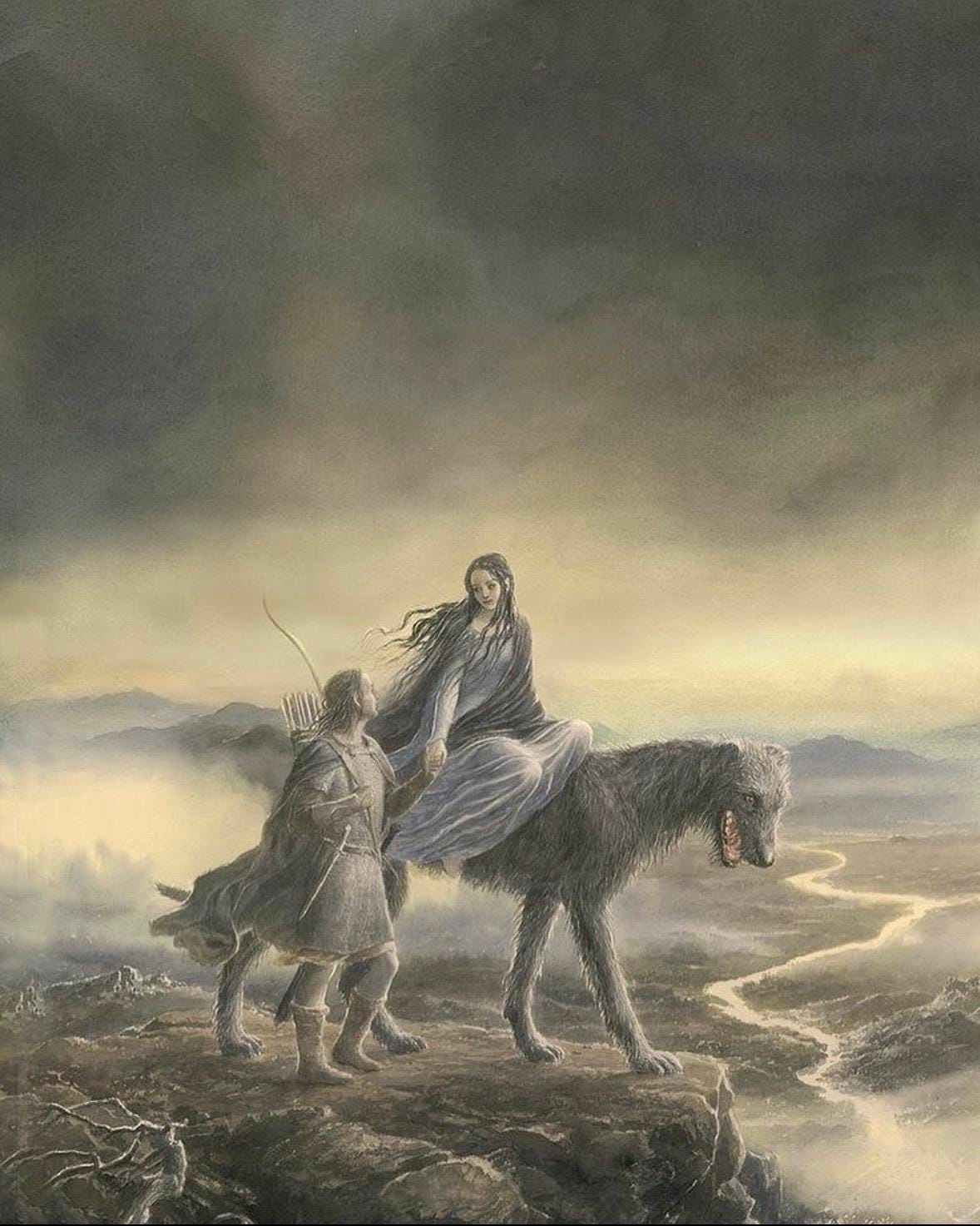
Notably, Huan the Hound will dispatch the wolves, and ultimately Sauron himself, but he does so aided by Lúthien’s singing. We see now a theological principle emerging from Beren and Lúthien’s love:
A grace that doesn’t just bond the two towards each other in vows of self-sacrificial goodness — but a bond that mediates a light that makes even the harrowing hordes of evil tremble in fear.
Here, in perhaps a bit of foreshadowing, Sauron is conquered not through superior force, but through a providential goodness working through the seemingly humble and lowly; a microcosm of a greater eucatastrophe to come…
And now, with Beren freed, the two lovers will march onto the very steps of Morgoth’s palace.
What follows is not merely their daring attempt to steal a Silmaril, but a revelation of the single truth that animates the entire cosmos and soul of Tolkien’s mythology…
