

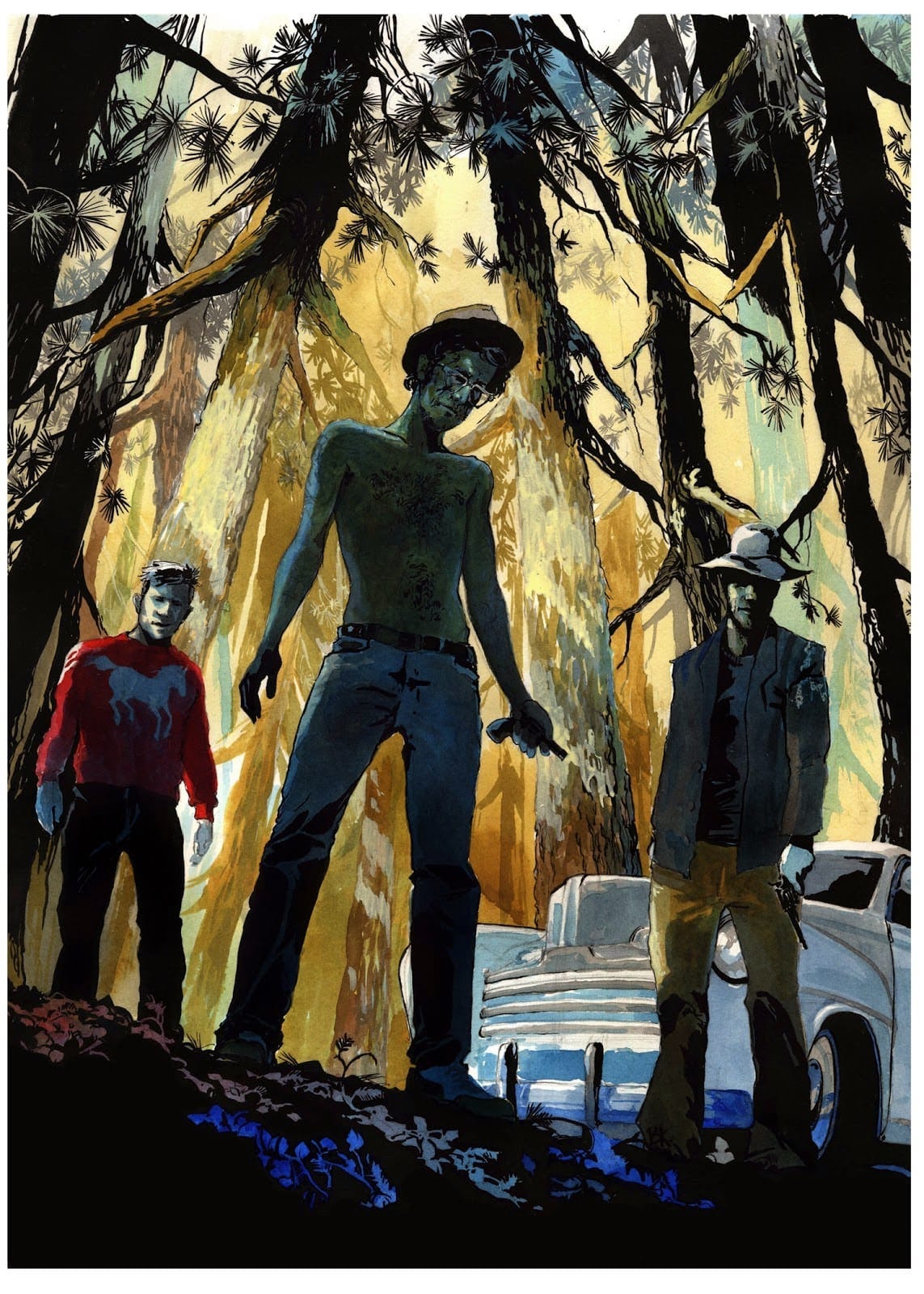
Flannery O’Connor is one of the greatest writers of the American South, and A Good Man Is Hard to Find is her masterpiece.
A staunch Christian, she wrote in the mid-twentieth century about a “Christ-haunted” South: a world where Christ was still a known name, but no longer a living faith embraced by its people.
Thus her writing embraced the grotesque — she used horror and violence to show how far the South had fallen, and hoped to remind the secular modern man of the grace he had lost.
A Good Man runs on this framework perfectly. It follows a family’s road trip from Atlanta to Florida, which ends in catastrophe as they come face to face with three escaped convicts wanted for murder.
What follows is a desperate attempt to plea for their lives, and a question of whether or not grace can crack the hardened heart of modern man…
I am 100% reader-supported. This newsletter is free, but if you’re able to support, please consider a paid membership — it helps my mission of sharing Truth, Beauty and Goodness with maximal reach
As a paid member, you’ll get:
Two full essays a week
Access to all recordings (past & future) of my Great Books lectures on this publication
Eternal gratitude from me
An Unhappy Family
The family consists of the grandmother, her son Bailey, his wife, and their two children. The grandmother doesn’t want to go to Florida; she’d rather visit relatives in Tennessee. As a pretext, she warns of “the Misfit,” an escaped convict reportedly headed that way.
The opening lines show her to be selfish and manipulative. The rest of the family is no better — Bailey is sullen, the mother is apathetic, and the children undisciplined brats. This register is negative, but it’s O’Connor’s medium: spiritually impoverished men and women, embroiled in worldly affairs, and bitter for it.
We know the grandmother best, and she is vain and self-sufficient. This vanity is best expressed on the day of the road trip, in which she dresses up in her finest clothes.
Why exactly?
The narrator affirms:
“In case of an accident, anyone seeing her dead on the highway would know at once that she was a lady.”
Even facing death, the grandmother’s chief concern is her appearance: to be seen as genteel, even by strangers. This is pride, the precise “spiritual illness” O’Connor saw in the South, and she believed only the grotesque and the violent could shake a man from it.
A Minor Accident…
The trip is banal and tedious. The mother sleeps, Bailey drives in bitter silence, and the grandmother rambles.

After a stop for sandwiches, the family passes near Toombsboro, where the grandmother recalls an old plantation house she wants to see again. She knows Bailey won’t oblige, so she lies again:
The house has a “secret panel” where the family silver was hidden from Sherman.
The children kick and scream at this lie, demanding to visit, until Bailey relents. He follows the Grandmother’s directions, travelling upon an obscure dirt road.
Unfortunately, a horrible thought crosses the grandmother’s mind — the house is in Tennessee, not Georgia. She jerks upright, upsets her valise, and the cat she smuggled into the car against Bailey’s wishes springs onto his shoulder. It claws into his neck, and the car crashes into a ditch…
Meet the Misfits
Everyone survives, the mother worst with a broken shoulder.
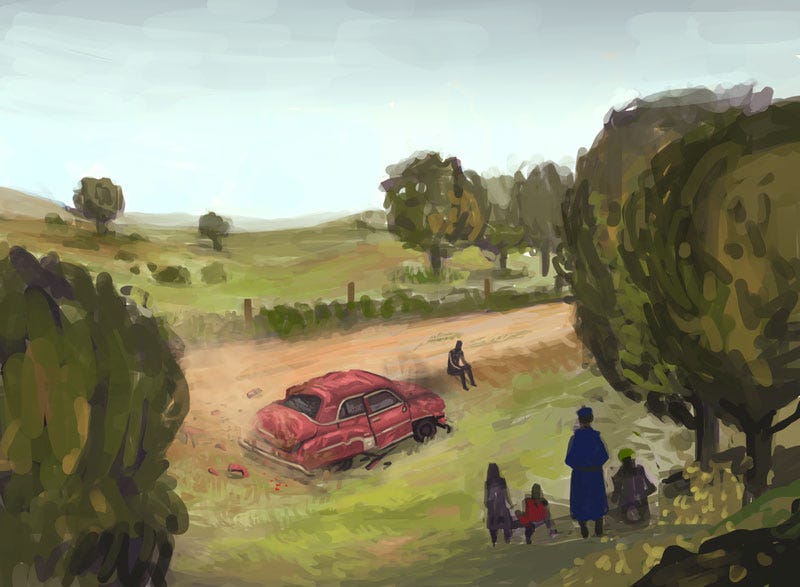
After the family gathers themselves, another car appears, approaching slowly, as if the occupants were watching all along. Upon pulling over, three armed men emerge from the car, and the grandmother recognizes the driver:
“’You’re The Misfit!’ she said. ‘I recognized you at once!’
‘Yes’m,’ the man said, smiling slightly as if he were pleased in spite of himself to be known, ‘but it would have been better for all of you, lady, if you hadn’t of reckernized me.’”
Unfortunately, her vanity about “being right,” may have sealed her family’s doom. His identity is compromised, and they may have to die.
What follows next is a series of bargains from the grandmother. First, she pathetically appeals to what she values most, namely class and propriety:
“I know you’re a good man. You don’t look a bit like you have common blood.”
Just as she wants the world to recognize her as a lady, she assumes he’ll respond kindly to being called a gentleman… but he doesn’t.
Instead, the Misfit sends Bailey and his son into the woods. The once sullen Bailey leaves parting words of assurance to his mother:
“I’ll be back in a minute, Mamma, wait on me!”
Moments later, shots ring out in the woods, and only the Misfit’s minions return.
The Grandmother’s pleas continue. After offering money, which the Misfit rejects, she appeals to faith:
“If you would pray,” she says, “Jesus would help you.”
“I don’t want no hep,” he answers. “I’m doing all right by myself.”
It’s at this moment that despair begins setting in. For perhaps the first time in the grandmother’s life, her suffering cracks through her worldly pretensions:
“Alone with The Misfit, the grandmother found that she had lost her voice. There was not a cloud in the sky nor any sun. There was nothing around her but woods. She wanted to tell him that he must pray. She opened and closed her mouth several times before anything came out. Finally she found herself saying, “Jesus. Jesus,” meaning, Jesus will help you, but the way she was saying it, it sounded as if she might be cursing.”
Surprisingly, it’s here, when the Grandmother curses the name of Jesus, that she finally breaks through to the Misfit.
A certain snarl comes over his face, and he reveals the roots of his faithlessness, his evils, and why he cannot bear the reality of the Cross…
