

I have a love hate relationship with Twitter/X.
It’s long been lamented (correctly) as a cesspool where all civility goes to die, and human wrath runs amok in a variety of facets like a thousand headed hydra. My mental well-being improved ten-fold when I made the executive decision to stop posting there regularly.
But I feel an immense gratitude to Twitter as well. That platform marked the beginning of my, “online career.” When I began posting in early 2024, Twitter was a far more robust platform for writers and thinkers. I found a medium where I could write a thoughtful longform post about Dostoevsky, CS Lewis, or Aristotle and garner millions of views.
Even better were the mutuals I came across. There was a niche community of accounts that shared my passions for theology, philosophy and the great books. I hosted weekly spaces (audio only livestreams) where we connected, bonded, and pontificated about the greatest minds and thinkers in Western History — and grew substantive audiences around this shared love of virtue. The point being, Twitter is a unique platform that hosts genuinely brilliant scholars and thinkers, and provides sound discourse that you won’t find anywhere else online.
And yet, this intellectual hub I so appreciate is also a double-edged sword.
Despite my praise above, there is also a disturbing trend of pseudo-intellectualism — of anonymous writers who proudly champion blatantly incorrect “hot takes,” on philosophy, theology, and literature, often at the expense and mockery of the “normies,” (normal, generally well-adjusted people). These posts go viral with acclaim despite the fact they can be debunked with a minimal effort.
The real problem, however, is not the “misinformation” of the hot take, but the pathology that develops in the pseudo-intellectual and his followers:
Namely, the cultivation of a vainglorious mind that is proudly incorrect while believing itself to be an aristocratic free thinker, superior to its fellow man.
And if this is the case, I reckon it’s a brain rot far more pernicious than even the vilest of tik-tok slop video trends.
Today then, I’m going to reflect on this trend of “Twitter brainrot,” what it looks like, how to spot it, and how to reasonably use social media without it ruining your intellect.
I am 100% reader-supported. This newsletter is free, but if you’re able to support, please consider a paid membership — it helps my mission of sharing Truth, Beauty and Goodness with maximal reach
As a paid member, you’ll get:
Two full essays a week
Access to all recordings (past & future) of my Great Books lectures on this publication
Eternal gratitude from me
On the Pseudo-Intellectual
For brevity, we’ll simply define twitter’s brainrot as pseudo-intellectual brainrot.
I would define this as a hot-take that takes a legitimate intellectual authority and uses it as a credential for a provocative claim, while offering the reader the emotional thrill of possessing “hidden knowledge,” without actually requiring them to understand the underlying subject.
When you come across one of these posts, you get the emotional rush of feeling like you’re in “the inside crowd,” discovering a hot secret that the “normies,” don’t know.
Below is a prime example:
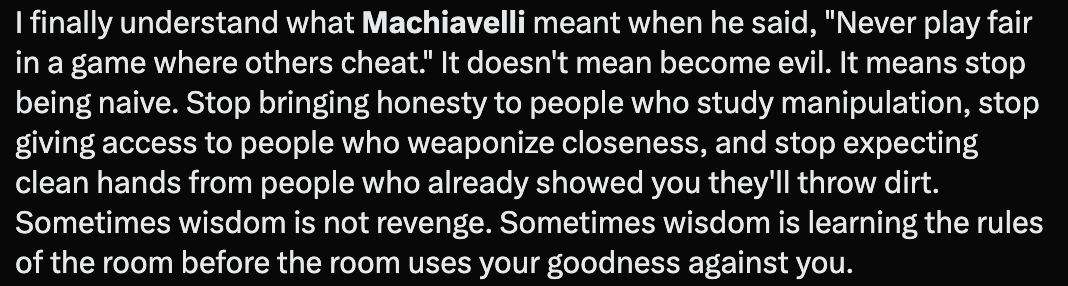
This tweet went viral with acclaim, nearing 1 million impressions and over 30k likes. The internet raved over it as a brilliant take on Machiavelli that gives you true wisdom to operate on the real world.
But there are some problems with this post:
Machiavelli almost certainly never said this (I would reckon at best it’s a paraphrase, of a paraphrase, of a paraphrase)
Even if it were a viable quote, the content itself is so vague it cannot be traced to any tangible lesson from Machiavelli
This post’s staccato-centric rhythm is eerily similar to AI’s writing cadence
This post is a word for word repost that has appeared from dozens of other accounts across platforms (a blatantly unoriginal rip off shared for virality, rather than authentic intellectual substance)
In other words, this particular post represents the trend of the current pseudo-intellectual brain rot trend on twitter:
An endless stream of fabricated, nonsensical content, that gets passed off as intellectually poignant, giving its consumers the “feeling,” of education whilst gaining nothing but a faulty perception of the actual thinker at hand.
Now I chose the above example as a blatantly obvious example of pseudo-intellectualism, but we can grant that such a post may not be all that pernicious — in this case, a couple hundred thousand people enjoyed some vague AI jargon, gave it a like, and kept it moving.
But now I want to add an example that shows where this pseudo-intellectualism can become dangerous.
The Dangers of Intellectual Vanity
I saw a recent post go viral on twitter where a user lamented the difficulty about Christ’s exhortation to “love your enemy.”
They joked that they “read 7 different translations, including the original Greek,” to make sure they understood the commandment correctly, and were frustrated by the unfortunate reality that, indeed, they must love their enemy.

Then, in true twitter form, an anonymous account quoted them and put them on blast in the public square.
I’m going to paraphrase rather than post a screenshot, as my article’s point goes far beyond this individual tweet. The main point is not the tweet itself (which is actually quite tame by Twitter standards), but the pathology behind accounts who frequently post like this:
“This guy read the original Greek, and still cannot distinguish between ‘polemios’ (public enemy) and ‘echthros’ (private enemy). Christ uses echthros you midwit.”
This gentleman, by appealing to the original Greek, pointed out that the “real meaning,” of Christ’s Sermon on the Mount is that love of enemy only refers to personal enemies, not public enemies. In practice, then, this grants a political argument that hatred of foreign enemies is actually permitted, if not celebrated, as a viable act of Christian virtue.
This post went viral with acclaim, to the mockery and shame of the original poster who got dog-piled by commenters for his innocuous tweet.
But there’s a problem with our gentleman’s ‘correction’: his argument is based on a quite fringe, if not outright incorrect, reading of Scripture.
The distinction he makes between polemios and echthros is real in classical Attic Greek, but the term polemios does not appear anywhere in the Greek New Testament. The New Testament’s primary term for “enemy” (be it personal, national, or cosmic alike) is echthros, including at Luke 1:71 and 74, where it’s used of Israel’s political deliverance from her national enemies (in reference to Psalm 106:10). In other words, contextual reading of echthros appears to collapse the distinction of personal and private, suggesting that Christ’s love of enemies is universal.
Furthermore, while I have no reason to believe this was intentional by the poster, his argument itself is a very close rehash of Carl Schmitt’s (the German jurist who became a prominent member of the Nazi Party), in his work The Concept of the Political. Schmitt tried to argue that the Bible's silence on politics permits a militant form of Realpolitik — which goes to show how high the stakes can become from confidently asserting even simple hermeneutic errors like the one above.
To be clear, it is absolutely permissible to make an error in public (Lord knows I’ve had plenty of gaffs myself), but to build a platform around arrogantly proclaiming (incorrect) hot takes at the expense of ‘normies’ becomes a far less forgivable (and far more dangerous) vice worthy of condemnation.
I consider this brand of Twitter-posting to be the most dangerous form of brainrot, because it gives followers the growing illusion of knowledge, and the pride of being an “insider,” when in actuality, they’re distorting their fundamental comprehension of literature, philosophy, and theology as such.
The danger for the poster who fits this type, and their followers alike, is not merely “misinformation,” but the risk of pathologizing an unearned, vainglorious, superiority complex that ironically makes one a fool. To reference Socrates in the dialogue Alcibiades I — the most shameful form of ignorance is to believe you know, when in fact, you don’t know.
The Tik-Toker at least doesn’t have any false pretensions to aristocratic superiority.
Now let’s talk about why this type of twitter brainrot exists, how to spot it, and how to resist it.
Deconstruction as True Wisdom
We might wonder why this genre of brain rot exists. On any given day, I can scroll my timeline and find dozens, if not hundreds, of tweets fitting the above genre.
It’s not the substance that makes them viral (these tweets can often be corrected or debunked with a simple google search), but the psychological thrill that wins this type of poster public acclaim.
Readers see a “hot take,” that is culturally subversive and scandalous. It’s packaged well enough to appear authoritative on the surface, but above all, readers get the rush of the “insider crowd.” You feel like one of the select few who can see through “the matrix.” You understand how reality actually works. You’re one step above the herd.
The sad reality is, you’ll find far more success in growing your platform by learning the genre of the “hot take,” that dunks on normies rather than providing nuanced dissertations on the subject matter at hand. On Twitter, you don’t have to be right, you just have to be provocative. Mock the normies to make your audience feel smart, and you’re now an authority.
So how exactly do you differentiate this genre of brainrot from genuinely sound posting?
The answer might be to reconsider Socrates’ wisdom from Alcibiades I.
Again, Socrates exhorts that the most shameful thing is to think you know when you do not.

Socrates helps Alcibiades grow wiser in this text, but not because he teaches him anything new. Instead, he deconstructs Alcibiades’ false pretensions to wisdom. By asking Alcibiades to explain justice and exposing his ignorance through cross-examination, Socrates leads him toward the beginning of genuine wisdom: namely, self-knowledge.
I bring up Alcibiades as a good framework for navigating the online world.
It’s first important to remember that there are genuinely brilliant thinkers online who can fundamentally enrich your life with their writings. Some of my favorite thinkers are those who run anonymous online twitter accounts. The goal of this post is not to advocate a blanket rejection of all online hot takes, but to learn to separate the wheat from the chaff.
I’d also like to remind you this post is specified to short-form hot takes that can be digested in 30 seconds. It’s not that long-form writing is inevitably superior, but you have more room to read, digest, and make inquiry into the validity of an argument that short form doesn’t allow for.
The best practice then, in dealing with short form hot takes, is to subject them to the same scrutiny Socrates does with any idea. If a hot take personally catches my curiosity, I try my best to debunk it by all accounts. If I find that my best efforts fail, and the general audience of commenters agree with the hot take, and even the best of an online search fails, then I’ll be willing to grant the subversive idea merit.
It’s also worth emphasizing how precious these ideas are when you discover them. When you find the anonymous poster who shares provocative ideas that sound scandalous but are in fact true, you’ve found a gem of a thinker that you ought to cherish dearly. They can do wonders for your intellectual life, and in some cases, can even transform your understanding of life’s meaning itself.
However, practically speaking, no one is going to do a cross examination of any and every hot take tweet they find. Which brings me to my conclusion that short form social media hot takes from strangers should be taken with the heaviest grain of salt, if not outright disregarded. The true cure to brain rot is to cultivate the Socratic disposition to humility, to know that you know nothing at all.
This humility, married with the aforementioned healthy skepticism, not only inoculates you from the epidemic of pseudo-intellectual brain rot, but becomes one of the ultimate bastions of living a genuinely rigorous, fulfilling, and wise intellectual life.
I am 100% reader-supported. This newsletter is free, but if you’re able to support, please consider a paid membership — it helps my mission of sharing Truth, Beauty and Goodness with maximal reach
As a paid member, you’ll get:
Two full essays a week
Access to all recordings (past & future) of my Great Books lectures on this publication
Eternal gratitude from me
Excellent piece! I recently wrote something similar on how our desire to be entertained is consuming our ability to decipher truth appropriately. I was inspired by Bonhoeffer’s “Theory of Stupidity.”
https://kimberlyacharest.substack.com/p/on-everything-as-entertainment-why
I had to get off X long ago. Loathe it!