

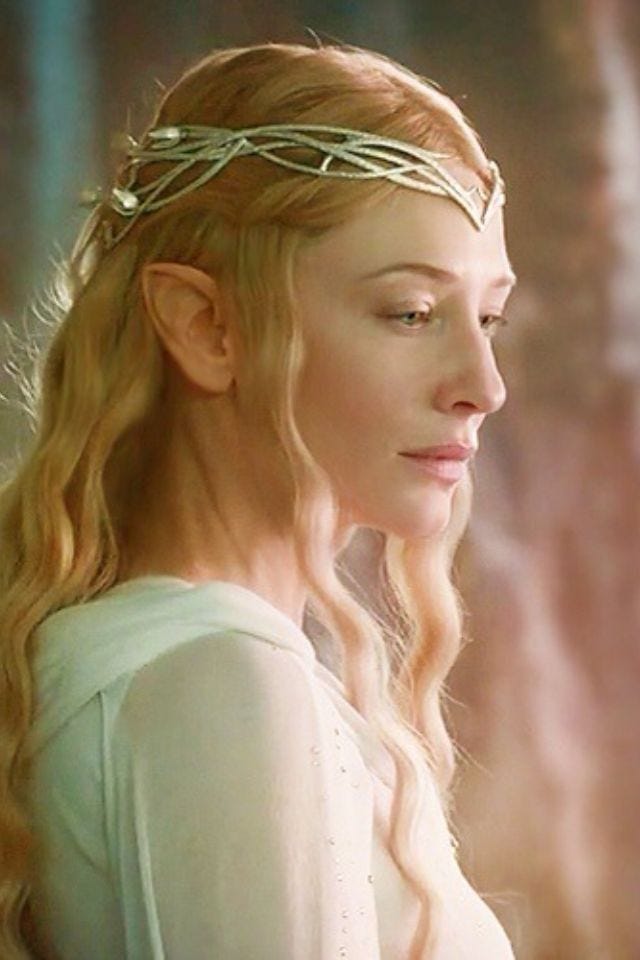
Tolkien’s Lord of the Rings is not just one of the greatest selling novels of all time, but also one of the most spiritually nourishing novels ever written.
Behind the narrative of LOTR is an entire legendarium that Tolkien spent decades building. Middle-earth’s history spans 10,000 years before Frodo, including a creation story, a creator God, a heavenly host, and a host of demons.
The “magical” feel of Middle-earth arises from this sub-creation — a fully realized mythopoeic universe underpinning the story.
Amid all this, one of Tolkien’s most profound insights comes from a brief conversation between the Fellowship and Galadriel. Though small, it can reshape how we understand beauty and manhood, showing how a proper love of beauty can draw us toward the divine — and even make us modern day heroes, like Frodo, Gandalf, and Aragorn.
Reminder:
Join me on Dec 10 for a live discussion where we’ll explore how to recover the education modernity stole from us.
Seats are limited — reserve your spot now and start rebuilding your intellectual foundation:
The Good Behind the Beautiful
The aforementioned passage takes place in The Fellowship of the Ring, which is the first book of the LOTR trilogy.
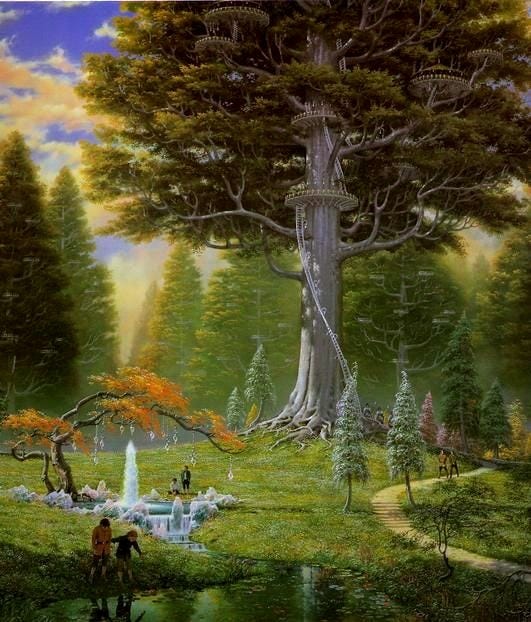
To recap the plot, Frodo and the fellowship are now tasked with destroying the “one ring,” of power to defeat Sauron. After surviving the terrors of Moria, the group takes rest in Lothlorien — an ancient forest inhabited by elves, overseen by Lady Galadriel.
Galadriel, like all elves, is immortal and therefore has lived on Middle Earth for thousands of years. Hailed “the Wisest of Elves,” she’s both beautiful and a paragon of virtue. Her gaze alone is said to incite awe, fear, and reverence for the divine upon its onlookers.
In other words, Galadriel’s outward beauty is but an echo of her inward purity, rooted in an elvish tradition of history, divinity, and wisdom that reveres Eru Illuvatar (the God of Middle Earth) and all things that are holy.
In this sense, Galadriel is the feminine example of Tolkien’s running motif — that those who bring grace, salvation, and light to the darkness of Middle Earth are not heroes of pure brawn, but rather virtuous souls rooted in wisdom, veneration, and respect for the past (Aragorn, Gandalf, and the entire Elvish tradition).
Indeed, memory and respect of one’s history is a crucial and necessary respect to save the world… but that’s not all that it takes.
As we’ll soon see through Galadriel, there’s a greater beauty you have to call upon.
An All-Seeing Gaze
The most stunning passage from Galadriel appears when the Fellowship first arrives in Lothlorien.
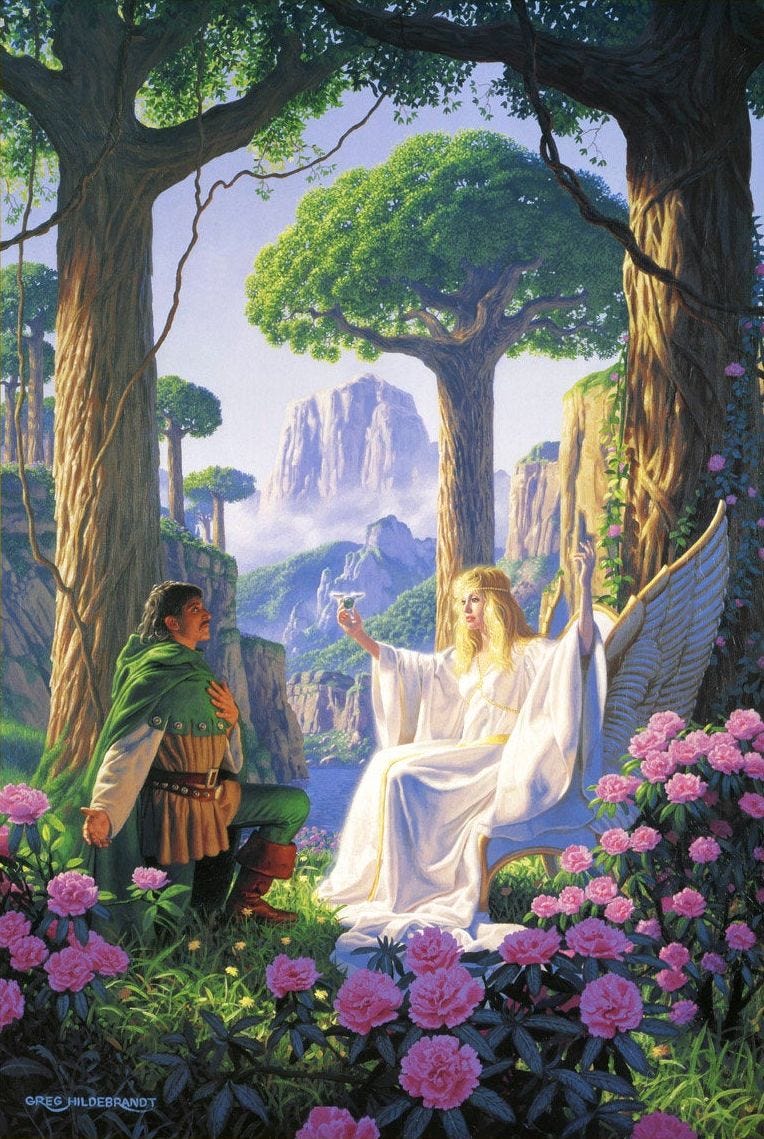
They approach her seeking counsel on their quest to destroy the ring, but Galadriel’s answer to them is interesting:
“‘I will not give you counsel, saying do this, or do that… But only in knowing what was and is, and in part also what shall be, can I avail.
But this I will say to you: your Quest stands upon the edge of a knife. Stray but a little and it will fail, to the ruin of all. Yet hope remains while all the Company is true.’
And with that word she held them with her eyes, and in silence looked searchingly at each of them in turn. None save Legolas and Aragorn could long endure her glance.”
Here she denies them counsel, but the details that follow are striking. She stares at each member, asking them to be true, and all hang their heads in shame except Legolas and Aragorn.
Two questions arise:
Why did the Fellowship hang their heads in shame?
Why are Aragorn and Legolas exceptions?
Point one is understandable: Galadriel is beautiful, and men naturally feel embarrassed in the presence of a woman, especially one hailed as “wisest of all elves.”
But why are they embarrassed by her beauty?
We later learn that Galadriel’s stare was a temptation. Her sanctifying gaze illuminated their moral shortcomings, and each member felt tempted to abandon the quest and return home. Every man felt “naked” before her gaze.
This notion of shame and temptation draws parallels to the Garden of Eden, where man felt naked in his fall.
Tolkien is teaching us that beauty — especially when joined to holiness — reveals the truth of a man’s heart. Galadriel’s beauty makes them vulnerable; her sanctity exposes what lies within. Shame arises not from erotic attraction but from moral clarity.
The shame is a sign that the Fellowship is morally insufficient, not yet at full potential, and must continue to grow in virtue to succeed in their quest.
But the real question is: why can Aragorn and Legolas meet Galadriel’s gaze without shame?
The answer reveals a timeless truth about how beauty shapes virtue — and how any man can cultivate the strength to stand before the divine without fear.
