

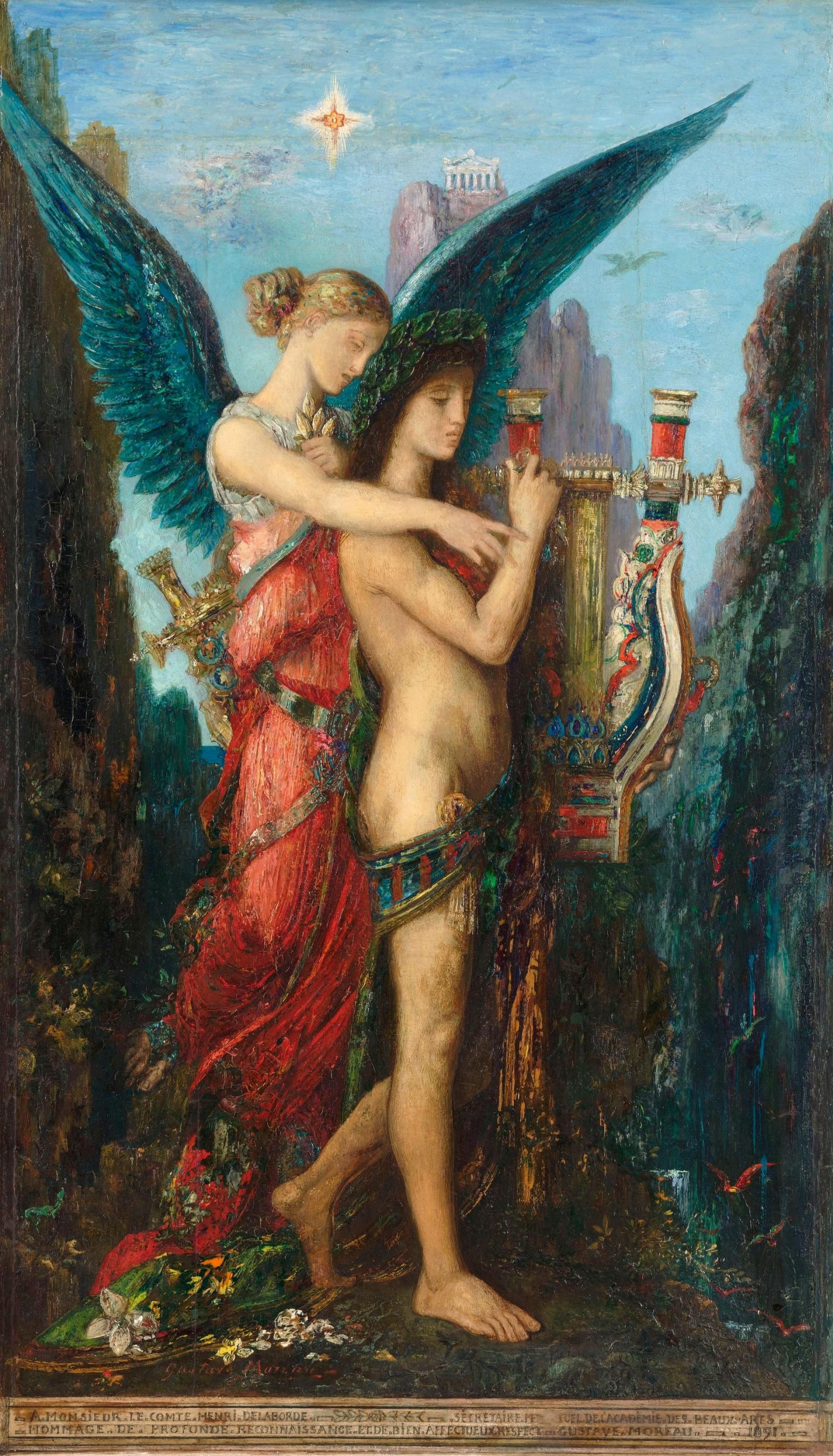
Most people think eros is the enemy of human wisdom. In our modern, hyper-sexualized world, it becomes easy to adopt polarized opinions on eros — that we ought to either suppress it to “conquer lust,” or fully embrace it in the name of “free love.”
But classically speaking, eros was meant for far more than sexuality.
In fact, Plato argued that eros is the very gateway to appreciating beauty, virtue, and the divine.
In the Symposium, he shares his famous Ladder of Love, which claims to teach you how to train your eros to love beautiful things, so that your soul can ascend and contemplate the highest realities of beauty itself.
Today then, we’ll do a deep dive on Plato’s Ladder of Love, to learn how to perfect this ascent ourselves, and gain a deep appreciation of the highest form of Beauty.
I offer private mentorship in the Great Books for those seeking clarity of vision and depth of soul. Inquire here.
If you’d like to support this work and receive future writings, you can subscribe below.
Plato’s Forms
First, let’s remind ourselves of Plato’s metaphysics.
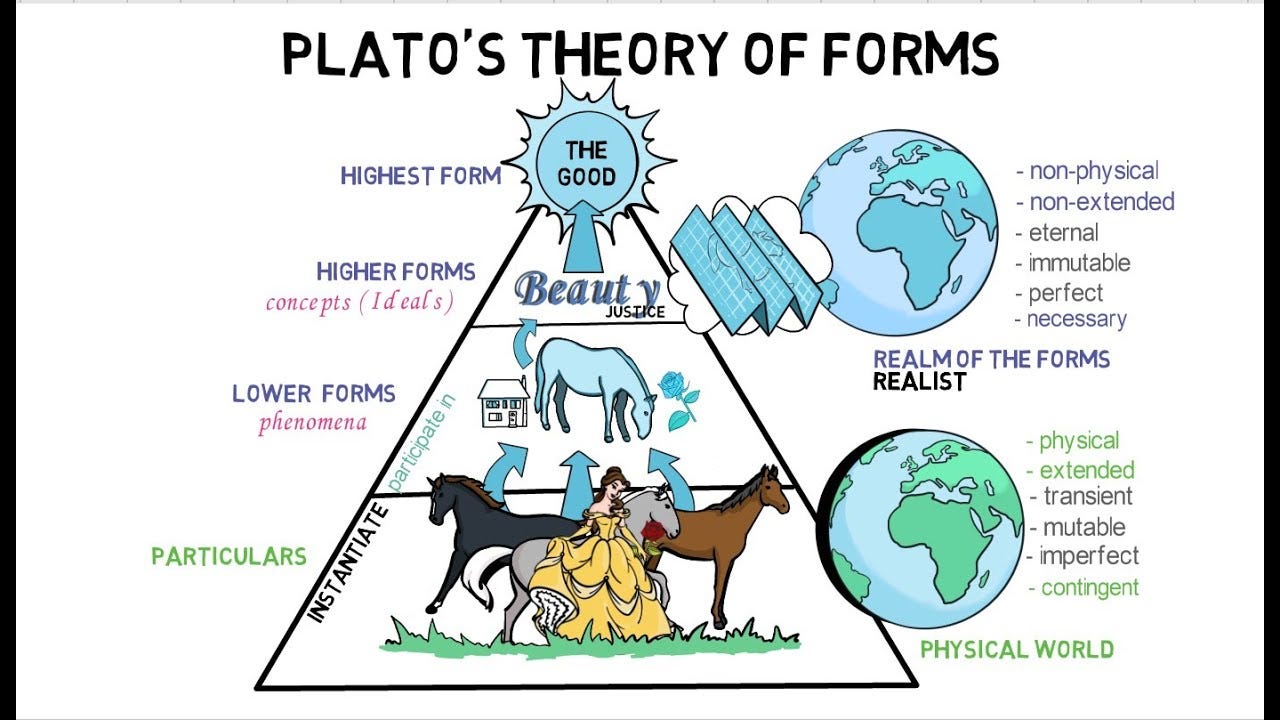
Plato believed that reality was governed by the forms — an immaterial dimension where the highest reality of being was located. The ultimate form was the Good. Corresponding forms acted in unison, such as the form of Truth and the form of Beauty. Hence, Plato suggests that reality the cosmos is fundamentally predicated upon the forms of Truth, Beauty, and Goodness.
The good life was found through man contemplating these forms, and directing his life so that his soul was in harmony with the True, Good, and Beautiful.
As such, Plato’s Symposium asks, what is Beauty? How do we contemplate it? And how can we seek the form of Beauty itself?
Plato provides the answer to these questions through his famous Ladder of Love.
The Ladder of Love
Below is an outline of the Ladder of Love.
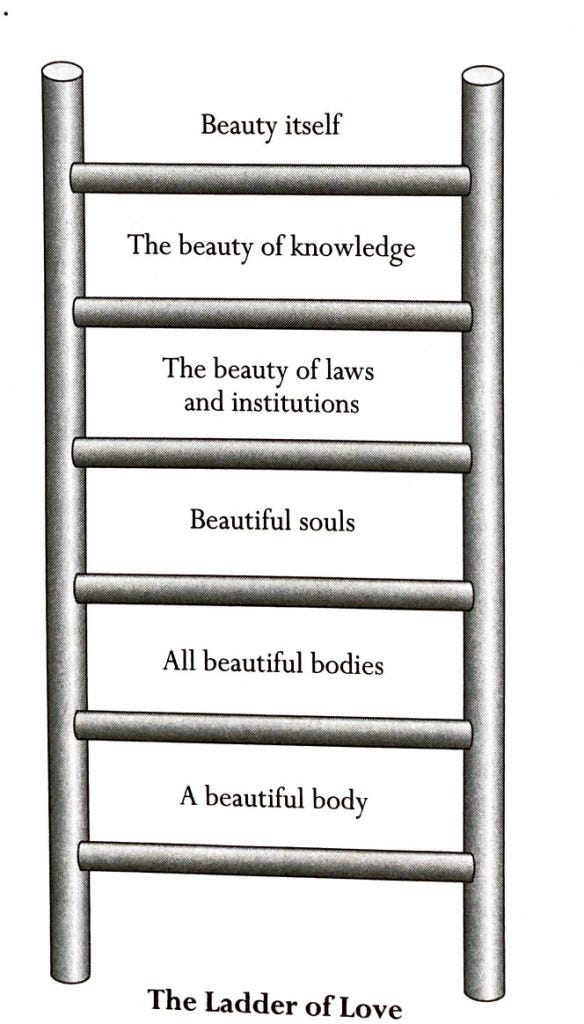
You’ll notice the Form of Beauty itself is at the top rung of the ladder. But the human soul’s ascent begins at the bottom of the ladder, at “a beautiful body.”
So how do we ascend the ladder?
The key is to understand your eros. Eros is the Greek word that corresponds to one’s romantic drive, or their passions. Plato’s first teaching is this:
Your eros fundamentally desires Beauty itself. Therefore, as a human, your goal is to channel and direct your eros so that it seeks Beauty.
Notably, Plato doesn’t instruct us to suppress our eros, but train it. The same erotic energy that can drive a man toward lust, addiction, and self-destruction can also drive him toward wisdom, virtue, and contemplation.
A proper contemplation of beauty then, promises to transform your very being itself to become beautiful.
Ascending to the Divine
Now let’s begin our ascent up the ladder.
First, why is the first rung “a beautiful body?”
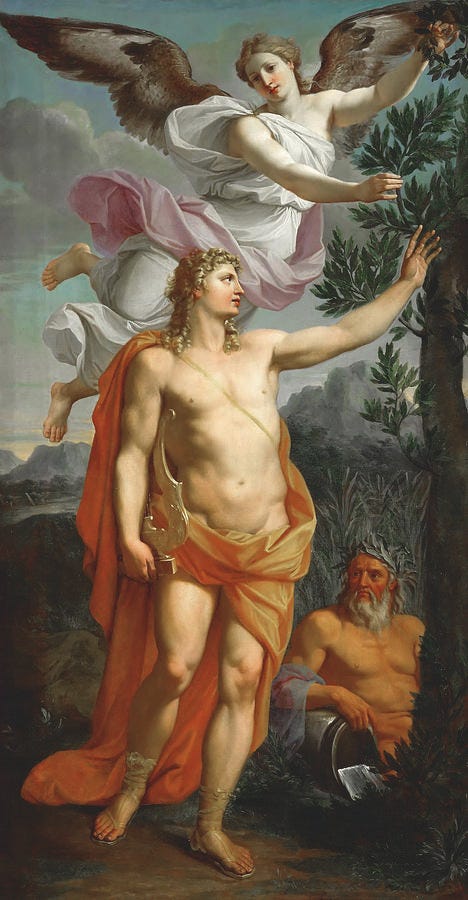
Plato notes how, normatively speaking, beautiful people are the first things that inspire our eros in our youth. Think of your first crush, or the sight of a beautiful human being as you entered adolescence.
This love of a beautiful body is natural, and good, but not to be celebrated. It has to be matured. It would be incorrect to worship the body of your beloved — as that doesn’t lead to healthy relationships — rather it perverts your understanding of beauty and virtuous love.
The next step in your ascent is to mature from excessive love of a singular body, to appreciating beautiful bodies. This maturation doesn’t mean that you want to carnally engage with every beautiful person you see. It’s an intellectual maturation — you appreciation of beautiful bodies teaches you what makes a human body beautiful in a universal sense.
Here, however, we reach a problem, namely: physical beauty is fleeting.
All human bodies eventually age and lose their luster. Thus, we come to a turning point where our love of beauty matures in a deeply virtuous sense.
To mature our love of beauty beyond the physical, we turn interior — and learn to love beautiful souls.
Beauty and Goodness
The “love of beautiful souls,” means to love someone for their interior disposition — their virtues, desires, hopes, etc. In a sense, we love them for who they are.
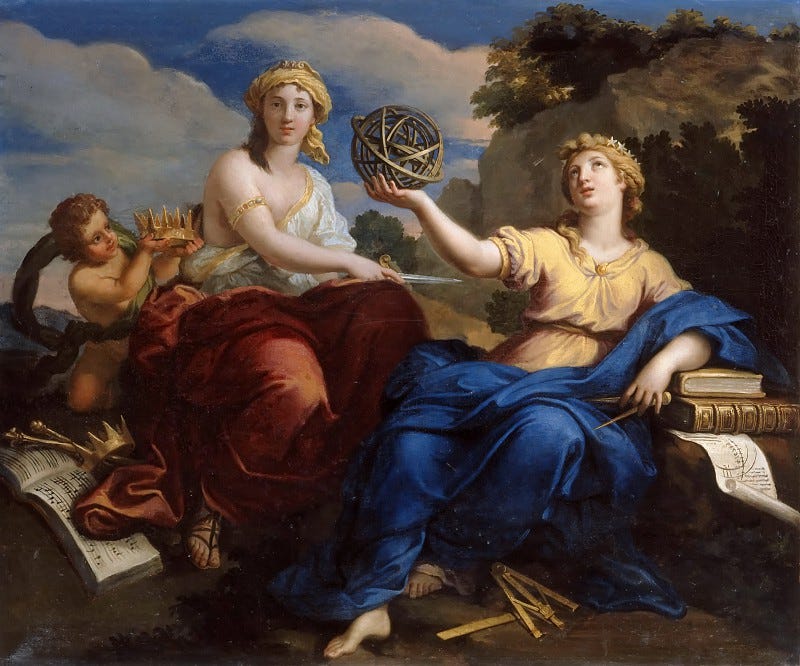
This introduces a major maturation in our love of Beauty:
Our eros now has a moral element that accompanies it. A love of beautiful souls means that we learn to desire a selfless sort of goodness to our beloved. This begins to approximate a “true love,” that you find in a viruous marriage or friendship.
Notably, this point is where most of us tend to think a love of beauty ends — learning to apprecaite a beautiful and virtuous soul.
But notice on Plato’s ladder, we’re only halfway there. What follows is the truly transformative elements of beauty.
A Polis of Beauty
Once we learn to love virtue in a person, we naturally begin to ask what conditions help virtue flourish:
What kind of education produces noble character? What customs encourage justice? What habits cultivate courage?
In other words, we wish to see the beauty in our beloved reflected everywhere in reality. We want our very communities and civilizations themselves to reflect the beautiful qualities of soul.
This is where a love of laws and institutions comes in.
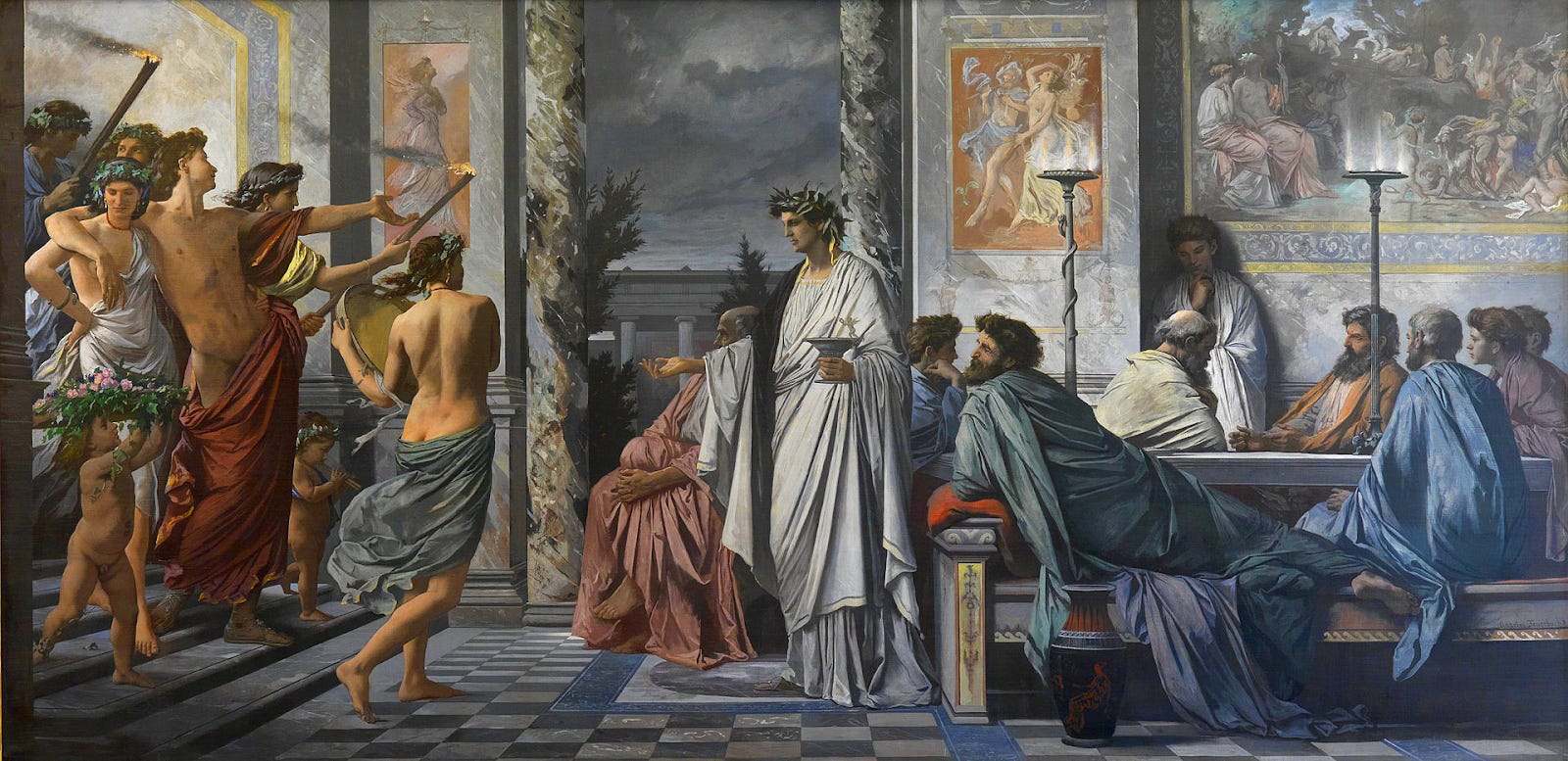
It might sound strange to invoke politics, but for Plato, the natural end of politics is Goodness itself. And given that Goodness and Beauty are inter-connected — then the creation of good laws and institutions means creating beautiful laws and institutions.
For Plato then, a virtuous love of the political means creating a beautiful civilization.
It’s this very love of laws and institutions then that helps us ascend in contemplation of beauty.
Why?
Because a love of laws teaches you the philosophy behind them — meaning you reach the next stage of Plato’s ladder: the lover of knowledge.
To restate it more simply, a lover of beauty will contemplate the highest goods capable of the human intellect — such as justice, virtue, and moral goodness — for these highest goods of knowledge are transcendental, and beautiful in their own right.
To restate it even more simply — a selfless love of beauty teaches you a selfless love of your fellow man, via love of Goodness itself.
And finally, this leads us to the top of the ladder — the form of Beauty itself.
Though for Plato, man can never directly encounter the forms — can never directly contact Beauty itself — his contemplation of heavenly things satiates his erotic desires for beauty far more than earthly things ever could.
To come full circle then, Plato teaches us that beauty is a gateway to contemplating and encountering the divine.
Beauty Incarnate
It’s notable that Plato’s idea was more than a pagan thought exercise. To this day, philosophers still hold Symposium as a gold standard to comprehending eros and beauty.
And yet, the one “shortcoming,” of Plato’s ladder is it ends in frustration. Though your eros seeks beauty, it can never truly encounter it. Man is left in a state of unsatisfied yearning, despite his best efforts.
Yet notably, Christianity would later adopt Plato’s thinking.

St. Augustine particularly credited Neoplatonic writings for inspiring his conversion to Christianity. He wrote that, in Neoplatonic metaphysics, he found everything expressed in Christianity except for the Incarnation itself.
In other words, Plato the pagan philosopher taught man to seek the unknowable form of beauty itself, and Augustine (and the Christian tradition), would claim the form of Beauty was made incarnate in Christ.
As such, Christianity can be said to have “baptized Plato,” by saying Plato’s ladder of love leads to none other than God himself.
What’s even more shocking, is Christianity inverts the ladder.
True beauty is not experienced by the select few philosophers who can ascend the ladder. Rather Beauty itself is made visible at the bottom of latter, through the incarnation of Christ.
To state it simply, the erotic desire for Beauty is fully satiated by those who abide by the golden rule of loving God and neighbor as self. For such love is the essence of the Good, and to love the Good is to love the Beautiful.
As Augustine said more succintly, “our hearts are restless until they rest in thee.”
And thus, a Beautiful life is freely open to all — not through exaltation of mind, but humility of one’s spirit. To love the Good is to love the Beautiful, and form your soul in accordance with Beauty incarnate itself.
I offer private mentorship in the Great Books for those seeking clarity of vision and depth of soul. Inquire here.
If you’d like to support this work and receive future writings, you can subscribe below.
. . . I often wonder where Heavenly Kindness resides inside our restless heart. Kindness poured out to others is not meant to create a kind world, it is meant to allow someone else to feel the power of kindness and then to practice being kind to others.
Did Plato think eros changed forms? For example, a love of other human souls, is that phileo, fraternal love? Or a love of knowledge, we call that philo-sophia. Is that still eros. And is Beauty at the top agape?