

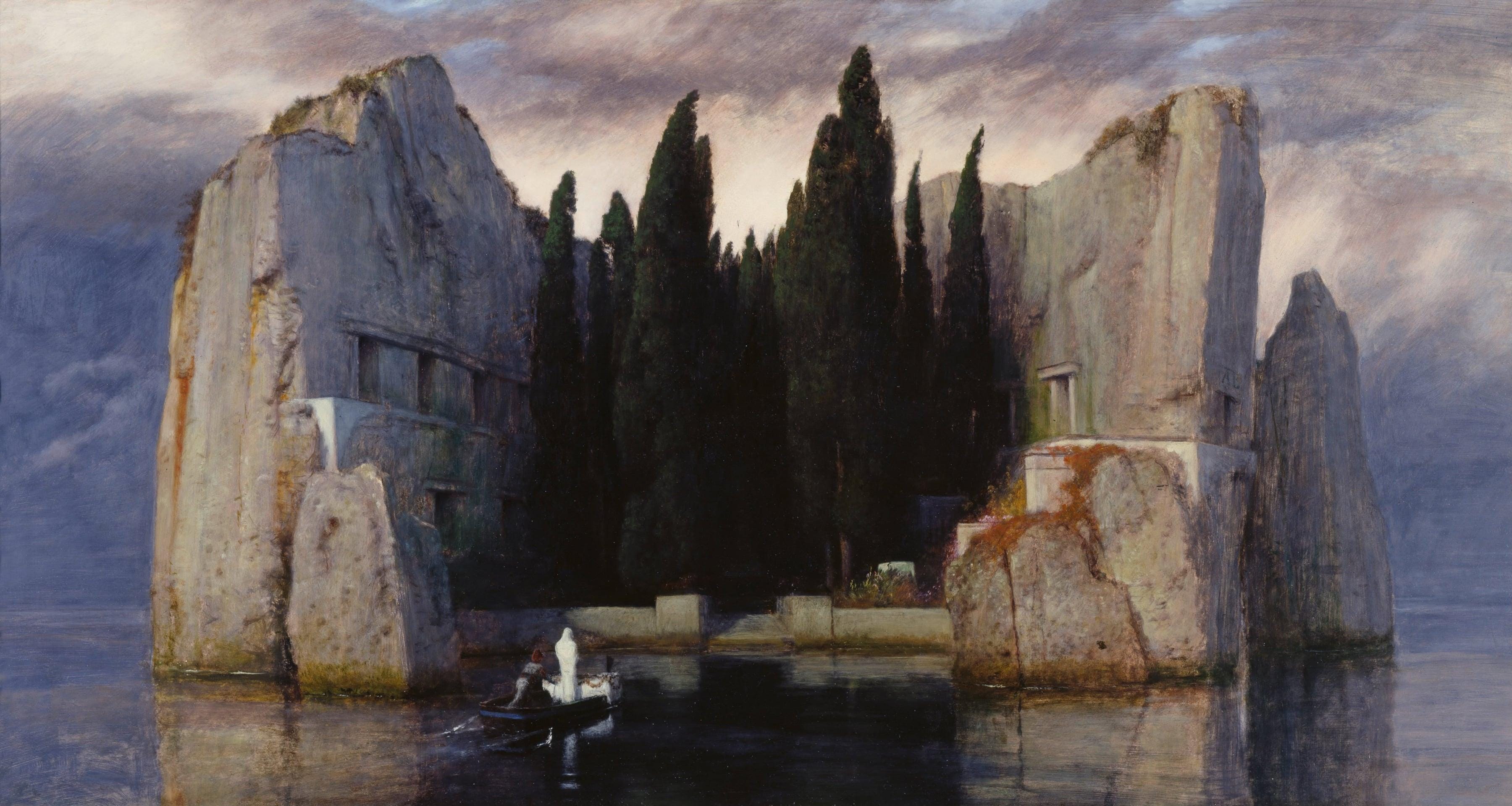
A serious inquiry into the Western Tradition involves a grappling with death. This is not hyperbole. Rather, studying the Western Canon impresses upon us a single question:
“In light of death, promised to all, how are we to live?”
In fact, Tolkien himself bluntly affirmed in an interview with the BBC that not only The Lord of the Rings, but all stories, ultimately, are about death.
But what is the point of meditating upon death, and how can it teach us to truly live?
Well, we’ll find that the Western Tradition has had an ongoing dialogue and development around this very question. From Homer all the way to Tolkien, death, and how it informs the meaning of life, has been a substantive topic of discussion.
Today, then, we’ll take a high-level tour through the canon to understand how death can teach us how to live.
I am 100% reader-supported. This newsletter is free, but if you’re able to support, please consider a paid membership — it helps my mission of sharing Truth, Beauty and Goodness with maximal reach
As a paid member, you’ll get:
Two full essays a week
Access to all recordings (past & future) of my Great Books lectures on this publication
Eternal gratitude from me
Turning Down Paradise
It’s fitting that we begin with Homer in our discussion of death, as he is the foundation of the Western Canon. And the Iliad, for one, is absolutely filled with death at every corner.
Yet our attention will take us to The Odyssey, believe it or not.
I would argue the greatest book of the Odyssey is Book 5 — our introduction to Odysseus.
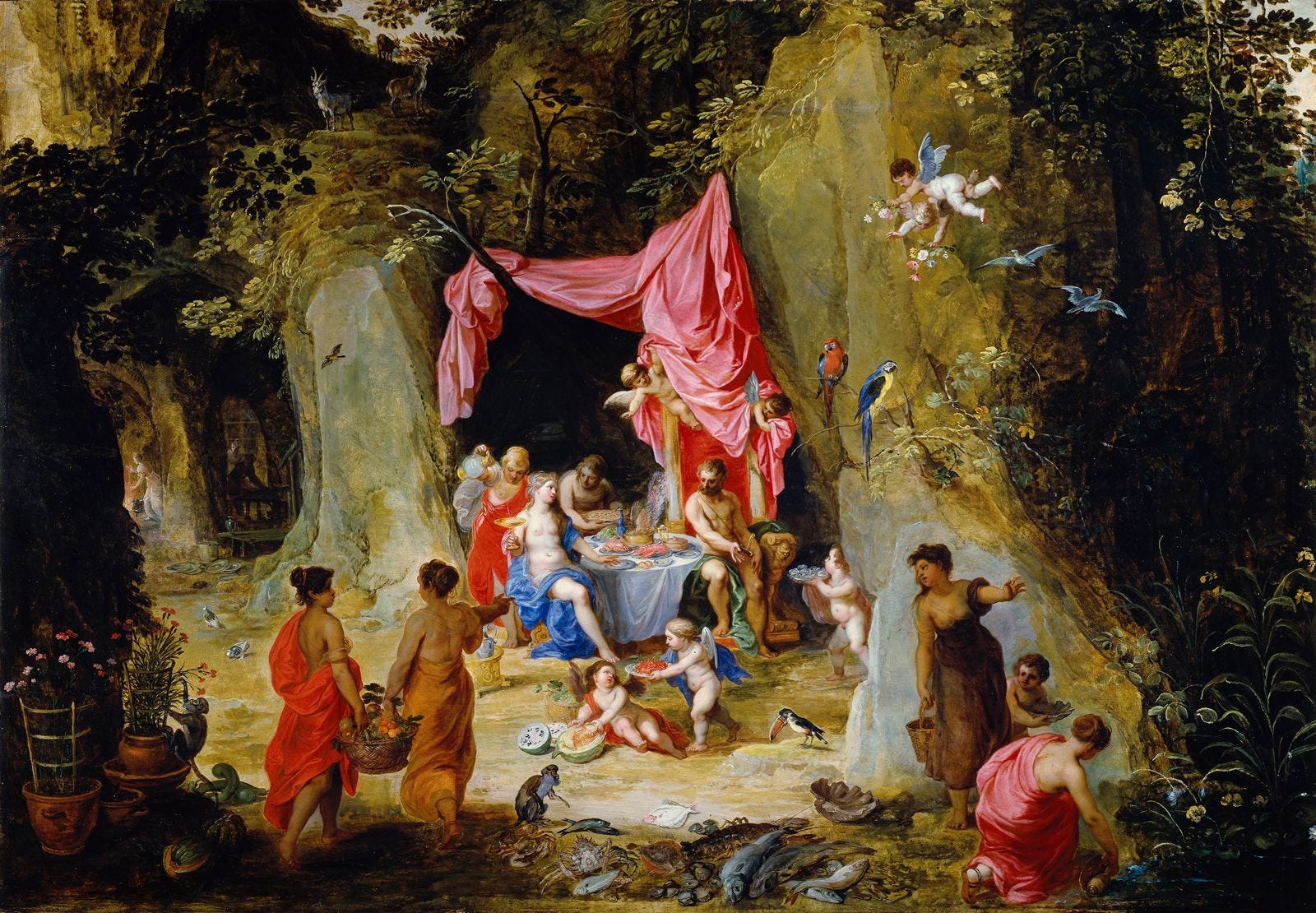
We find him on the nymph Calypso’s island, where he’s been held hostage for seven years. He’s got a pretty good deal, all things considered:
The island is a utopian paradise, and he can enjoy his days within the loving arms of a beautiful goddess. And yet, we find Odysseus crying on the beach, yearning to return home to his family. Homer makes it clear that Odysseus is held against his will.
Soon enough, Zeus intervenes, demanding Calypso set Odysseus free. Calypso complies, but not before offering Odysseus a great temptation:
Stay with me, and I will make you immortal.
This is the ultimate temptation. Remember, in Homer’s day, one of the highest aims of heroic life was kleos, or glory, for glory gave you an immortal name to live on after death. The Iliad is particularly concerned with this pursuit. Odysseus, however, is now offered an even great boon, namely immortal life itself!
And yet, Odysseus denies this gift, instead favoring a return journey home to his family, which will be filled with trials, tribulations, suffering, and eventually… death.
Why exactly would Odysseus turn down immortality?
On the surface, he wants to return to his family, but beneath this lies a deeper meditation on the human condition. An implication of Odysseus’ desire to return home is not just his love for his family, but a restless spirit. He is the “man of twists and turns,” who is most alive when he is striving. In other words, implicit in his yearning for home is an affirmation that the human soul was made for more than “cake and sex.”
This is not to say that Odysseus rejects pleasure, but rather that pleasure alone cannot give him the life he desires. His longing is for a particular human life — one filled with love, struggle, and the responsibilities of homecoming.
This is but the beginning of the great conversation on death — that human life was perhaps made for more than… prolonged life on Earth.
Which brings us to our next stop… the Inferno.
False Counsel, Endless Ambition
Any serious literary discussion on life and death has to invoke the Divine Comedy at some point.
And believe it or not, our discussion will focus on Dante’s Inferno, where we see Odysseus a second time, now under the Roman moniker of Ulysses.
But why exactly is Ulysses — the great hero of Greco-Roman antiquity — in Hell, according to Dante?
Ulysses reveals his fate:
Upon returning home, his restless soul refused to remain in tranquility with his family. Instead, he sailed west past the Strait of Gibraltar (the edge of the known world at the time). His travels took him toward a vast mountain (Mount Purgatory), and though Ulysses sought to reach it, God sent a storm to destroy his ship and drown its crew.
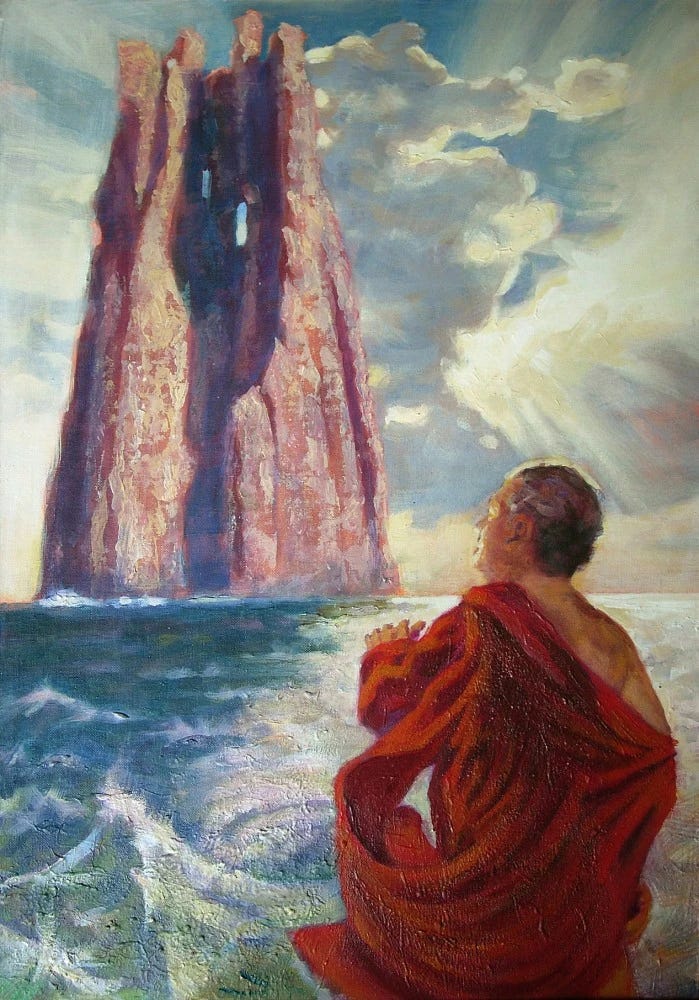
Now what exactly was Ulysses’ sin? And how does it pertain to this development of death?
He’s specifically in Hell for his deceits, lies, and false counsel — but this story gives an additional insight into the corruption of his heart and how it pertains to death.
Well, first let us recall the scope of the Divine Comedy:
Dante the protagonist is lost in the wilderness — meaning that he’s not just lost in the woods, but his soul is lost in sin. To attain salvation, he must descend the Inferno, climb Mount Purgatory, and then ascend to Paradise.
The point of the Inferno is a prolonged meditation on death, and how human nature can be corrupted. Ulysses shares the nature of his own corruption upon recalling the speech he gave to his men before sailing beyond the known world:
“You were not made to live like brutes, but to pursue virtue and knowledge.”
This actually sounds noble at first. Ulysses had an insatiable thirst for knowledge — and rationality is that which separates man from beast, considered by many to be the spark of the divine that makes him in the image of God.
Ulysses’ sin, however, was not a desire for knowledge as such, but an ambition that shirked all limitation. Knowledge, according to Dante and the Christian tradition, is useful insofar as it teaches you about Truth, Beauty, and Goodness, or God. In other words, knowledge ought to be ordered toward the moral good, revealing the truth of your nature as one made in God’s image.
Ulysses’ desire for knowledge, by contrast, is more like “desiring to know for its own sake, without reference to the Good.”
This is a form of pride — a knowledge predicated as an end itself, oriented towards power or independence from God. It’s the same impulse that drove Lucifer to rebel against God, and become a fallen angel in perdition. Note that Ulysses’ crime is not merely seeking knowledge, but pursuing a knowledge that transgresses the known limits of man (trying to literally climb a mountain to paradise, echoing the sins of Babel).
Thus, through the Divine Comedy, we understand death as that which points man toward a greater purpose than eternal life on Earth (Homer). And now we understand death as a meditation on the limits of one’s nature — a form of self-knowledge that recognizes man as a creature made by a Creator who informs him of his destiny.
And yet, the most powerful, and jarring, account of death will come in the 20th century, from a famous thinker of Middle-earth.
Tolkien says death is not just a gruesome reality that orients the soul toward Heaven… but that, if you understand it correctly, it becomes one of the greatest tools for making your life meaningful, thrilling, and beautiful in the here and now.
Here’s how…
The Gift of Death
Lovers of Tolkien know that his writings of Middle-earth go far beyond The Lord of the Rings. Indeed, Middle-earth has an entire cosmology, history, and theology that includes God, angels, demons, and thousands of years of history before we ever hear the name of Frodo.
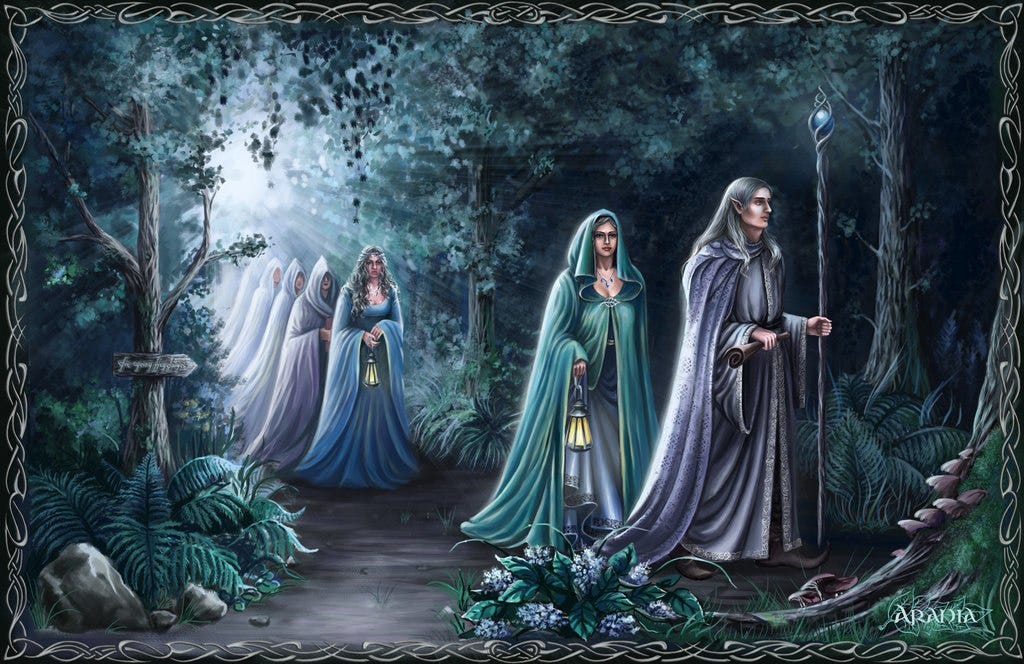
And one of the most interesting aspects of Middle-earth’s history is the creation of mortal mankind — who arrives thousands of years after the immortal Elves have been created.
Though man was mortal, and far less powerful than the Elves, he was accounted among the favorites of Eru (God), and had a mysterious gift so wonderful that even the Elves themselves envied it.
That gift was death.
Quite literally, in Tolkien’s mythology, death was hailed as a unique gift given by God to man.
But why did the Elves — who are stronger, handsomer, and immortal — envy such a gift?
The reasons are twofold. For one, the hope was that death would bring man to an intimate communion with God, and that, in the fullness of time, mankind would participate in a song called the “Second Music of the Ainur.”
Without diving into the weeds, this would be the Middle-earth equivalent of eternal beatitude — man living in perfect bliss and harmony with God. Tolkien leaves the precise nature of mankind’s ultimate destiny mysterious, but the hope of such a communion is central to the idea of death as a gift.
Now this is understandably a point of envy for the immortal Elves, but there’s a second point that is often overlooked. It’s arguably a “lesser point” of envy in the macro, but its wisdom helps man transform his life in beauty in the here and now.
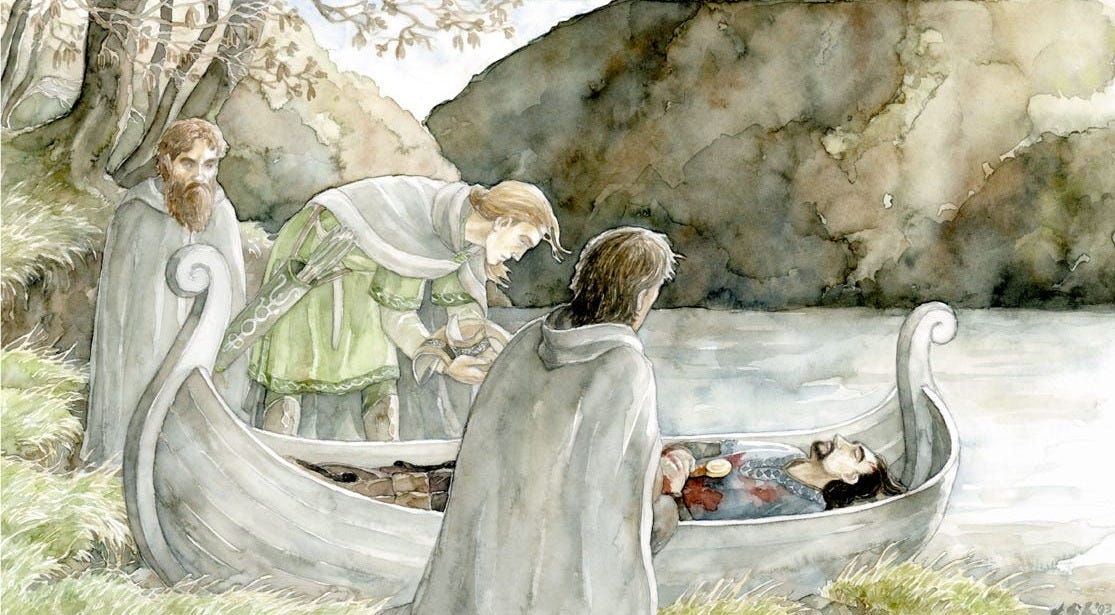
That point is that death makes life far more meaningful, and thus rich and beautiful, for man than the elves. Indeed, man’s time on Earth is finite. Because its limited and passing, every second felt is precious for mankind. He values his life, his loved ones, and the pleasures of this world — precisely because he knows they can be lost.
This is not a luxury afforded to the Elves. Their lives stretch beyond the bounds of mortal time, and though they too know grief and loss, they do not possess the same urgency that makes man's brief existence so precious. Indeed, it echoes the wisdom of many that an eternity of “mortal life,” is actually a curse — for the ensouled being has an infinite longing that cannot be satisfied in temporal creation.
Stated more simply, nothing may be more painful than an eternity of unsatisfied desire.
Man, meanwhile, has a short life to live, and in this short time his life becomes a work of art. And this is because all beauty requires restraint. Just as a painting is constrained by its edges, a statue by the limits of its marble, and a building by the measurements and symmetry of its design, so too is man made beautiful by the constraints of his time on Earth.
Your life is a work of art — and mortality gives you the canvas on which to create it. So get to sculpting.
Learning to Die…
Of course, Tolkien’s idea of death as a gift is unorthodox — for the majority of the classical and Christian traditions alike count death as an evil or consequence of sin.
Yet even parts of Scripture echo Tolkien’s general teachings:
“Teach us to number our days, that we may get a heart of wisdom.” — Psalm 90:12
The underlying conclusion of this great tradition is that death is the destiny of all, but not the conclusion. It is the constraint — or proverbial pressure that makes demands — and makes life meaningful precisely because it forces man to look beyond an otherwise chaotic world and veil of tears.
A line remembered by St. Thérèse of Lisieux may put it best: “The world is thy ship, not thy home.”
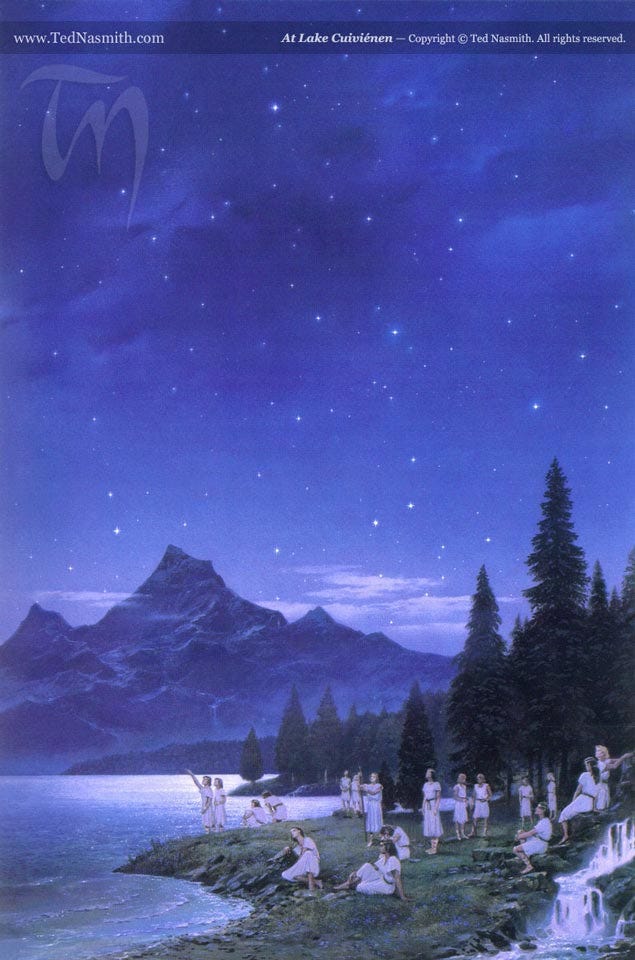
Such is the wisdom that orients man toward his ultimate destiny. To remember that one is to die is to release one’s attachment to worldly things, and such detachment turns the soul toward the spiritual dimension of our being, revealing a fullness that transcends the temporal world.
“Whoever loses his life for my sake will find it,” Christ maintains. And indeed, the great paradox of the Cross is that the Resurrection is preceded by the Crucifixion. Life may, in the end, amount to “learning how to die,” but if we die well, there is reasonable hope that our lives may have only just begun.
I am 100% reader-supported. This newsletter is free, but if you’re able to support, please consider a paid membership — it helps my mission of sharing Truth, Beauty and Goodness with maximal reach
As a paid member, you’ll get:
Two full essays a week
Access to all recordings (past & future) of my Great Books lectures on this publication
Eternal gratitude from me
Having been close to death already this year I was knocking on heavens door _ I need to take my second chance & learn to live
Thanks for your article. Please would you annotate the paintings & drawings. I like to know the artists’ names.