

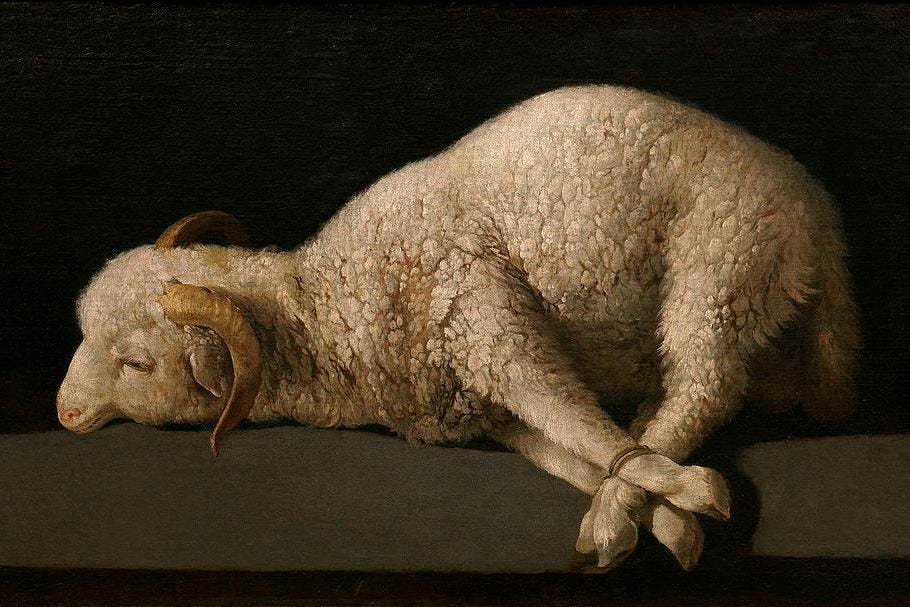
While the Bible claims to be the Word of God, filled with truths accessible to all mankind, the proper understanding of its teachings can be quite difficult to capture.
The Old Testament itself is particularly elusive, filled with strange rituals and principles that can appear archaic, superstitious, or even nonsensical to modern eyes. Amongst these strange rituals, perhaps most striking is the Bible’s insistence on animal sacrifice.
Now sacrifice is not distinct to the Bible — nearly all ancient pagan religions offered various forms of sacrifice — but those pagan religions have since been understood to be untrue religions, carried out by the superstitious man of antiquity.
Is Biblical sacrifice to be read the same way? Ancient superstition that was a product of its time, but ultimately meaningless?
This does not appear to be the case. But to see why, you have to see what sacrifice is actually doing in the narrative, and how it plays a crucial role in teaching man his nature, his relationship to the divine, and how to navigate a fallen world of vice.
In short, once you understand sacrifice, a single thread runs from the Garden of Eden all the way to the cross: death is the fruit of the fall, and nearly everything the Old Testament calls sacrifice is a temporal stand-in for the death man himself owes — until one sacrifice stops standing in for the debt, and pays it.
Here, then, is how to understand the strange insistence on animal sacrifice, and what it teaches you about yourself.
I am 100% reader-supported. This newsletter is free, but if you’re able to support, please consider a paid membership — it helps my mission of sharing Truth, Beauty and Goodness with maximal reach
As a paid member, you’ll get:
Two full essays a week
Access to all recordings (past & future) of my Great Books lectures on this publication
Eternal gratitude from me
Sacrifice Since the Fall
It’s easy to think of the Mosaic law and its insistence on sacrifice as inscribed later in Israel’s history. But sacrifice actually appears far earlier than Sinai.
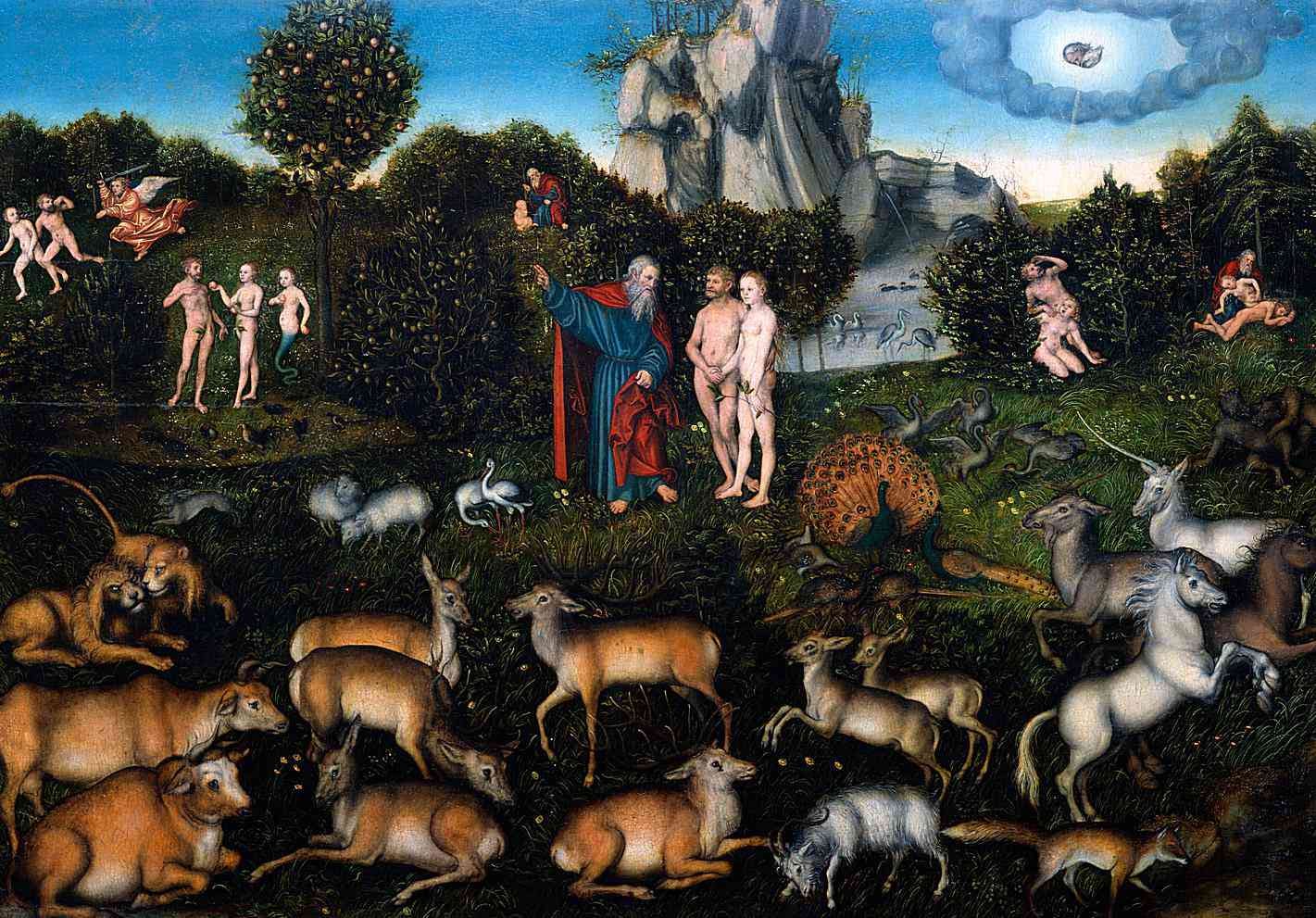
Animal sacrifice first appears in Genesis 3, at the Fall itself. Right after Adam and Eve sin, God pronounces the curses upon man:
Eve is subordinate to her husband and burdened in childbirth, while Adam is condemned to toil against thorns as discord is set loose between the sexes. Most notably, death itself accompanies their plight — “Dust you are, and to dust you shall return.”
Yet notice what happens immediately after:
“And the Lord God made for Adam and for his wife garments of skins, and clothed them.” (Gen 3:21)
An animal is sacrificed so that Adam and Eve can be covered and stand before God again. It’s striking that this is God’s first action after the fall, and this sets the precedent for how man is to navigate a fallen world:
Death is the price of the crime, and from this point onward, a life offered up becomes death’s temporal stand in. Sacrifice is a substitute paid so that the one who actually owes the debt does not have to pay it himself in full (at least not yet).
Thus, Genesis 3 sets the precedent of sacrifice, but further reading will show a refined development of this pattern.
Sacrifice Unfolding in Time
After Genesis 3, sacrifice continues immediately into the next generation. Both Cain and Abel offer sacrifices to God. We thus understand that, though man has fractured his relationship with God, unable to live in harmony with him, sacrifice becomes the practice to help, “mend the tear,” as simplistic as it can be.
However, Abel’s sacrifice of a lamb is favored over Cain’s sacrifice of crops. There’s no definitive answer for God’s favoritism, but one popular read is that the lamb itself is a more valuable sacrifice than crops, for it is a “blood sacrifice,” and blood has specially holiness in OT theology. Also, one might notice a symbolic significance of “sacrificing the lamb,” but more on this later.
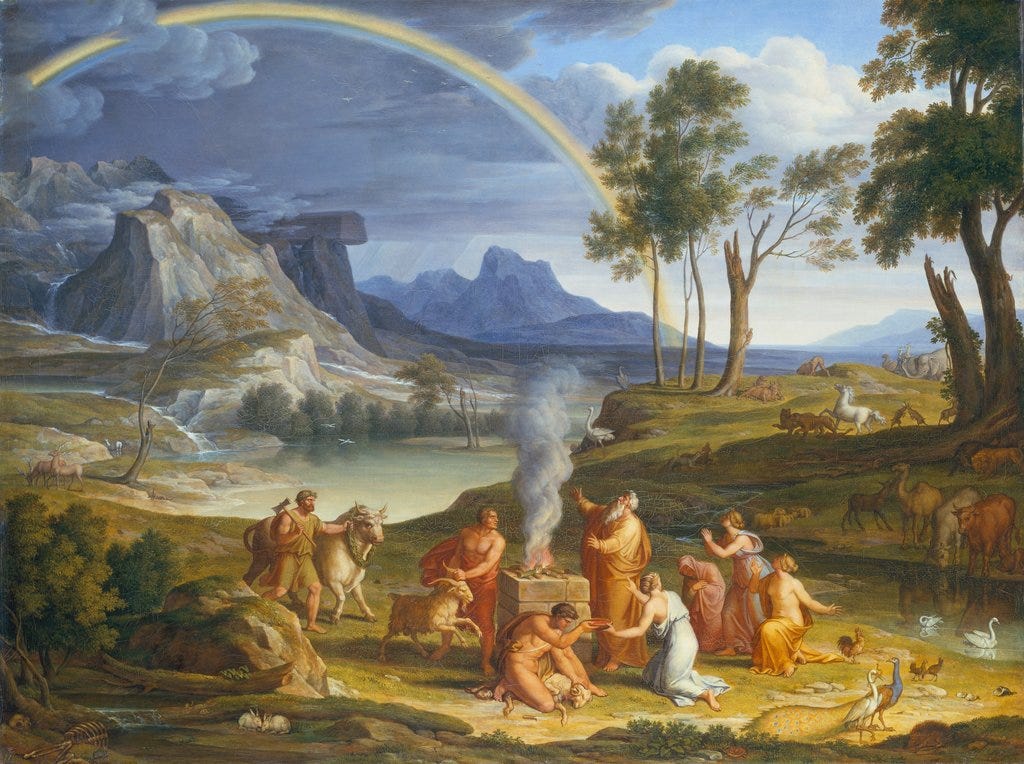
So Cain and Abel teach us sacrifice is the normative practice of man to walk close to God. This gets re-emphasized by Noah. He sacrifices to God immediately after the Flood, which instills a new covenant of God’s peace which brings the righteous men of God closer to him.
And then, we have the infamous sacrifice of Abraham offering up his firstborn son Isaac to God. Though God ultimately stops the sacrifice, Abraham is counted blessed for offering up his son as sacrifice.
Finally, we have the Mosaic law. Moses is called upon the found the nation of Israel — God’s chosen people who will prepare a way for the messiah. Israel was called to be “holy,” (or “set apart,”) from the sinful ways of the world, and the laws of Leviticus trained them how.
Most notably, there’s an entire code of laws related to sacrifice as restoration of one’s relationship with God. And the most important sacrifice was the “passover meal,” where an unblemished lamb of each family’s flock is offered up to God in honor of Israel’s deliverance from slavery into the promised land.
This is the pinnacle of Old Testament sacrifice, and yet it also exposes the limit of animal sacrifice. Israel’s story is one of repeated infidelity despite the law and the many sacrifices offered. Even the tradition itself seems to sense this isn’t enough. The Psalmist writes,
“For thou hast no delight in sacrifice; were I to give a burnt offering, thou wouldst not be pleased. The sacrifice acceptable to God is a broken spirit; a broken and contrite heart, O God, thou wilt not despise.”
And this is where the Old Testament closes — Israel patiently awaiting a Messiah who would be a “New Moses,” to enact a “New Exodus,” with a “New Passover,” to bring mankind to the “new Promised land,” to save them once and for all…
Of course, this is an allusion to Christ, but the question remains — Why did Christ need to be sacrificed in the first place? Why did God demand sacrifice to begin with, and why did he insist on sacrificing himself? Wouldn’t it be easier to “forgive and forget?”
As we’ll now see, the crucifixion itself becomes not just a typological fulfillment of Scripture, but the answer to understanding human nature, the nature of the cosmos, and how sacrifice becomes the theological language of love itself…
