

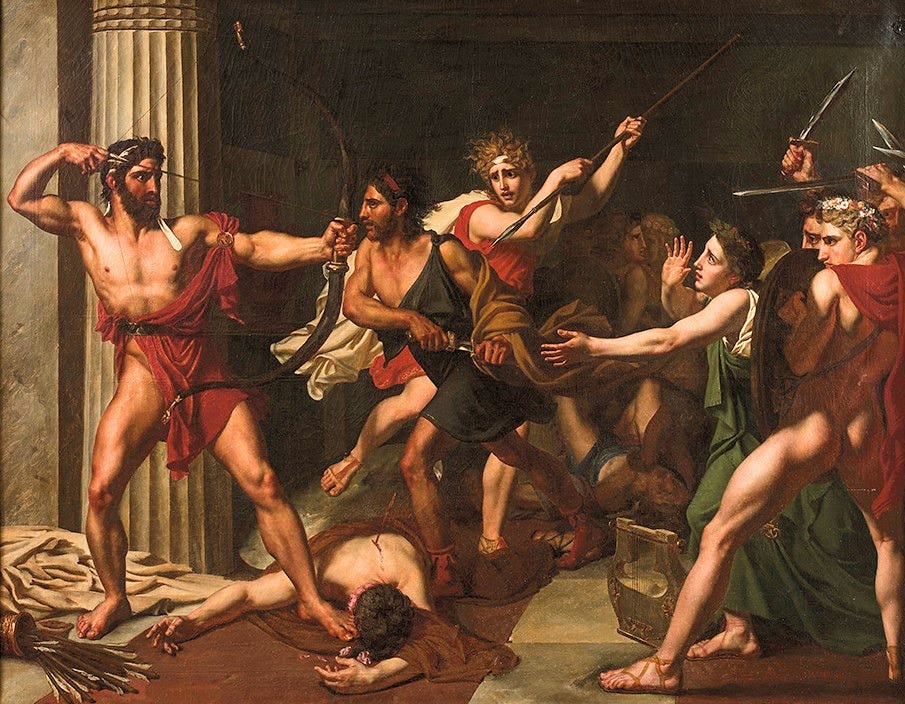
Homeric vengeance is the biggest obstacle modern readers face in truly understanding Homer. The Iliad gets written off as antiquated slaughter from immature warriors; the Odyssey, as a poem glorifying “eye for an eye” bloodshed.
It’s understandable — the violence is jarring. But the uncomfortable reality is that it’s precisely Homer’s moments of vengeance that have offered humanity its greatest wisdom: what it means to be civilized, and how to move beyond bloodshed to actually preserve civilization.
This is because Homer’s moments of slaughter are rarely aimless, rather they’re often pedagogical and teach us a greater truth.
This is perhaps made nowhere more clear than in Odysseus’ slaughter of the suitors. His epic killing spree goes far beyond personal vengeance, rather it’s Homer’s ultimate meditation on the genealogy of legitimate authority.
To say it more bluntly — to fully appreciate why Odysseus slaughters the suitors is to understand the framework that makes human civilization possible itself in the first place. In fact, you can even argue that Odysseus himself is the mythic archetype for the virtuous statesmanship that builds and maintains civilization.
Here’s how…
I offer private mentorship in the Great Books for those seeking clarity of vision and depth of soul. Inquire here.
If you’d like to support this work and receive future writings, you can subscribe below.
An Unhappy Homecoming
When most readers think of the Odyssey, they imagine the famous beasts, islands, and adventures at sea, as Odysseus makes his way home.
In reality though, this poem isn’t so much about “returning home,” as it is “returning order to home.”
In fact, almost the entire second half of the poem follows Odysseus’ trials on Ithaca, as he attempts to overthrow the suitors.
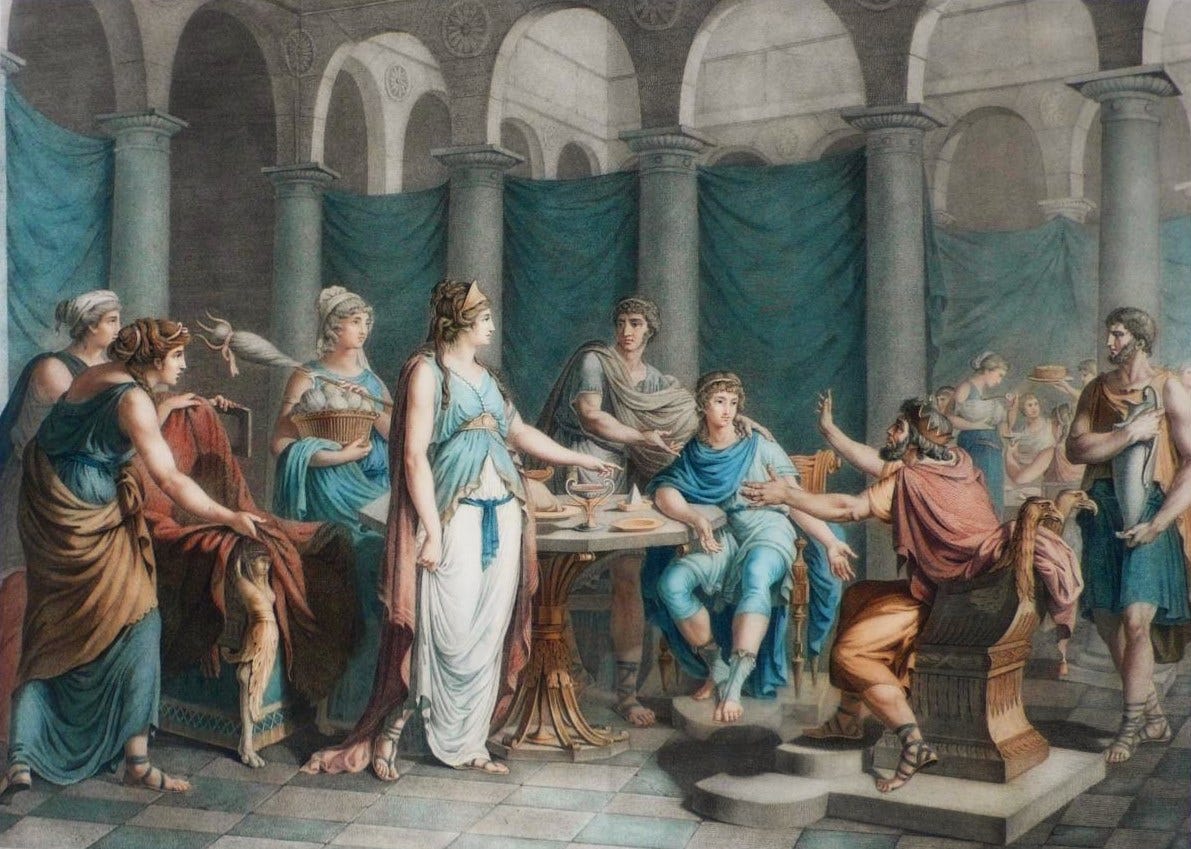
Recall that the suitors — 108 young men — have been betraying the divine law of xenia (guest-host friendship) to plunder Odysseus’ wealth and attempt to marry his wife.
Thus there’s 3 levels of interpreting the Odyssey’s meaning:
A revenge story against suitors
Odysseus as protector of xenia — a man preserving the divinely sanctioned order of human affairs
Odysseus as the mythic archetype of judge and lawgiver, who builds civilization itself
It’s this third layer that asks our focus today.
Restoring Order to Home
Now before we get to the slaughter, let’s remind ourselves of the need for the slaughter.
The earliest books of the Odyssey showcase the suitors abusing Odysseus’ household, while his son Telemachus denounces them in vain.
How did such tyrannical young men overrun the household of their king?
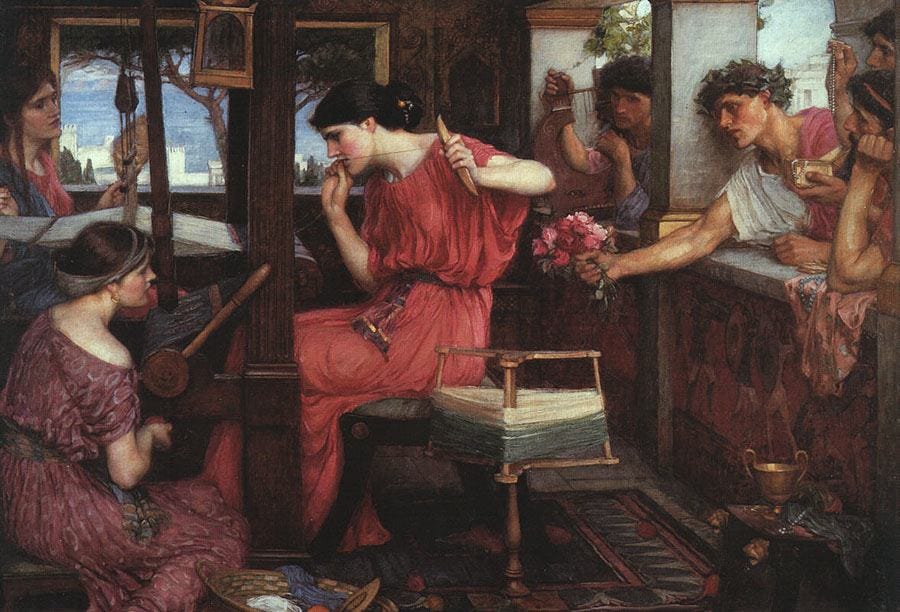
Recall that Ithaca actually had laws, an assembly, and democratic-esque forms of structure in place. The problem is — there were no strong men to enforce these laws. All the strong men went off to fight at Troy. After 20 years of their absence, what remained were the now full grown suitors, and old men too weak to stop them.
This is the core truth of all politics — that force is the fundamental law of nature that precedes even justice itself. A set of perfectly just laws cannot stand a tyranny of unjust men. Thus, though justice is greater than force, the problem of force must be answered before justice can be established.
This later becomes Plato’s greatest concern. He recognizes that justice is far superior to force, and explicitly rejects the notion that “might makes right,” but he still has to address the problem of force.
For instance, The Republic asks “what is justice?” but in Book 2, before he even attempts a definition, he asks an even earlier question:
“Who’s going to police the police?”
All civilizations need strong men to protect them from invaders, but the polis must also protect themselves against these men who monopolize force.
This is the first step that makes Odysseus an ideal statesman — his return makes him the first threat to tyranny, because he’s an actual threat.
However, we’ll see it takes far more than brawn to save a household, let alone a kingdom…
Mending the Soul
Right now, it’s still not obvious how Odysseus dons the role of a mythic statesman.
After all, on the surface, all he does is come home and murder a bunch of criminals. Maybe the slaughter is justified, but it still appears barbaric.
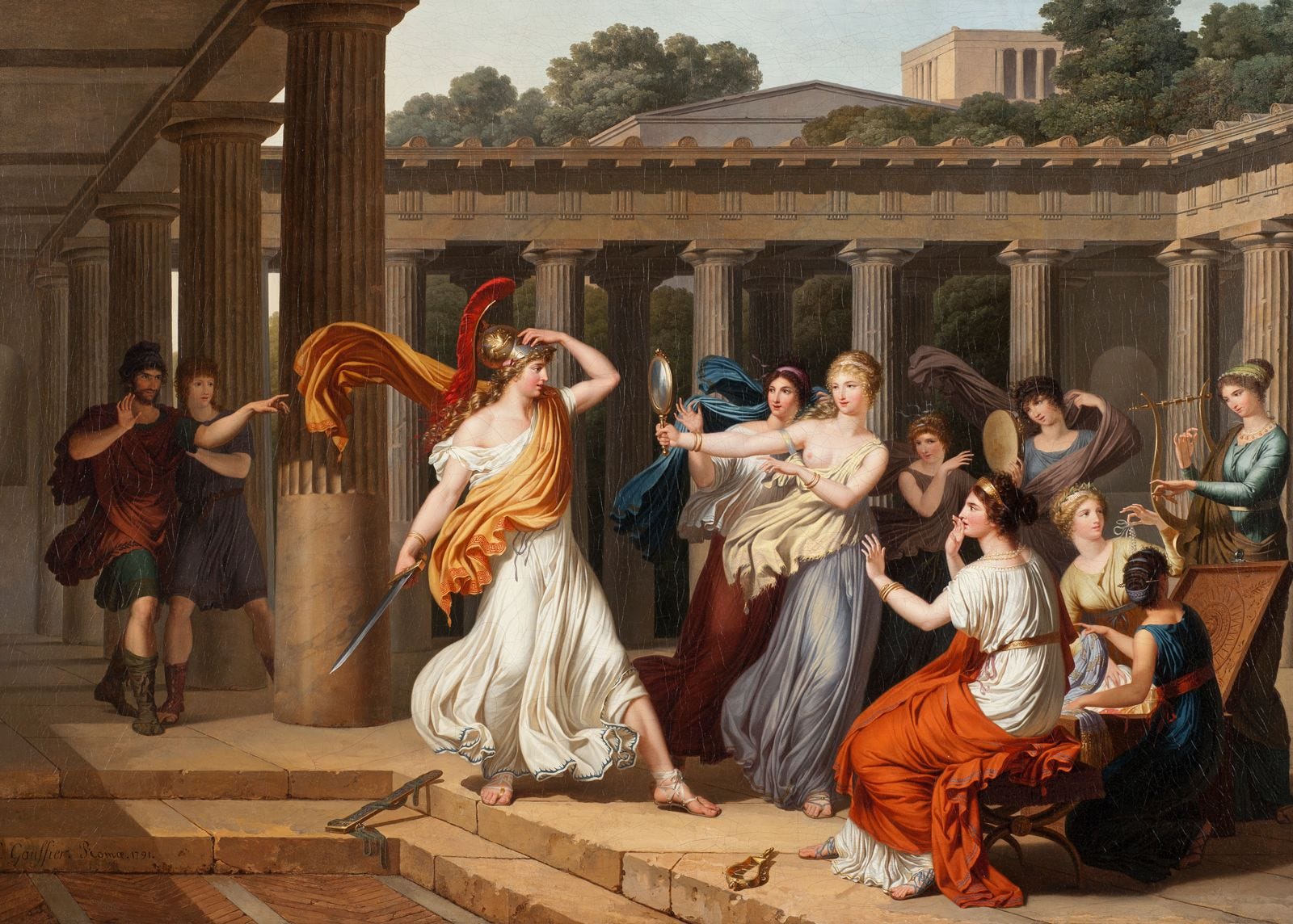
The first detail we need to remember, then, is that Odysseus’ slaughter brings order to his household:
He reunites his family, purges the immoral, and rewards the loyal. A quick reminder of Aristotle’s politics helps us appreciate the significance of, “getting your house in order,”:
In his Politics, Aristotle explicitly argues that the household (Oikos) is the foundational microcosm of the city (Polis).
Odysseus is King of Ithaca, and yet true statesmanship begins with ordering his household right. The idea is, if you want to rule a kingdom, first rule your house.
And yet, Homer’s wisdom goes even deeper:
The first half of the poem — Odysseus’ journey home — requires him to first bring order to his soul.
When he left Troy, he was proud and arrogant. Though already wealthy from the war, he took to pirating and plundering neighboring islands. His faceoff with the cyclops also revealed his imprudence and pride — when he shouted his name in victory, which brought Poseidon’s wrath on Odysseus’ voyage.
In short, for the hero to come home, his soul had to be properly ordered. This doesn’t happen until Book 11 — when the gods call him to the House of the Dead. Here, he sees his deceased mother, brothers in arms, and all the past heroes of Greek mythology. It’s this disillusionment that makes Odysseus virtuous — allowing him to shirk his excessive love of glory and earnestly yearn to return home.
Thus, his 10 years of toil, heartbreak, and long suffering at sea gave him a wisdom and self-restraint that later proved necessary to conquering the suitors.
So to return order to Ithaca, Odysseus had to return order to his house, and to return order to his house he had to impose order on his soul.
This detail becomes the running theme of classical statesmanship — you cannot rule a kingdom, or even a family, well until you learn to rule yourself.
Pious Odysseus
The final piece of Odysseus’ statesmanship is his piety.
His slaughter isn’t just a personal vengeance, but the will of the gods. Recall that Athena is his protector, and primary helper in the slaughter, and that Zeus himself gives a divinely sanctioned sign right before the slaughter takes place.
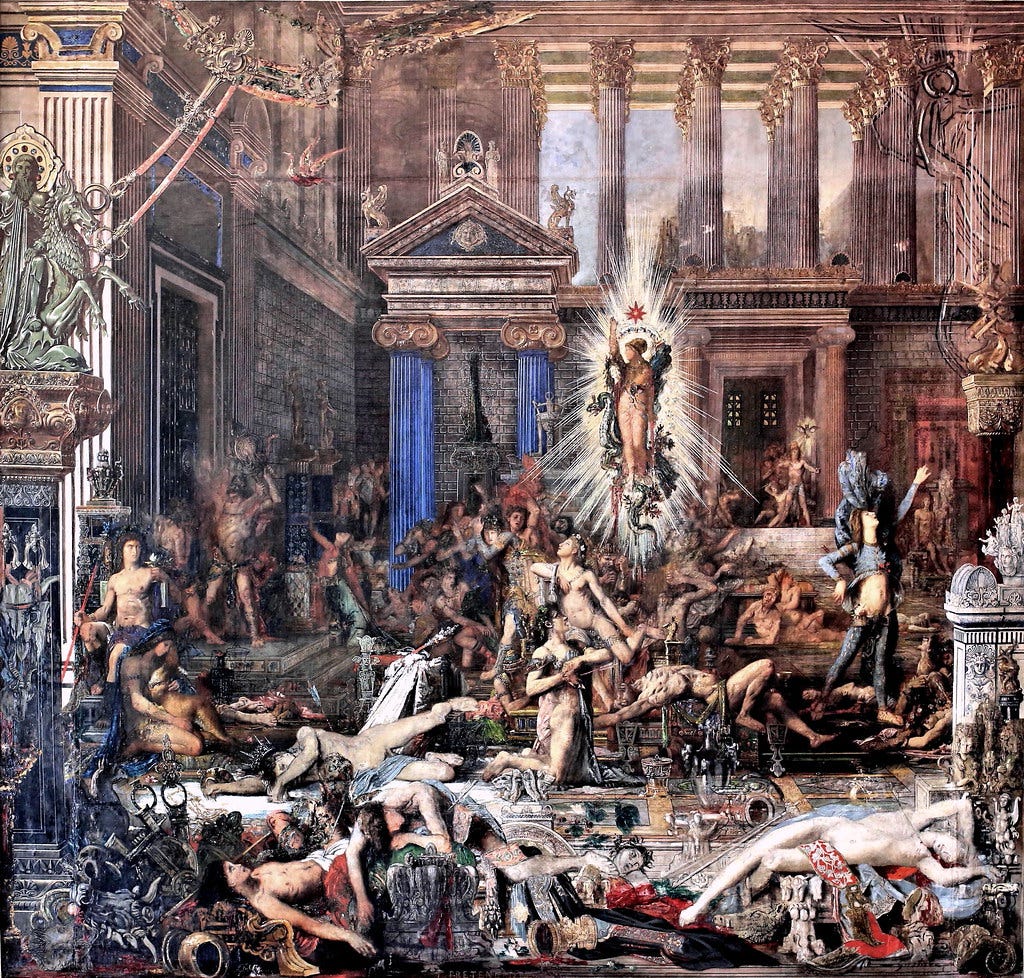
The point is that Odysseus was not just strong, nor wise in his own eyes, but an executor of divine justice. His vengeance was truly just because it was not rooted in his opinion, but the authoritative decree of the divine.
This last point is not merely mythic, but necessary in history:
Minos, the legendary lawgiver of Crete, reportedly sought Zeus for his laws
Lycurgus, the historic lawgiver of Sparta, first sought the Oracle of Delphi
Plato, in his laws, says the lawgiver’s laws reflect divine realities (and said atheism is a crime against human civilization as such)
Odysseus’ slaughter then, was ultimately venerated because he was protecting the divine law of xenia — making himself a friend of the gods who imposed order on reality.
The Mythic Statesman
The running theme of all these great thinkers and statesmen — from Homer, to Lycurgus, to Aristotle — is that the true statesmen is called to be a “conduit of Zeus.”
Odysseus himself is the mythic story that dramatizes the process.
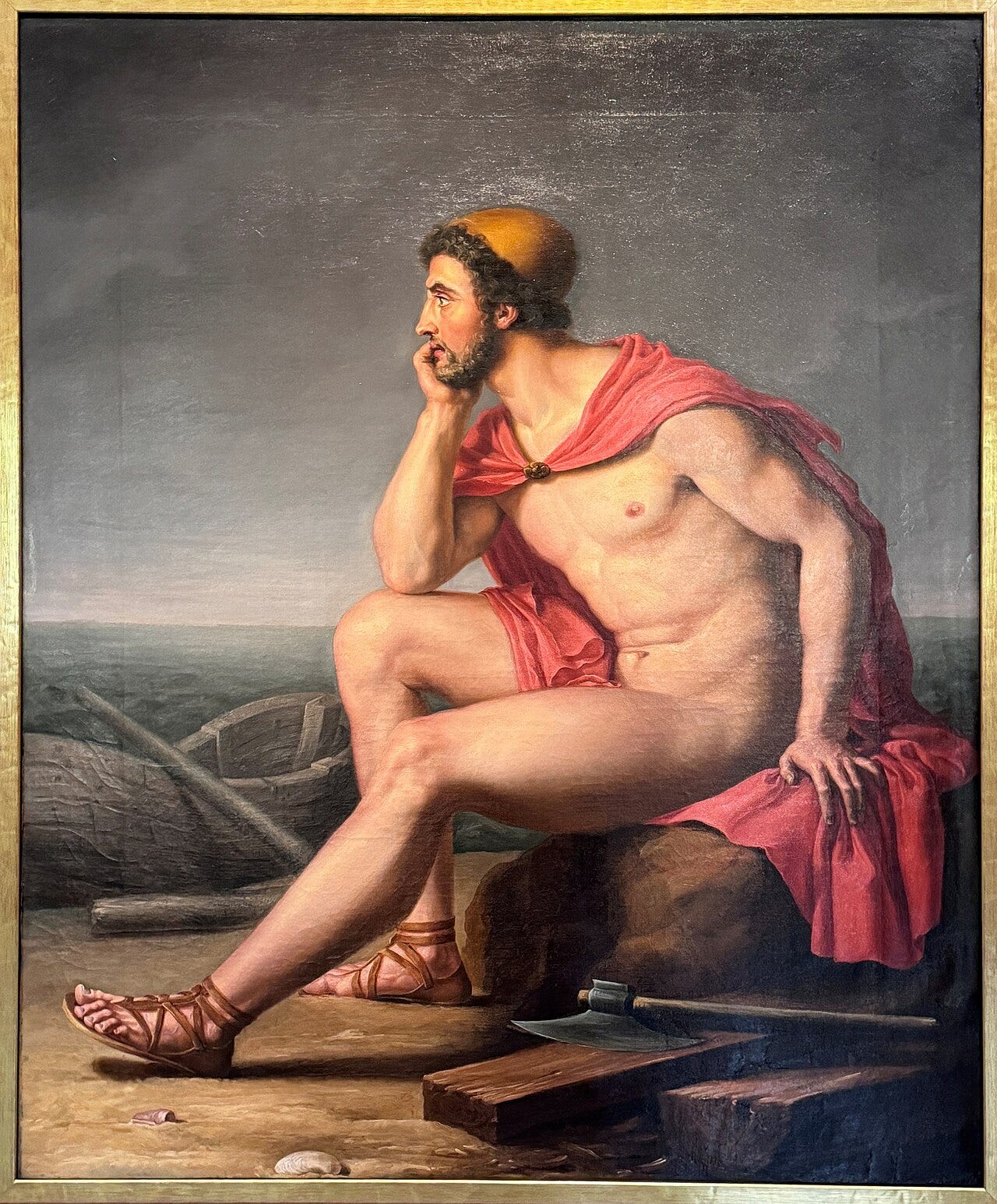
The Trojan War made him virtuous in brawn, but it was his long suffering that ordered his soul to wisdom. The wise and shifty mind of Odysseus, complimented by his sheer strength, allowed a slaughter that was not so much blind vengeance as a protector of divine law (xenia) that restored order to his house and kingdom.
So too are all called to follow in his path — whether that’s restoring order to a kingdom or household alike. True statesmanship is not made possible through brute strength, or masterminding the perfect system of rationally constructed laws, but is made possible through a life long pursuit of virtue.
A well ordered soul can bring goodness out of a tyranny (Odysseus is proof), but a tyrant can only bring destruction to even the most prosperous of kingdoms. The art of statesmanship then, is but the art of living — for you cannot rule others well if you cannot rule yourself — and one who lives enslaved to their passions is anything but free.
The life of true rule then, is but the life of virtue.
I offer private mentorship in the Great Books for those seeking clarity of vision and depth of soul. Inquire here.
If you’d like to support this work and receive future writings, you can subscribe below.
Sean, I found your distinction between "returning home" and "returning order" very interesting and thank you! It made me think about the difference between possessing power and possessing legitimacy. Odysseus didn't simply reclaim his throne because he was strong enough to defeat the suitors; he reclaimed it because his actions restored the moral and social order the people recognized as rightful. That's a distinction many modern leaders overlook. Authority may be established through position or force, but legitimacy emerges when people believe a leader's actions align with the values and meaning system of the community. It raises an interesting question for today: how many leaders lose legitimacy not because they lack power, but because they no longer embody the story their people believe should guide them?
Thanks for the gift, Sean. I'll send it to some friends.
I really enjoyed this article. You explained very well the moral, political, and religious arc that connects Homer, Plato, and Aristotle.
It is, in a way, the Greek version of The Man Who Shot Liberty Valance. Force comes before justice. Or, to put it differently, there are always moral gaps that must be bridged before the rule of law can be established.
With your permission, I should add that, while I recognize the value of your work and your commitment to historical and textual accuracy, I do not share the Greek conservative perspective. In my view, the democratic tradition has ultimately been more beneficial to humanity than the aristocratic one.
Perhaps the greatest surprise in political history is not the strength of the great philosophical systems, but the persistence of the democratic impulse. Despite the intellectual prestige of thinkers who distrusted government by the people, the human desire to participate in shaping one's own destiny has reappeared again and again throughout history.
I hope we will have the opportunity to discuss all of this.
Best regards,