

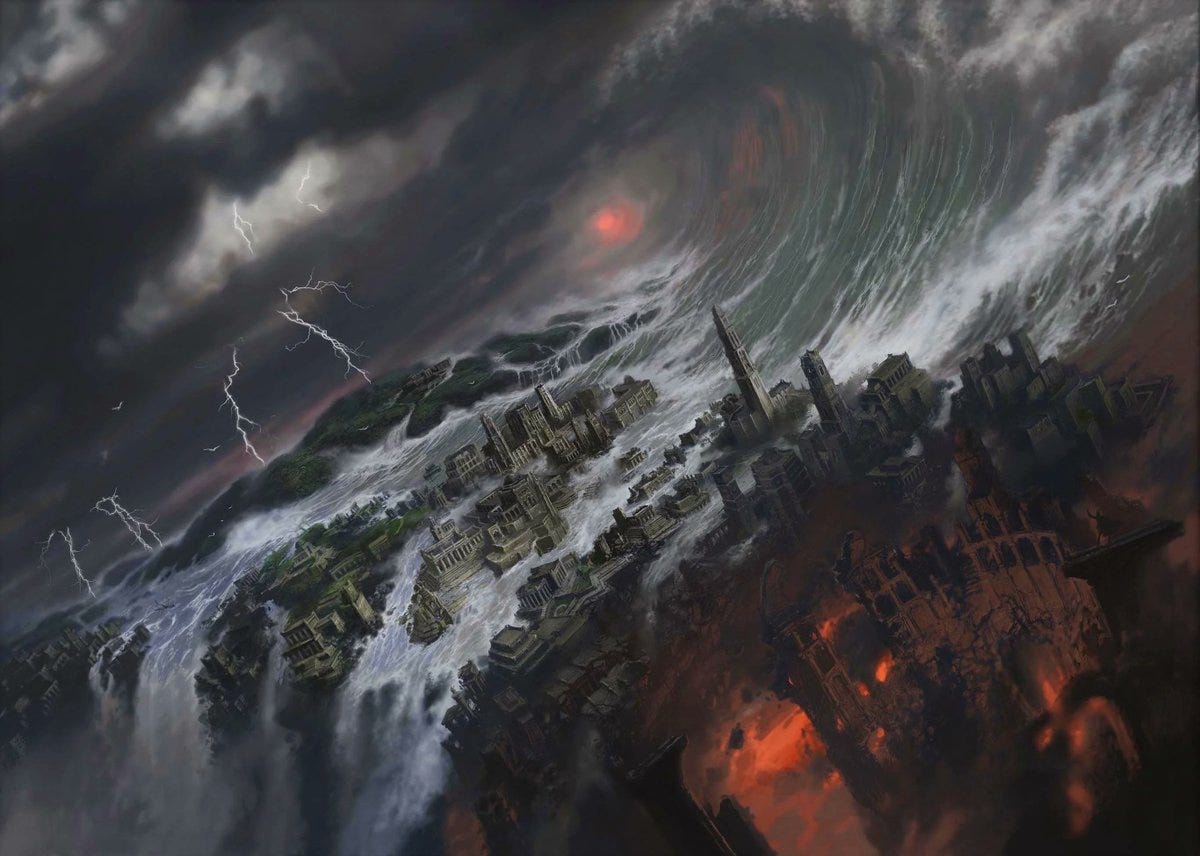
If you want to fully appreciate the Lord of the Rings and Tolkien’s literary genius, then the Fall of Numenor is a must-read.
The work appears in The Silmarillion, following the collapse of the greatest human civilization to ever appear in Middle Earth. This story not only provides you with the rich history of Middle Earth, but functions as a meditation on human nature, politics, and empire.
In the collapse of Numenor is a warning of how all great civilizations begin to die and collapse, and it’s not for the primary reasons you’d suspect.
Tolkien suggests that civilizations rarely collapse because they become hegemonically weak. More often, they collapse after becoming so powerful that they forget who they are — and begin striving to attain that which man by nature was never meant to possess.
So the Fall of Numenor becomes an invaluable story to grasp the rise and fall of human empire, the nature of man, and how the fate of civilizations ultimately depends upon the souls of the men who lead them.
I offer private mentorship in the Great Books for those seeking clarity of vision and depth of soul. Inquire here.
If you’d like to support this work and receive future writings, you can subscribe below.
A Gift from the Divine
Numenor’s history begins thousands of years before the Lord of the Rings takes place.
In the height of the second age, the Valar (angels) gifted the island kingdom of Numenor to the descendants of men who fought nobly against the Dark Lord Morgoth. It proved to be a prosperous kingdom, benefiting from its fertile land, merchants, and ample trade routes.
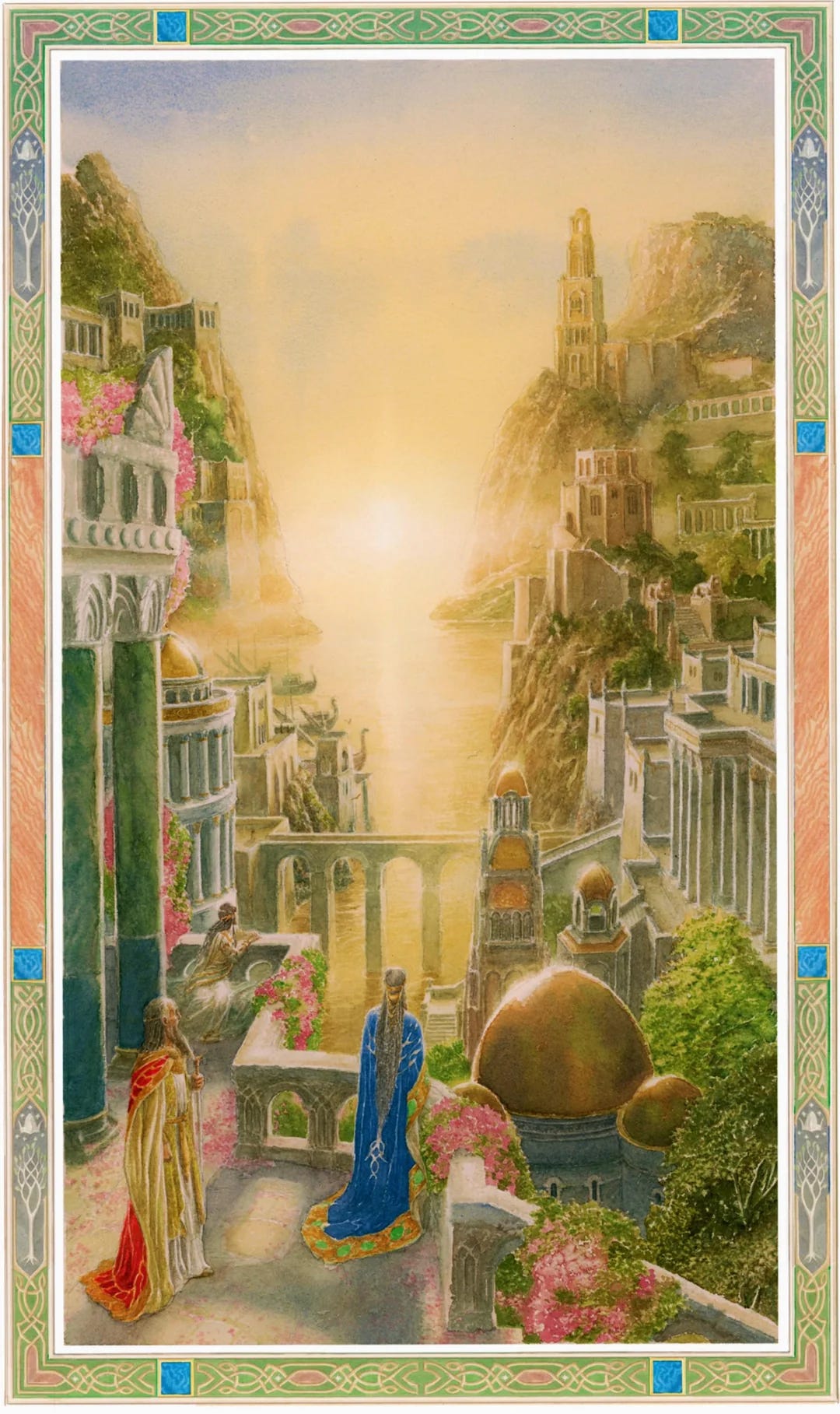
Through commerce and maritime technology, it became a powerful empire, its people beloved by God and the Valar. There was only one rule placed on their kingdom — they could never sail west to the Undying Lands of immortality.
At first glance, the command seems almost arbitrary. Why would the Valar deny such a blessed people an even greater blessing?
Through this command, Tolkien is highlighting a classic piece of wisdom in antiquity: every created being has its proper limits. One of the greatest temptations mankind must conquer is the temptation to reject his nature and strive beyond divinely ordained limitations (think the Garden of Eden).
Nonetheless, the Numenorians seem to have a good deal — a rich kingdom that enjoys peace, long life, and ample prosperity beyond all desire… but unfortunately, human desire proves insatiable.
As generations passed, the Numenorians grew forgetful of their favor with the Valar. They began to resent their inability to sail West, wondering why they need be inferior to the divine.
This becomes the first crack in civilizational collapse — a cultural amnesia that results in impiety and ignorance of one’s roots. A civilization begins to decay the moment its people forget that their greatest blessings were first received as gifts.
For the now restless Numenorians, they adopt a new strategy to console their discontent — endless expansion.
The Rise of Empire
Rather than sail West, the Numenorians expanded East into Middle Earth.
They became a maritime empire, and amassed their army to colonize other peoples under their rule. In fact, they were so powerful that the Dark Lord Sauron himself, upon seeing the Numenorian army, surrendered without conflict.
This could have been the Numenorian’s crowning glory — to permanently defeat the evil war lord who later became the main antagonist of LOTR. Instead, however, the Numenorians committed a grave folly:
They brought Sauron back to their empire as a prisoner.
This might sound merciful at first, but strange things started happening. Reportedly, King Ar-Pharazon began having dialogues with Sauron. Not much later, Sauron was allowed reprieve from his prison cell — touring the castle on house arrest. In due time, he became the King’s primary advisor.
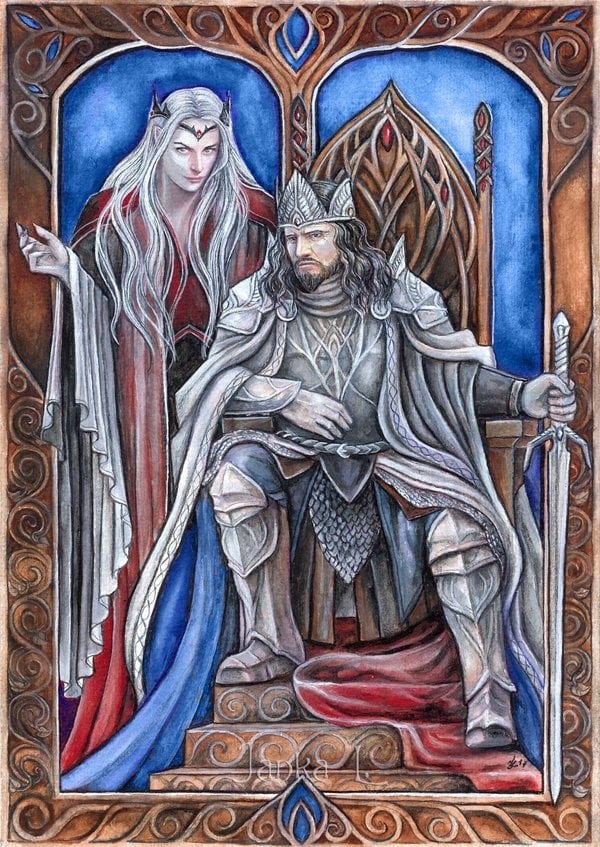
Why did Sauron become so valuable?
He knew the King’s greatest fears — and the fears of the Numenorian people — that they were going to die. He discovered their desires to sail west to the undying lands of Valinor, where immortal life could be grasped.
Notice then that Sauron’s most devilish vice was not raw power, but deceit. He was able to corrupt his listeners by twisting natural fears or desires, while tempting mankind with transgressive counsel that validated their vicious desires.
In fact, Sauron promised that all their desires could be satiated, including immortality, if they did but one practice:
Worship the Dark Lord Morgoth.
A temple was then constructed in his name. The old religious order — faithful to Eru (God) and the Valar — was persecuted. Traditional temples, rites, and relics were shattered. Morbid new religious practices were put in place. It’s said that even human sacrifice became a norm in the temple of Morgoth.
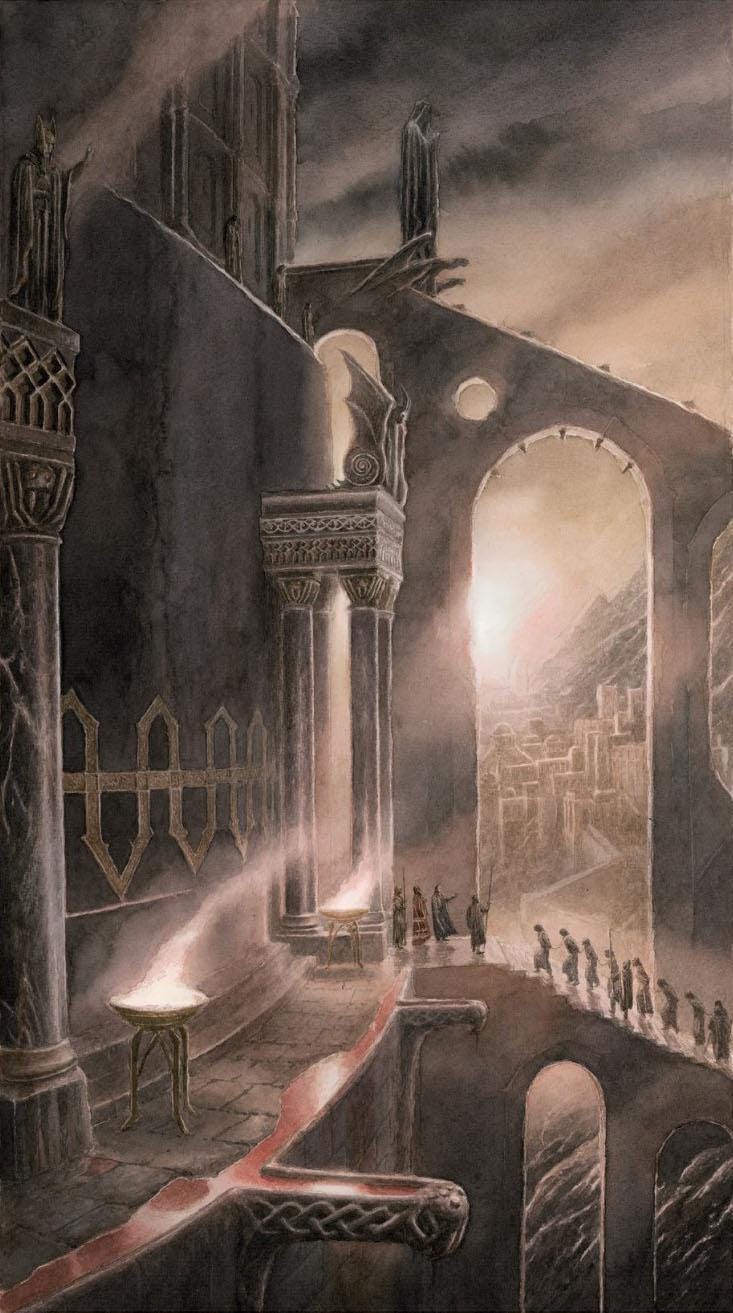
At first glance, this appears like the moment Númenor falls. It reasonably cannot get worse than blasphemy, idolatry, devil worship, and human sacrifice.
Yet Tolkien reconciles this idolatry as a symptom of Numenor’s ills, rather than a root cause. Long before the devil worship changed, the hearts of the people had already grown rebellious in spirit, yearning for power, longevity, and even immortality.
As such, the worst of their evils has yet to come.
Sauron would trick Ar-Pharazon into committing the one unforgivable transgression against the divine. A crime that would result in not just the destruction of Numenor, but a permanent cataclysm that would forever mar the lands of Middle Earth.
Here’s what happened…
