

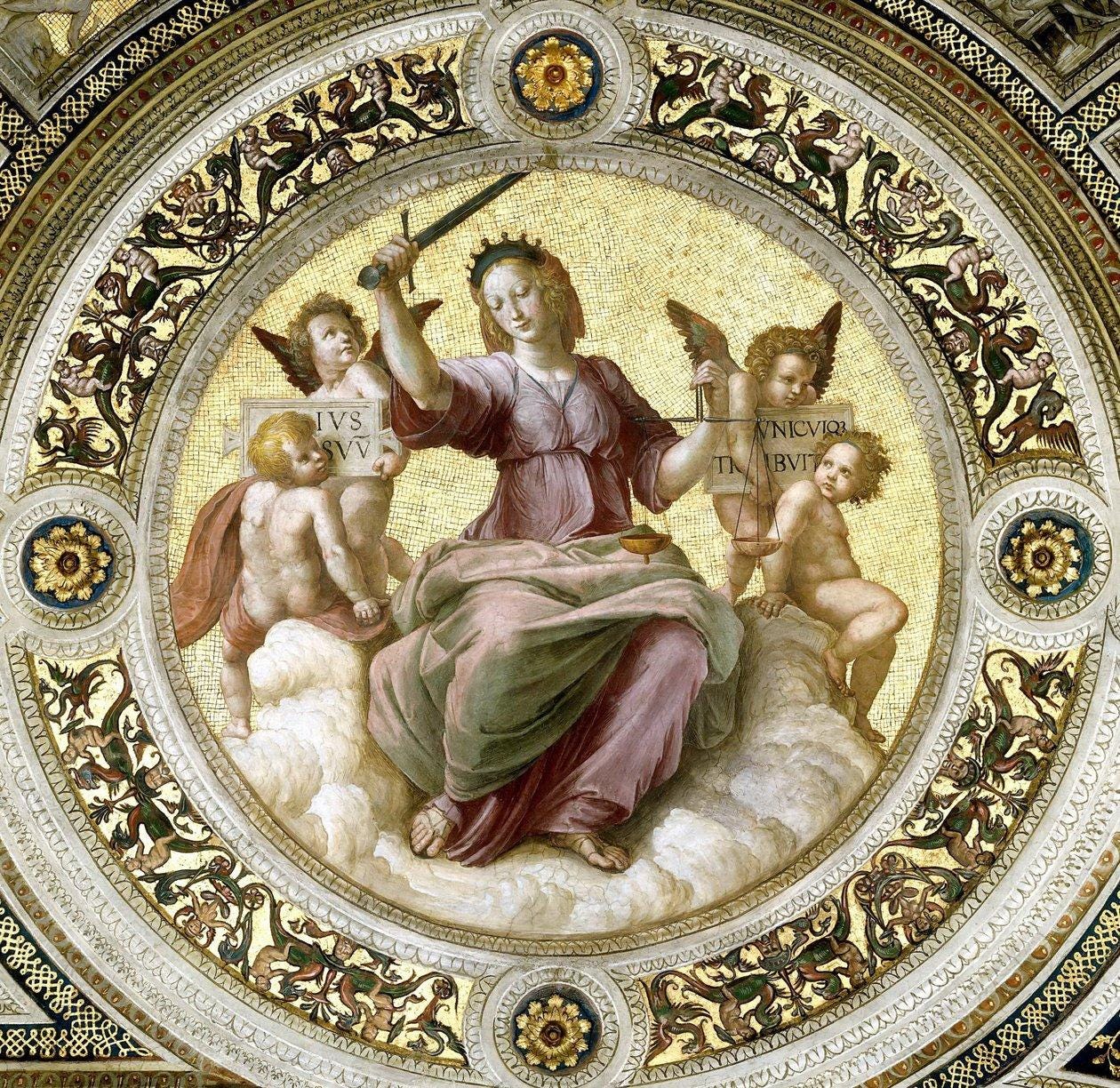
Justice is one of the most celebrated, and yet least understood, of all the virtues in human life.
Indeed, if you ask 10 people today to define justice, you’d probably get 10 different answers. Occasionally, you might get someone to repeat the classical definition of justice:
“The act of giving each person his due.”
And while this may be correct, we then have the follow-up question — what exactly does this mean?
What is the “due” of each person, and how do we know what to give, or how to give it?
This might sound like abstract questioning, but the point is this:
Historically, Western society was built on an unprecedentedly rich and complex understanding of justice, and how it informed the entire constitution of not just political and social life, but man’s own comprehension of his nature. And this vision is almost entirely lost in the realm of modern politics.
If we take seriously the idea that justice is one of the four cardinal virtues — and thus one of the chief goods man must attain to live well and realize the fullness of his human potential — then we must, by any means, rediscover a rich understanding and love of what justice truly is.
This will be our goal today, with Thomist philosopher Josef Pieper as our guide, referencing wisdom from his work The Four Cardinal Virtues...
I am 100% reader-supported. This newsletter is free, but if you’re able to support, please consider a paid membership — it helps my mission of sharing Truth, Beauty and Goodness with maximal reach
As a paid member, you’ll get:
Two full essays a week
Access to all recordings (past & future) of my Great Books lectures on this publication
Eternal gratitude from me
The Origin of Human Rights
So where do we begin our argument?
Pieper first asks us to consider again the definition of justice:
“The act of giving each person his due.”
Notice, Pieper says, this implies man is owed something:
“If the act of justice is giving each man his due, then the act of justice is preceded by the act whereby something becomes his due… justice comes second: right comes before justice.”
In other words, justice can only exist if it is preceded by rights — for rights are the basis upon which man can claim something is owed to him, like the rights to life, liberty, and private property.
But where do these rights come from?
Here is where modern political philosophy often deviates from the traditional understanding:
While the founding of American government, taking note from Locke, said rights are grounded in a state of nature, established by God, much of today’s modern political thought has abandoned such grounding. Inalienable human rights are no longer consistently understood as founded in nature, nor God, but increasingly in social contracts:
I agree not to hurt you, so long as you agree not to hurt me.
The problem, however, is that justice at this point becomes an arbitrary, non-binding contract, free to be abolished or altered on a whim. Justice, in this framing, is whatever the people happen to say it is. As opinion changes, so too does justice change.
Pieper rejects this understanding, and explains how authentic, genuine, and authoritative justice is to be established…
The Imago Dei
Pieper says that to understand the “inalienable rights” of man that make justice possible, we must first understand what a man is.
What exactly is human nature?
His answer:
“Man is a person—a spiritual being, a whole unto himself, a being that exists for itself and of itself, that wills its own perfection…
For that reason, he does inalienably have a suum, a ‘right,’ which he can plead against everyone else, a right which imposes upon every one of his partners the obligation at least not to violate it.”
To paraphrase, rights derive from the fact that man is a created being who possesses an intrinsic dignity and wills his own perfection. No man is self-made. Rather, all are created, and all inherit the same human nature, whose telos is to perfect itself.
To echo Aristotle, every action is preceded by an aim at some good that man wishes to attain. Every man, implicitly if not explicitly, seeks to perfect his own nature and flourish — which is the ultimate happiness known as Eudaimonia.
Given this account of human nature is universal to all, man owes an acceptance and respect of the inalienable rights of all. I owe you a recognition of your right to life, liberty, and the pursuit of happiness, as you do me, for both of us inherit the same nature that strives toward the same ultimate good.
Notice that in this case, inalienable rights are not grounded in a social contract, but in natural law and ultimately God. Man’s right to life is not an opinion — it is a metaphysical fact about his being and the nature of how the cosmos is constituted. The concept of justice itself becomes fundamentally nonsensical and absurd until man first learns a proper view of nature — a nature embedded within an order directed toward a transcendent good.
The shorthand for the above is the imago Dei — man is made in the image of God, and thus possesses an inherent dignity and is owed protection of his inalienable rights on account of the Creator who reigns over all.
Thus justice is indeed about giving each his due, but it requires an adherence to a metaphysics in which order, harmony, and morality are inscribed both upon the heart of man, and the stars of the universe.
Finally, we can conclude with an understanding of how to enact justice in our everyday lives…
The 3 Types of Justice
Pieper, taking note from Aquinas, says man understands justice by his relationship between individuals and society, as shown in the diagram below
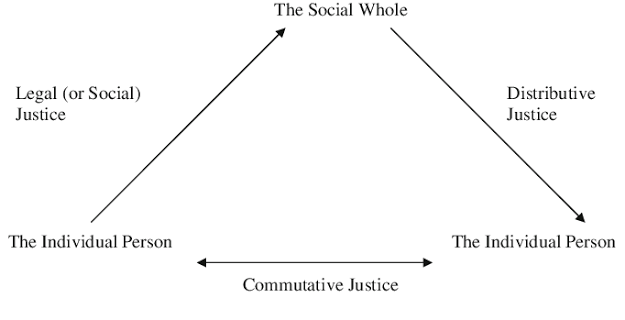
Thus are 3 types of justice:
Legal Justice
Distributive Justice
Commutative Justice
Legal justice is about what the individual owes the community he lives in. Remember, this echoes Aristotle, who reminds us we are social creatures, not merely isolated individuals. As such, we participate in a common life that offers us communal goods: security, order, infrastructure, education, economic cooperation, etc.
Thus, we have obligations to the social whole on account of these goods. Legal justice is a matter of fulfilling these obligations (paying taxes, obeying just laws, fulfilling one’s civic duty, etc.).
Distributive justice is about what the community owes the individual.
The social whole, acting through its governing authorities, has an obligation to distribute common goods, benefits, burdens, and responsibilities according to what is properly due to each person.
For example:
The distribution of public resources.
The allocation of public offices and responsibilities.
The distribution of taxation and other civic burdens.
The provision of public goods and protections.
The challenge here is learning how to distribute these goods. It is not a linear, even split, but must be proportional to what is properly due to each person, according to the nature of the good being distributed:
The general who saves the city from barbarians deserves more glory than the cowardly foot soldier who nearly abandoned his post.
The challenge then is not just distributing goods, but discerning which goods, and how much, are the due of each member of the community. For what is owed to one man may not be owed to another, depending upon the nature of the good and the circumstances of the individual.
Finally, commutative justice is the most straightforward, as it concerns the relationships and exchanges between individuals:
Buying a good at an agreed-upon price.
Repaying a debt.
Facing a punishment fitted to a crime, etc.
And now that we’ve mapped out these three types of justice, let us conclude why they matter, and how they lead to a harmony of the individual soul and the community at large.
Transcending Justice Itself
The primary thing to notice amongst these accounts of justice is this:
They are predicated upon restoring a transcendentally authentic harmony between the individual, his neighbor, and the community.
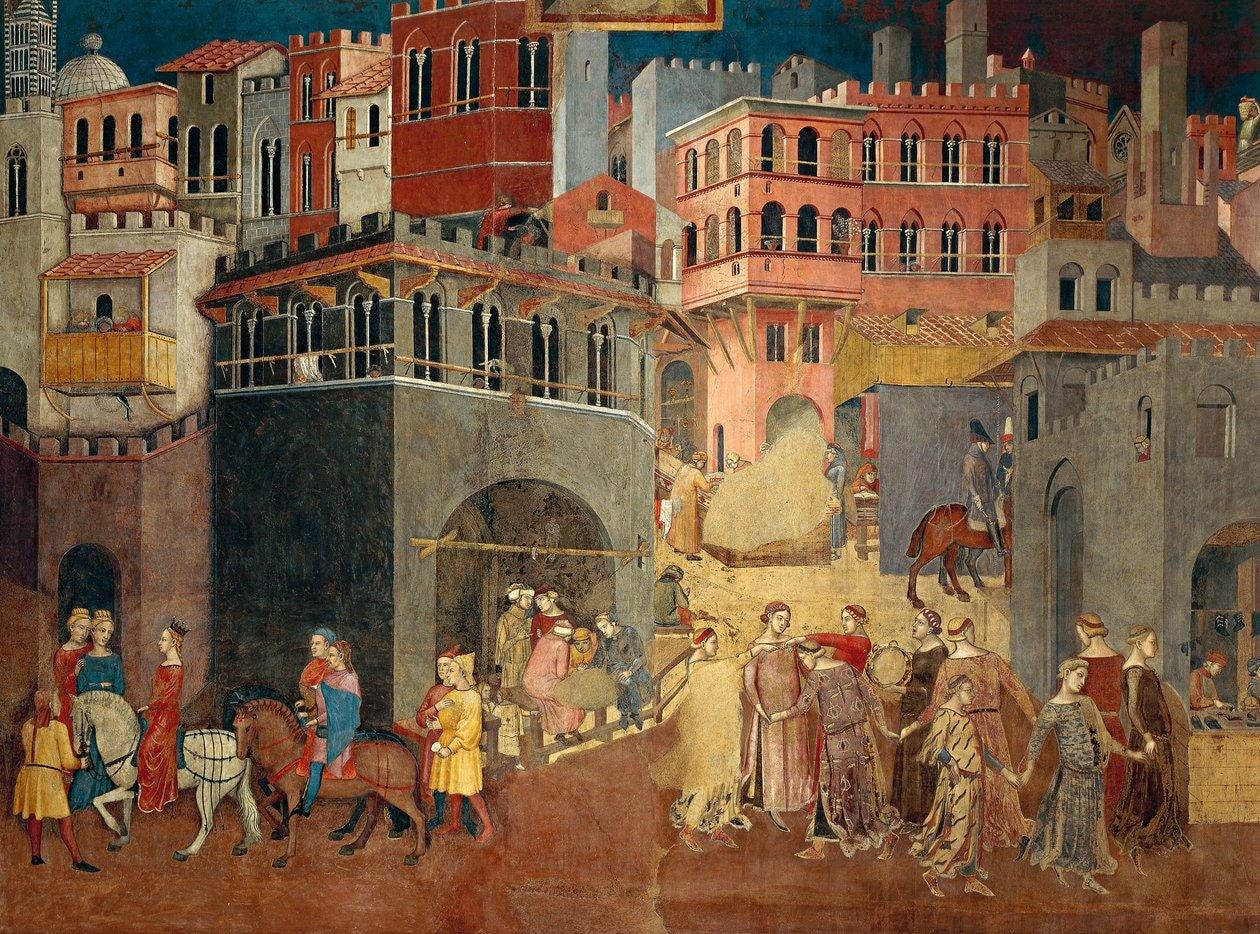
Justice has everything to do with individual rights, but cannot be reduced to them. Rather, it concerns the restoration of harmony in accordance with goodness. Man, as a political animal, cannot fully understand himself nor his rights while taken in isolation. His identity can only be realized in relation to the whole.
The rights owed to him cannot be separated from the duties owed to his neighbor and country, as JFK famously affirmed:
“Ask not what your country can do for you, but what you can do for your country.”
To realize a true sense of justice is not merely to defend the rights you’re entitled to, but to recognize the duties demanded of your character as well.
And this is because there are virtues, Pieper explains, that are closely connected to justice, and one that even precedes it in the order of our obligations — piety.
Justice is about fulfilling one’s duty of paying debts owed to one’s neighbor and country, but a full account of man acknowledges one hard truth:
Every human being owes debts that he fundamentally cannot fulfill — to his parents who gave him life, his community and country who raised him, and his Creator, who created him.
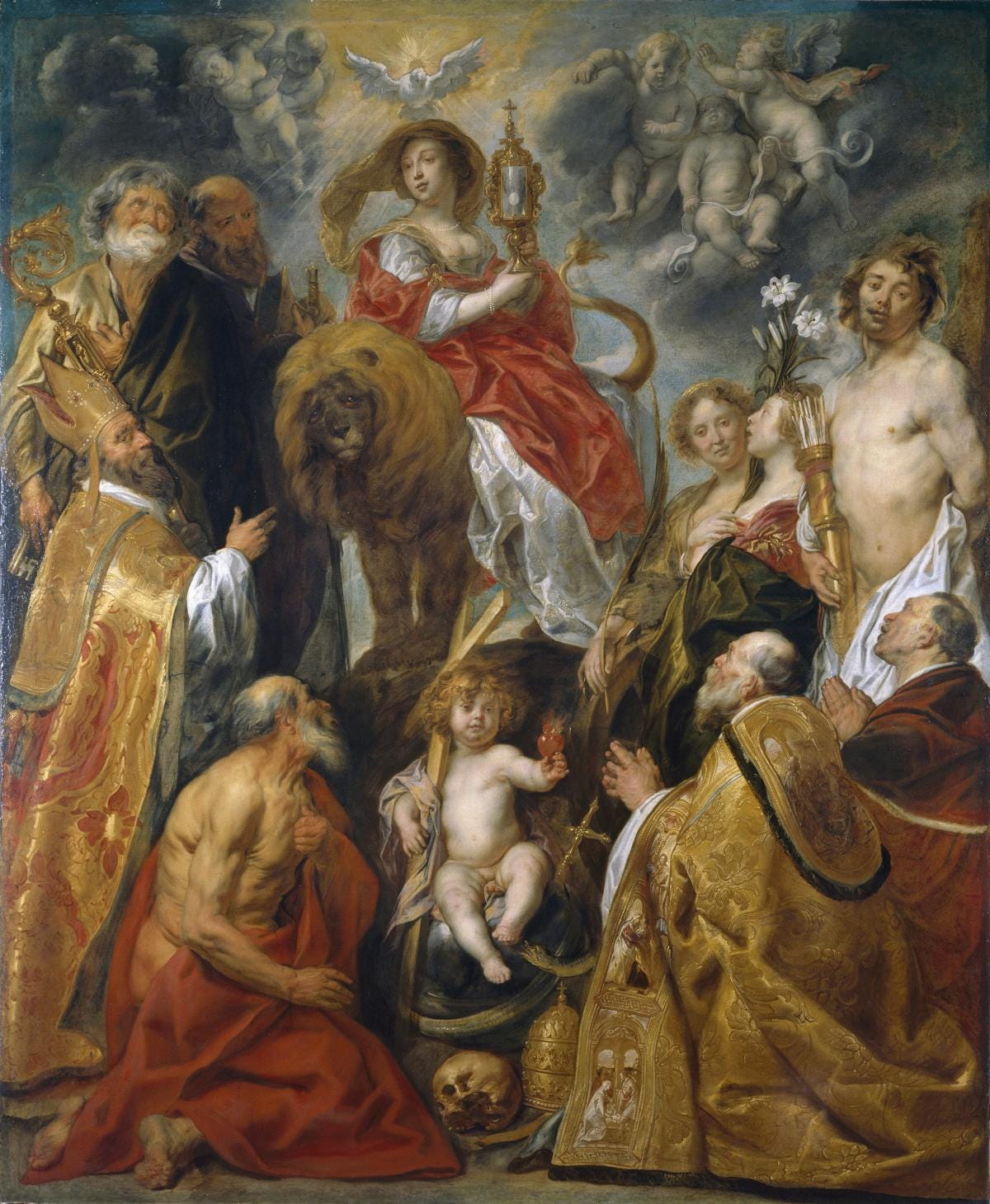
St. Thomas Aquinas gives us several terms to understand these debts and the virtues by which we render them:
Religio — the due owed to God through worship, reverence, and prayer.
Pietas — the gratitude and reverence owed to one’s parents and country, who gave us life and formed us within a community.
Observantia — the respect and recognition owed to those who possess legitimate authority and dignity over us.
All these virtues are annexations of justice. We can honor our parents, but never repay them in full for giving us life. We can love our country that raised us, but never repay the inheritance of being nurtured within it. And we can worship God, but no amount of gratitude can render a payment for the gift of our existence.
These virtues reveal something profound about the nature of justice itself.
In light of these unpayable debts — justice becomes far more than a virtue of self-knowledge, social harmony, and the administration of virtue.
Followed to its root, justice leads us to the most profound understanding of our nature as created beings, that we owe a fundamental debt — to family, country, and Creator — that can never be fully repaid, but ought to be rendered nonetheless.
Hence, man is accounted happiest when he honors his parents, loves his community, and gives due reverence to the divine.
Such a posture is not merely a gratitude that grants one temporal happiness, or social brownie points, but fundamentally raises man toward the full actualization of his human potential — for he fundamentally acknowledges the most intimate reality of how his nature is constituted, and where it fits into the grand order of creation — ranging from the most minute and personal familial relationships, ascending all the way to God Himself.
Indeed, such a love of justice is one of the profound ways in which man may ascend to his Creator.
I am 100% reader-supported. This newsletter is free, but if you’re able to support, please consider a paid membership — it helps my mission of sharing Truth, Beauty and Goodness with maximal reach
As a paid member, you’ll get:
Two full essays a week
Access to all recordings (past & future) of my Great Books lectures on this publication
Eternal gratitude from me
This essay is excellent! I got a jury duty summons yesterday for the first time in my life (I’d been living in Spain for the past decade), and my husband (who is from Spain) and I had a fantastic conversation about justice and this exact idea! That our justice system in the USA was built on ideals, virtues, and a more complete understanding of the nature of the human person that has largely been lost or stepped on by modern society.
My husband tends to see people more as where they are now instead of the potential they have, plus the justice system in Spain is different, so he was skeptical about the idea of jury duty…that a group of randomly selected citizens have the knowledge, correct moral formation, and level of critical thinking necessary to decide a person’s fate. I agree to a certain point, looking at where we are as a society, but I was thinking about the formation of the person and how someone cultivates critical thinking skills and virtues, specifically justice. I like the idea of jury duty being randomly selected people because I feel if people have a circumstance with real gravity placed in front of them, it will stimulate that telos we have within each of us to be called higher and perfect our nature.
Thanks for writing such a fabulous essay, and for reading my whole big long comment. I’d love to know your thoughts on the topic! ☺️
but whats justice to a person that knows no justice in his life and has never experienced it for then this person cannot have the nous and the virtuous because he couldn't comprehend the outcome