

Whether you’re a longtime subscriber, or a new reader, you probably subscribed to me for one of these reasons — to learn about:
History
Theology
Philosophy
The Great Books
The Western Tradition, etc.
But if you pressed further — asking why you want to learn about these disciplines — the underlying reason boils down to this:
You enjoy the act of contemplation, and believe that will lead you to a more meaningful life. Or stated more simply, you believe contemplation leads to happiness.
This also, is the precise thesis of Josef Pieper’s essay Happiness & Contemplation. He argues that contemplation is not just an optional practice for the bookish types, rather it is the practice that connects man to the heart of his nature. In other words, man’s capacity for happiness in life is directly correlated to his ability to engage in contemplation.
But what exactly is contemplation? For surely, it’s far more than reading books and thinking about history.
Today, we’ll analyze Pieper’s discussion on contemplation, how it pertains to human nature, and how it can help you lead to a life of deeper happiness.
I am 100% reader-supported. This newsletter is free, but if you’re able to support, please consider a paid membership — it helps my mission of sharing Truth, Beauty and Goodness with maximal reach
As a paid member, you’ll get:
Two full essays a week
Access to all recordings (past & future) of my Great Books lectures on this publication
Eternal gratitude from me
The Meaning of Life
Pieper makes his thesis clear from the beginning:
“Man’s ultimate happiness consists in contemplation… it contains a whole philosophy of life, a basic conception of the nature of man and the meaning of human existence.”
Already this is a bold claim, for if you ask mankind what makes them happy, you’ll find a litany of answers, and yet I reckon very few will posit that “contemplation,” is the greatest source of their happiness. We understand then, that Pieper has his work cut out for him to justify his claim.

And yet, his following claim is just as profound:
“Man craves by nature happiness and bliss… We want happiness by nature. We means: all beings endowed with reason”
This statement sounds so commonplace that it’s easy to miss its significance.
Implicitly, he says that human nature was made for happiness. In other words, happiness is not a mere optional luxury — one good too pursue among many — rather it’s the destiny inscribed upon your heart since birth.
This recalls Aristotle’s own Ethics, in which he argues that man’s purpose is to achieve eudaimonia [happiness] through the pursuit of virtue and the good.
But right now, this is just an asserted claim. Pieper continues his argument by expanding what constitutes human nature.
In other words, what kind of beings are you and I?
Only if we can understand our nature can we understand our destiny, and thus what brings us happiness…
Understanding Our Origins
So what are Pieper’s thoughts on human nature?
He expands:
“‘By nature,’ means by virtue of creation… Part of the definition of the created soul, therefore, is that it has received its essence from the shaping and life-giving act of creation…
The natural desire for happiness springs from the innermost core of man’s being; it concerns man’s very own will, unrestricted by any external coercion. And therefore it is free. Secondly, this desire points right through the human heart, back to an ultimate origin which is not human.”
To understand our nature is to understand our origins, namely that man is not “self made,” rather he is a created being. He is created by his parents first and foremost, but also raised in a community, within a country, all in a cosmos with its signature left behind by a heavenly Creator.
This recognition, believe it or not, gives recourse to the virtue of piety:
To recognize that we have received our existence is to recognize that we are indebted to other people and goods that we did not create ourselves. Our lives are gifts, mediated through our parents, our communities, and ultimately our Creator. Piety is the virtue by which we acknowledge these relationships and render what is due to them. Such gratitude helps us attain the perfection of our social nature: a life ordered toward loving relationships.
Thus we can recap Pieper’s argument — man is a created being whose nature was made for happiness, a happiness which Pieper still asserts comes through contemplation.
And yet, it’s this emphasis on relationship that now prepares us to properly understand contemplation.
The Vision of Love
Again, we must re-emphasize that contemplation is not merely being “bookish.” You could read the entire works of Plato, Aristotle, and Shakespeare and leave none the wiser for it if your spiritual disposition is improper.
Given that man is a created being, Pieper stresses that man’s relationship to reality is fundamentally relational. Just as man attains temporal happiness via the relationships of friends, family, and community — Pieper says the ultimate relationship is man’s relationship with God.
Here he cites St. Thomas Aquinas:
“The good of man depends upon God’s cognition, and therefore man’s happiness depends upon his glory before God.”
In simpler terms, Pieper and Aquinas both affirm that man’s happiness is contingent upon their relationship with God — a happiness consisting through the intellect’s vision of its Creator.
This may sound surprising, but the logic behind this philosophy is quite simple:
If God is the supreme Good, and man is created in God’s image, then man’s fulfillment cannot be understood apart from his relationship with God. The goods we encounter in this life are indeed real, but no temporal goods can satiate the nature of man who is ultimately ordered toward the source of all goodness, which is God.

This then, finally brings us to Pieper’s meditations on contemplation.
He further cites Aquinas, who asserts that “the essence of happiness consists in an act of the intellect.”
Pieper expands on what this means:
“What is implicit in this sentence? This is implicit: the fulfillment of existence takes place in the manner in which we become aware of reality; the whole energy of our being is ultimately directed towards the attainment of insight. The perfectly happy person, the one whose thirst has been finally quenched, who has attained beatitude—this person is one who sees. The happiness, the quenching, the perfection, consists in this seeing”
Contemplation, then, is a cognitive activity that’s fundamentally concerned with seeing — or apprehending the truth of reality.
This seeing is not merely the physical act of observing the material world or gazing at a sunset (although both can be wonderful), rather contemplation concerns the intellect’s apprehension of truth, which is ultimately rooted in the vision of God.
Consider these examples:
A love of mathematics doesn’t just teach you numbers, but equations, laws, and truths that speak to the order and harmony of the created world
A love of philosophy teaches you wisdom to understand your nature and your fellow man
A love of history teaches you a love of your present existence, as the inheritor of a grand civilization and human story which has preceded you
A love of theology teaches you a love of God — the intimate relationship of creation loving its creator
The idea is that the cognitive activity of these fields of study do not merely increase our acquisition of knowledge, rather they fundamentally expand our vision by teaching us to apprehend truths of the created world, along with ourselves, and our place inside of creation. And if creation ultimately proceeds from God, then the truths we encounter within it can lead us, however indirectly, toward their divine source.
And if God is the creator of all creation, than a love of knowledge and truth leads, implicitly, to a love of God — a love that surpasses understanding and is justified by its own nature.
The Sight that Sets Man’s Heart on Fire
None of this means that contemplation stands in opposition to charity, for if God is the supreme Good, then our love of God should order our love of our neighbors, rather than diminish it. The contemplative life and the life of charity are fundamentally intertwined.
Pieper’s argument is not so much a novel discovery as a recovery of an ancient wisdom: that the fulfillment of human existence is found in the contemplation of truth, ultimately in the vision of God. Indeed, contemplation’s definition as — the joyful happiness of the mind who takes sight of God — is at least several centuries old.
Consider the closing Canto of Dante’s Paradiso. After he’s braved hell, climbed Mt. Purgatory, and ascended the various circles of Heaven, the poem ends as he arises face to face in God, and falls into a silent adoration of his creator, gazing upon “the Love that moves the sun and other stars.”
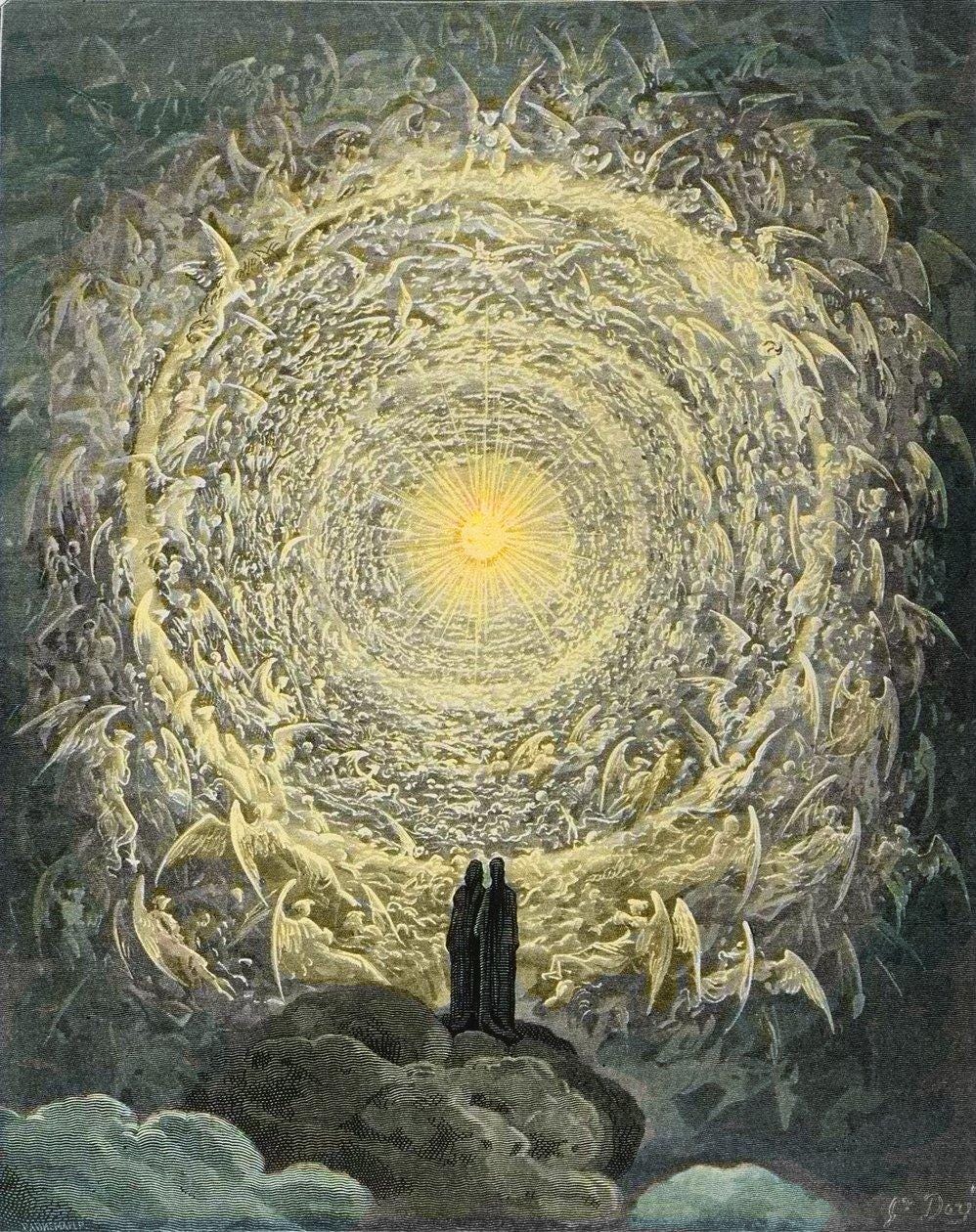
Dante is made happy by taking in the source of all creation itself. His nature is fulfilled, and he is happy within an eternal beatitude of contemplation with his creator — which is nothing short of the orthodox account of heaven itself.
True contemplation then, is nothing but a cognitive activity, the intellect’s vision of the whole, from which love and joy follow, as man seeks to open his eyes to the totality of being himself — to gaze upon all of creation, history, its highs and lows — and affirm within himself, “it is good.”
I am 100% reader-supported. This newsletter is free, but if you’re able to support, please consider a paid membership — it helps my mission of sharing Truth, Beauty and Goodness with maximal reach
As a paid member, you’ll get:
Two full essays a week
Access to all recordings (past & future) of my Great Books lectures on this publication
Eternal gratitude from me